
Built to provide research that’s more actionable and strategically valuable, The Business Research Company’s 2026 market reports include market attractiveness analysis, total addressable market sizing, company benchmarking matrices, interactive Excel dashboards, broader supply chain intelligence, emerging startup tracking, and in-depth product insights.
Radio Frequency (RF) Radio Transmitter Market Forecast: What Value Will The Market Reach By 2030?
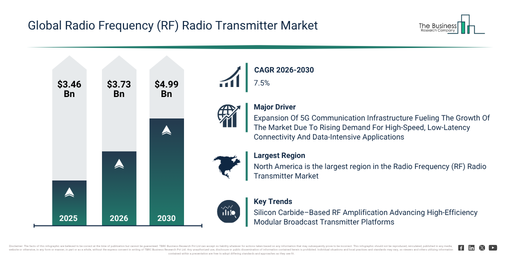
The market for radio frequency (RF) radio transmitters has witnessed strong growth in recent years. This market is projected to expand from $3.46 billion in 2025 to $3.73 billion in 2026, showing a compound annual growth rate (CAGR) of 8.0%. The historical growth of this market can be attributed to factors such as the expanding broadcasting infrastructure, the increasing deployment of wireless communication networks, rising investments in military communication systems, the broader adoption of radio communication equipment, and the growing demand for reliable long-distance communication.
The market for radio frequency (RF) radio transmitters is projected to experience substantial growth in the near future. This market is forecasted to reach $4.99 billion by 2030, exhibiting a compound annual growth rate (CAGR) of 7.5%. During the projection period, this expansion is driven by the increasing rollout of next-generation wireless communication infrastructure, greater demand for sophisticated digital broadcasting systems, wider implementation of secure defense communication networks, growing investments in satellite communication infrastructure, and a rising requirement for high-performance RF transmission technologies. Key developments anticipated in this period encompass the wider embrace of software-defined radio transmitters, the ongoing advancement of high-power RF transmission systems, a heightened need for multi-band radio transmitters, the broader incorporation of compact RF transmitter designs, and an enhanced emphasis on ensuring high signal stability and transmission efficiency.
Get A Free Sample Report With In-Depth Market Insights:
Radio Frequency (RF) Radio Transmitter Market Demand Drivers Opening New Revenue Streams
The anticipated expansion of 5G communication infrastructure is projected to drive the growth of the radio frequency (RF) radio transmitter market. This infrastructure encompasses a network of sophisticated base stations, antennas, fiber-optic connections, small cells, and core network systems, all designed to facilitate ultra-fast, low-latency, and high-capacity wireless connectivity. Its rise is attributed to the growing need for high-speed, low-latency connections, essential for supporting data-intensive applications like AI, IoT, and cloud computing. Within 5G infrastructure, RF radio transmitters are employed in base stations to convert digital baseband signals into high-frequency RF signals, which are then transmitted wirelessly to user devices for effective communication. For example, data from 5G Americas, a US-based telecommunication trade organization, indicated in March 2024 that global 5G connections had reached 1.76 billion by the close of 2023, with 700 million new connections established that year, signifying a 66% annual rise. Specifically in North America, 5G constituted 29% of all wireless connections, experiencing a 64% year-on-year growth to achieve 197 million connections after 77 million new users joined in 2023. Consequently, the expanding 5G communication infrastructure is a key driver for the growth of the radio frequency (RF) radio transmitter market.
Radio Frequency (RF) Radio Transmitter Market Breakdown By Product Type And Application
The radio frequency (rf) radio transmitter market covered in this report is segmented –
1) By Type: Analog Radio Transmitter, Digital Radio Transmitter
2) By Frequency Range: Low Frequency, Medium Frequency, High Frequency, Very High Frequency, Ultra High Frequency
3) By Technology: Frequency Modulation Radio Transmitters, Amplitude Modulation Radio Transmitters, Digital Radio Transmitters
4) By Application: Broadcasting, Telecommunications, Military, Research And Development
Subsegments:
1) By Analog Radio Transmitter: Amplitude Modulation Transmitters, Shortwave Radio Transmitters, Longwave Radio Transmitters, Medium Wave Radio Transmitters
2) By Digital Radio Transmitter: Digital Audio Broadcasting Transmitters, High Definition Radio Transmitters, Software Defined Radio Transmitters, Digital Two Way Radio Transmitters
Radio Frequency (RF) Radio Transmitter Market Trends Powering Strategic Industry Growth
Leading companies in the radio frequency (RF) radio transmitter market are concentrating on developing advanced transmitter platforms that leverage silicon carbide (SiC)-based RF amplification technology. This strategic focus aims to enhance energy efficiency, reduce system size, improve reliability, and support multi-standard digital broadcasting capabilities. Silicon carbide (SiC)-based RF amplification technology employs wide-bandgap SiC semiconductor devices, such as MOSFETs, to amplify radio frequency signals, offering superior efficiency, greater power density, and improved thermal and voltage handling compared to traditional silicon-based amplifiers. For instance, in April 2026, BE, a US-based manufacturer of radio broadcast equipment, unveiled the AMX AM transmitter platform. This next-generation broadcast solution is engineered to provide higher efficiency, a compact design, and simplified maintenance for AM radio transmission. Constructed as a modular system, it offers a 5 kW output in a highly compact five-rack-unit chassis, facilitating ease of shipping and deployment. The transmitter integrates silicon carbide (SiC) MOSFET-based RF amplifier and modulator modules, which improve voltage handling, efficiency, and system robustness when contrasted with conventional designs. It supports broadcasting formats including analog, HD Radio, and Digital Radio Mondiale (DRM), alongside features like redundant power supplies and modular harmonic filtering. In essence, the AMX platform boosts performance while simultaneously diminishing size, power consumption, and operational complexity in broadcast infrastructure.
Radio Frequency (RF) Radio Transmitter Market Company Landscape And Competitive Strategy
Major companies operating in the radio frequency (rf) radio transmitter market are Aareff Systems Limited, Ampegon AG, Aviat Networks Inc., Bext Corporation, Broadcast Electronics LLC, Cisco Systems Inc., Comark Communications LLC, Continental Electronics Corporation, DB Elettronica Telecomunicazioni S.p.A., Elenos S.r.l., Electronics Research Inc., Filtronic plc, GatesAir Inc., Hitachi Kokusai Electric Inc., Huawei Technologies Co. Ltd., L3Harris Technologies Inc., Motorola Solutions Inc., Nautel Limited, NEC Corporation, Rohde & Schwarz GmbH & Co. KG, SYES S.r.l., Telefonaktiebolaget LM Ericsson, Thales Group, WorldCast Systems SAS
View The Full Radio Frequency (RF) Radio Transmitter Market Report:
Radio Frequency (RF) Radio Transmitter Market Geographic Landscape: Which Region Leads Industry Growth?
North America was the largest region in the radio frequency (RF) radio transmitter market in 2025. Asia-Pacific is expected to be the fastest-growing region in the forecast period. The regions covered in the radio frequency (RF) radio transmitter market report are Asia-Pacific, South East Asia, Western Europe, Eastern Europe, North America, South America, Middle East, Africa.
Reach Out To Our Team:
The Business Research Company: https://www.thebusinessresearchcompany.com/
Americas: +1 310-496-7795
Asia: +44 7882 955267 & +91 8897263534
Europe: +44 7882 955267
Email us at: marketing@tbrc.info
Follow us on:
LinkedIn: https://in.linkedin.com/company/the-business-research-company
YouTube: https://www.youtube.com/channel/UC24_fI0rV8cR5DxlCpgmyFQ
Global Market Model: https://www.thebusinessresearchcompany.com/global-market-model

Wasay has over a decade of experience in market research, data modelling, and analytics, with prior experience at GlobalData and Decision Tree Consulting Services. At The Business Research Company , he leads research operations across syndicated studies, customized consulting engagements, and the Global Market Model platform. His professional experience includes supporting organizations such as Boston Consulting Group, KPMG, and Ernst & Young. Wasay holds a degree in Electronics and Communications Engineering, postgraduate management qualifications from International Management Institute Belgium and Indian School of Business and Entrepreneurship, and completed the Integrated Program in Business Analytics from Indian Institute of Management Indore.