The Business Research Company’s 2026 market reports combine market attractiveness scoring, total addressable market sizing, company benchmarking matrices, interactive Excel dashboards, deeper supply chain intelligence, emerging startup tracking, and granular product-level insights to deliver research that is more actionable and strategically valuable.
Residential Energy Storage Market Size Trajectory: Key Numbers Every Industry Stakeholder Should Know
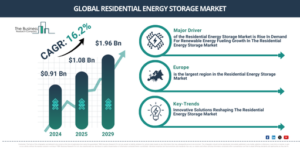
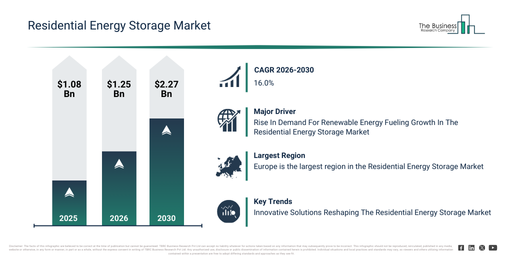
The residential energy storage market has seen significant expansion in recent years. Its valuation is expected to rise from $1.08 billion in 2025 to $1.25 billion in 2026, showing a compound annual growth rate (CAGR) of 16.4%. The factors contributing to this growth in previous periods include the initial adoption of rooftop solar installations, heightened anxieties regarding household power outages, a decrease in the price of lithium-ion batteries, an increase in utility time-of-use tariff programs, and the emergence of patterns towards residential energy self-sufficiency.
The residential energy storage market is projected to experience substantial growth over the coming years, with its valuation expected to reach $2.27 billion in 2030, exhibiting a compound annual growth rate of 16.0%. This expansion during the forecast period is fueled by several factors, such as the increasing demand for sustainable home energy solutions, the broadening reach of virtual power plant programs, a rise in the adoption of smart meters and energy monitoring tools, the growth in home electrification alongside electric vehicle charging requirements, and enhanced regulatory support for residential storage incentives. Furthermore, significant trends anticipated include the greater uptake of home backup power solutions, a rising need for high-capacity residential battery systems, the proliferation of solar plus storage installations in households, a growing preference for smart energy management systems, and a shift towards long-duration and high-efficiency storage technologies.
Looking For Reliable Residential Energy Storage Market Data? Request A Free Sample:
What Is Behind The Rising Demand In The Residential Energy Storage Market?
The escalating demand for renewable energy is anticipated to drive the expansion of the residential energy storage market moving forward. Renewable energy encompasses power derived from naturally regenerating sources, including sunlight, wind, rain, tides, and geothermal heat, which are considered sustainable and ecologically sound alternatives to finite fossil fuels. The heightened requirement for renewable energy is motivated by a commitment to reduce climate change by transitioning to sustainable and clean power sources. Renewable energy assists residential energy storage by offering a sustainable yet intermittent power supply, allowing homeowners to store excess energy during peak generation periods for later use, thus improving grid resilience and reducing reliance on traditional energy sources. As an example, in April 2024, the International Renewable Energy Agency (IRENA), a UAE-based intergovernmental organization, reported that global renewable power capacity increased by 585 GW in a single year, marking a record annual growth rate of 15.1%, which surpasses 2023’s growth rate of 14.3%. Therefore, the surge in demand for renewable energy is a key driver for the growth of the residential energy storage market.
Residential Energy Storage Market Segment Coverage And Subsegment Analysis
The residential energy storage market covered in this report is segmented –
1) By Technology: Lead-Acid, Lithium-Ion
2) By Utility: 3KW To < 6KW, 6KW To < 10KW, 10KW To 29KW
3) By Connectivity: On-Grid, Off-Grid
4) By Ownership Type: Customer Owned, Utility Owned, Third-Party Owned
5) By Operation: Solar And Storage System, Standalone Systems
Subsegments:
1) By Lead-Acid: Flooded Lead-Acid Batteries, Sealed Lead-Acid Batteries
2) By Lithium-Ion: Lithium Iron Phosphate (LiFePO4), Nickel Manganese Cobalt (NMC), Lithium Nickel Cobalt Aluminum Oxide (NCA)
Residential Energy Storage Market Future Trends: Where Is The Industry Heading?
Leading firms within the residential energy storage market are innovating sophisticated home storage battery system technologies, including those derived from electrified vehicle batteries, aiming to boost energy storage capacity, operational efficiency, and environmental sustainability for homeowners. Such systems utilize EV battery advancements to offer dependable backup power to households, streamline the consumption of energy from renewable sources like solar panels, and lower electricity expenses via demand management tactics like peak shaving and load shifting. An illustrative example is Pylontech, a China-based battery energy storage system provider, which launched Force H3X, a cutting-edge residential storage system, in June 2024. This platform provides flexible and expandable capacity ranging from 10 kWh to 210 kWh, accommodates both single-phase and three-phase power outputs, and incorporates a battery management system alongside intelligent energy management for optimizing solar energy consumption and improving household energy dependability. This solution marks a notable leap forward in the residential energy storage market, contributing to greater energy efficiency, reduced costs, and more sustainable energy practices.
Residential Energy Storage Market Top Players List For 2026
Major companies operating in the residential energy storage market are Huawei Technologies Co. Ltd., Tesla Inc., Siemens AG, Hitachi Energy Ltd., Panasonic Corporation, BYD Company Limited, ABB Ltd, Eaton Corporation plc, LG Energy Solution Ltd., Samsung SDI Co. Ltd., Delta Electronics Inc., Enphase Energy Inc., SMA Solar Technology AG, Saft Groupe SA, VARTA AG, Jiangsu GoodWe Power Supply Technology Co. Ltd., Sonnen GmbH, ShanghAI PYTES Energy Co. Ltd, Dyness Power Energy Limited, Deutsche Energieversorgung GmbH, Powervault Ltd., TESVOLT GmbH, Turbo Energy Ltd., Alpha ESS Co. Ltd., Sunverge Energy LLC, Eguana Technologies Inc.
Order Your Copy Of The Residential Energy Storage Market Report 2026:
How Does The Residential Energy Storage Market Vary By Region?
Europe was the largest region in the residential energy storage market in 2025. Asia-Pacific is expected to be the fastest-growing region in the forecast period. The regions covered in the residential energy storage market report are Asia-Pacific, South East Asia, Western Europe, Eastern Europe, North America, South America, Middle East, Africa.
Reach Out To Our Team:
The Business Research Company: https://www.thebusinessresearchcompany.com/
Americas: +1 310-496-7795
Asia: +44 7882 955267 & +91 8897263534
Europe: +44 7882 955267
Email us at: marketing@tbrc.info
Follow us on:
LinkedIn: https://in.linkedin.com/company/the-business-research-company
YouTube: https://www.youtube.com/channel/UC24_fI0rV8cR5DxlCpgmyFQ
Global Market Model: https://www.thebusinessresearchcompany.com/global-market-model

Wasay has over a decade of experience in market research, data modelling, and analytics, with prior experience at GlobalData and Decision Tree Consulting Services. At The Business Research Company , he leads research operations across syndicated studies, customized consulting engagements, and the Global Market Model platform. His professional experience includes supporting organizations such as Boston Consulting Group, KPMG, and Ernst & Young. Wasay holds a degree in Electronics and Communications Engineering, postgraduate management qualifications from International Management Institute Belgium and Indian School of Business and Entrepreneurship, and completed the Integrated Program in Business Analytics from Indian Institute of Management Indore.