Featuring market attractiveness scoring, total addressable market sizing, company benchmarking matrices, interactive Excel dashboards, deeper supply chain intelligence, emerging startup tracking, and granular product-level insights, The Business Research Company’s 2026 market reports are built to deliver research that is both more actionable and more strategically valuable.
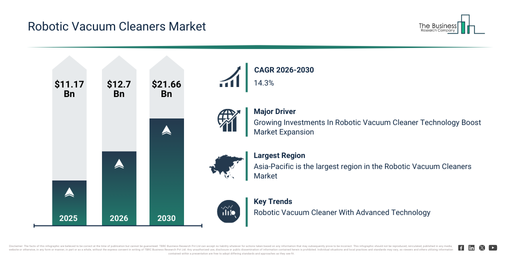
Robotic Vacuum Cleaners Market Forecast: Value Set To Climb From $12.7 Billion To $21.66 Billion
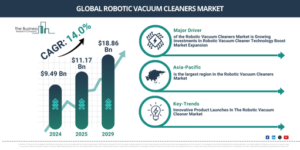
The market size for robotic vacuum cleaners has experienced rapid expansion in recent years. Its valuation is set to grow from $11.17 billion in 2025 to $12.7 billion in 2026, demonstrating a compound annual growth rate (CAGR) of 13.7%. The growth witnessed in previous periods can be linked to the increase in household automation devices, the expanding use of fundamental robotic cleaners, the initial adoption of battery-powered cleaning equipment, a heightened consumer desire for convenient home appliances, and the development of residential smart home ecosystems.
The robotic vacuum cleaners market size is anticipated to experience substantial growth over the next few years. It is projected to expand to $21.66 billion in 2030, achieving a compound annual growth rate (CAGR) of 14.3%. This projected growth can be attributed to several factors, including advancements in AI vision and mapping systems, a rising demand for autonomous commercial cleaning robots, the evolution of smart home integration technologies, an increasing need for hands-free cleaning solutions, and the expansion of multi-functional robotic cleaning systems. Key trends for the forecast period include the growing adoption of AI-powered navigation and obstacle detection, increased utilization of smart connectivity features in robotic vacuums, an escalating demand for sustainable and energy-efficient cleaning solutions, the broader application of robotic cleaning in commercial facilities, and the increasing integration of multi-surface cleaning and self-maintenance capabilities.
Get A Free Sample Report With In-Depth Market Insights:
Robotic Vacuum Cleaners Market Expansion Drivers: What’s Shaping Future Growth?
The Robotic Vacuum Cleaners Market is experiencing growth attributed to an increase in investments aimed at developing novel technologies for these devices. Enhanced investments in hardware and software innovations, such as advanced sensors and improved decision-making capabilities, enable robotic vacuum cleaners to perform household tasks more effectively and help consumers save valuable time, thus making them appealing for home chores. As an illustration, in January 2023, LionsBot International Pte Ltd., a smart robotics company based in Singapore, secured $7 million in funding from TransLink Capital, a US-based venture capital firm, specifically for advancing cleaning robots designed for commercial uses. Consequently, the rising investments, coupled with government backing, are instrumental in driving the expansion of the Robotic Vacuum Cleaners Market.
Robotic Vacuum Cleaners Market Driver: Role Of Robotic Vacuum Cleaners In The Growing Smart Home Market
The expansion of the smart home sector is anticipated to fuel the growth of the Robotic Vacuum Cleaners Market in the future. Smart homes are defined as residential properties equipped with various interconnected devices and systems that allow for remote monitoring, control, and automation. Robotic vacuum cleaners play a crucial role in these smart homes by ensuring a significantly cleaner living space through thorough and highly efficient floor cleaning, effectively acting as an automated personal housekeeper that cleans regularly. For example, data from January 2024, provided by Oberlo, a drop shipping company located in Lithuania, indicated that the total number of households in the United States utilizing smart home devices reached 63.43 million in 2023, representing a 10.2% increase to 69.91 million households. Therefore, the increasing prevalence of smart homes is a key factor propelling the Robotic Vacuum Cleaners Market forward.
Robotic Vacuum Cleaners Market Segment Trends And Revenue Contributors
The robotic vacuum cleaners market covered in this report is segmented –
1) By Type: Robotic Floor Vacuum Cleaner, Robotic Pool Vacuum Cleaner
2) By Type Of Charging: Automatic Charging, Manual Charging
3) By End-Users: Residential, Commercial
Subsegments:
1) By Robotic Floor Vacuum Cleaner: Robotic Mopping Vacuum Cleaners, Hybrid Robotic Vacuum Cleaners
2) By Robotic Pool Vacuum Cleaner: Residential Robotic Pool Cleaners, Commercial Robotic Pool Cleaners, Corded Robotic Pool Cleaners, Cordless Or Battery-Powered Robotic Pool Cleaners, Smart Or Connected Robotic Pool Cleaners
Robotic Vacuum Cleaners Market Trends Redefining Industry Growth
Major companies operating in the robotic vacuum cleaners market are prioritizing the creation of technologically innovative products, like the DEEBOT X2 OMNI, to offer reliable services to their clientele. The DEEBOT X2 OMNI functions as a robotic vacuum cleaner that integrates artificial intelligence (AI) with advanced machine learning capabilities. For example, in September 2023, Ecovacs Robotics, a China-based technology firm focused on in-home robotic appliances, introduced the DEEBOT X2 OMNI. This particular model is a robot vacuum and mop distinguished by its super-thin, low-profile design, which enables it to easily maneuver under sofas, beds, and other challenging areas where dirt often hides. It boasts an Auto-Empty function that can clear its dustbin in 10 seconds and employs dual-laser Lidar navigation technology, underpinned by a built-in light detection and ranging (LiDAR) sensor.
Robotic Vacuum Cleaners Market Competitive Landscape: Which Companies Lead The Industry?
Major companies operating in the robotic vacuum cleaners market are Samsung Electronics Co. Ltd., Metapo Inc., Robert Bosch GmbH, LG Electronics Inc., Panasonic Corporation, Haier Electronics Group Co. Ltd., Sharp Corporation, Koninklijke Philips N.V., AB Electrolux, Groupe SEB Deutschland GmbH, Dyson Ltd., Miele & Cie. KG, Vorwerk & Co. KG, SharkNinja Operating LLC, Karcher Cleaning Systems Pvt. Ltd., ECOVACS Robotics Co. Ltd., iRobot Corporation, Bissell Inc., Taurus Group BV, Yujin Robots Co. Ltd., Neato Robotics Inc., ILIFE Robotics Technology Co. Ltd., bObsweep Inc., Cecotec Innovaciones S.L., Mamibot Manufacturing USA Inc., Matsutek Enterprises Co. Ltd.
View The Full Robotic Vacuum Cleaners Market Report:
Robotic Vacuum Cleaners Market Regional Breakdown: Where Is Demand Concentrated?
Asia-Pacific was the largest region in the robotic vacuum cleaners market in 2025. Western Europe was the second-largest region in the global robotic vacuum cleaners market share. The regions covered in the robotic vacuum cleaners market report are Asia-Pacific, South East Asia, Western Europe, Eastern Europe, North America, South America, Middle East, Africa.
Reach Out To Our Team:
The Business Research Company: https://www.thebusinessresearchcompany.com/
Americas: +1 310-496-7795
Asia: +44 7882 955267 & +91 8897263534
Europe: +44 7882 955267
Email us at: marketing@tbrc.info
Follow us on:
LinkedIn: https://in.linkedin.com/company/the-business-research-company
YouTube: https://www.youtube.com/channel/UC24_fI0rV8cR5DxlCpgmyFQ
Global Market Model: https://www.thebusinessresearchcompany.com/global-market-model

Wasay has over a decade of experience in market research, data modelling, and analytics, with prior experience at GlobalData and Decision Tree Consulting Services. At The Business Research Company , he leads research operations across syndicated studies, customized consulting engagements, and the Global Market Model platform. His professional experience includes supporting organizations such as Boston Consulting Group, KPMG, and Ernst & Young. Wasay holds a degree in Electronics and Communications Engineering, postgraduate management qualifications from International Management Institute Belgium and Indian School of Business and Entrepreneurship, and completed the Integrated Program in Business Analytics from Indian Institute of Management Indore.