Built to provide research that’s more actionable and strategically valuable, The Business Research Company’s 2026 market reports include market attractiveness analysis, total addressable market sizing, company benchmarking matrices, interactive Excel dashboards, broader supply chain intelligence, emerging startup tracking, and in-depth product insights.
Scintillator Array Market Poised To Hit $2.73 Billion By 2030 With A 11.4% CAGR
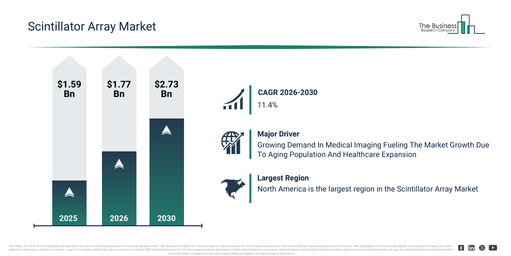
The scintillator array market has experienced rapid expansion in recent years. It is projected to grow from $1.59 billion in 2025 to $1.77 billion in 2026, achieving a compound annual growth rate (CAGR) of 11.7%. The market’s historical growth can be attributed to factors such as the increasing integration of medical imaging technologies, rising demand from nuclear power plants, an increase in high energy physics research, innovations in scintillator materials, and government investment for defense and security applications.
The scintillator array market is projected to experience substantial growth in the coming years. It is forecast to expand to $2.73 billion by 2030, achieving a compound annual growth rate (CAGR) of 11.4%. This growth during the forecast period can be attributed to the integration with AI-based imaging, the development of portable detection devices, an expansion in homeland security applications, innovations in multi-channel detector arrays, and the growth in precision medicine diagnostics. Significant trends in the forecast period encompass high-resolution imaging systems, advanced radiation detection techniques, miniaturized scintillator designs, enhanced light conversion efficiency, and customizable multi-channel detector arrays.
Get A Free Sample Report With In-Depth Market Insights:
Scintillator Array Market Opportunity Drivers: What’s Unlocking New Revenue Potential?
The increasing need for medical imaging is anticipated to drive expansion in the scintillator array market. Medical imaging involves employing various technologies and methods to produce visual depictions of the body’s internal structures for clinical examination, diagnosis, and medical interventions. The growing requirement for medical imaging stems from the global aging population, as older individuals often necessitate more frequent diagnostic procedures to track and identify age-related health conditions. Scintillator arrays are crucial to medical imaging by converting high-energy X-rays or gamma rays into visible light with superior spatial resolution and efficiency. This capability facilitates precise detection and accurate image formation in diagnostic equipment such as CT scanners, PET systems, and gamma cameras, thereby enhancing image quality and improving the ability to detect and diagnose medical conditions. For instance, according to the National Health Service, a UK-based government department, in November 2023, for the year ending March 2023, England conducted 45.0 million imaging tests, representing a 2.2% increase from 44.0 million the previous year. This figure included 10.3 million diagnostic ultrasound tests, a rise of 1.8%; 7.1 million CT scans, up by 5.5%; and 4.1 million MRI scans, showing a 6.2% increase. Consequently, the escalating demand in medical imaging is propelling the growth of the scintillator array market. The expansion of nuclear power plants is projected to boost the growth of the scintillator array market going forward. Nuclear power plants are facilities that use nuclear reactions to generate electricity, and their expansion involves constructing new reactors and enhancing existing ones. This increasing expansion is attributed to the rising demand for clean energy, the urgent necessity to reduce greenhouse gas emissions, and the drive towards sustainable and low-carbon electricity generation. Scintillator arrays assist nuclear power plants by offering precise radiation detection and monitoring capabilities, enabling accurate measurement of radioactive emissions, ensuring operational safety, safeguarding personnel and equipment, and supporting efficient maintenance and adherence to regulations. For instance, in August 2024, the International Atomic Energy Agency, an Austria-based intergovernmental organization, reported that electricity generation from nuclear power rose by 2.6% in 2023 compared to 2022. Additionally, in December 2023, there were 413 operational nuclear reactors across 31 countries, collectively providing a total global capacity of 371.5 GW(e). Therefore, the growth in nuclear power plants is fueling the scintillator array market.
Scintillator Array Market Segmentation: How Does The Market Break Down By Category?
The scintillator array market covered in this report is segmented –
1) By Type: Organic Scintillators, Inorganic Scintillators, Plastic Scintillators, Ceramic Scintillators
2) By Form Factor: Single-Channel Detectors, Multi-Channel Detectors, Custom Configurations
3) By Application: Medical Imaging, Nuclear Power Plants, High Energy Physics, Homeland Security, Other Applications
4) By End-User: Healthcare, Industrial, Defense, Research Institutions, Other End-Users
Subsegments:
1) By Organic Scintillators: Liquid Organic Scintillators, Crystal Organic Scintillators, Glass Organic Scintillators
2) By Inorganic Scintillators: Alkali Halide Scintillators, Oxide Crystal Scintillators, Fluoride Crystal Scintillators
3) By Plastic Scintillators: Polyvinyl Toluene Based Scintillators, Polystyrene Based Scintillators, Polyester Based Scintillators
4) By Ceramic Scintillators: Garnet Based Scintillators, Perovskite Based Scintillators, Rare Earth Doped Scintillators
Scintillator Array Market Competitive Overview And Top Companies
Major companies operating in the scintillator array market are Thermo Fisher Scientific Inc., Siemens Healthineers AG, Koninklijke Philips N.V., GE HealthCare Technologies Inc., Hamamatsu Photonics K.K., Mirion Technologies Inc., Ludlum Measurements Inc., Kromek Group plc, Berkeley Nucleonics Corporation, Crytur Ltd., Luxium Solutions Inc., Eljen Technology Inc., EPIC Crystal Co. Ltd., Scintacor Ltd., Advatech UK Limited, Rexon Components Inc., Zecotek Photonics Inc., ShanghAI SICCAS High Technology Corporation, Alpha Spectra Inc., Scintitech Inc.
View The Full Scintillator Array Market Report:
Scintillator Array Market Global Footprint: Which Region Leads The Market?
North America was the largest region in the scintillator array market in 2025. Asia-Pacific is expected to be the fastest-growing region in the forecast period. The regions covered in the scintillator array market report are Asia-Pacific, South East Asia, Western Europe, Eastern Europe, North America, South America, Middle East, Africa.
Reach Out To Our Team:
The Business Research Company: https://www.thebusinessresearchcompany.com/
Americas: +1 310-496-7795
Asia: +44 7882 955267 & +91 8897263534
Europe: +44 7882 955267
Email us at: marketing@tbrc.info
Follow us on:
LinkedIn: https://in.linkedin.com/company/the-business-research-company
YouTube: https://www.youtube.com/channel/UC24_fI0rV8cR5DxlCpgmyFQ
Global Market Model: https://www.thebusinessresearchcompany.com/global-market-model

Wasay has over a decade of experience in market research, data modelling, and analytics, with prior experience at GlobalData and Decision Tree Consulting Services. At The Business Research Company , he leads research operations across syndicated studies, customized consulting engagements, and the Global Market Model platform. His professional experience includes supporting organizations such as Boston Consulting Group, KPMG, and Ernst & Young. Wasay holds a degree in Electronics and Communications Engineering, postgraduate management qualifications from International Management Institute Belgium and Indian School of Business and Entrepreneurship, and completed the Integrated Program in Business Analytics from Indian Institute of Management Indore.