Backed by market attractiveness analysis, total addressable market sizing, company benchmarking matrices, interactive Excel dashboards, wider supply chain intelligence, emerging startup coverage, and detailed product-level insights, The Business Research Company’s 2026 market reports are designed to offer research that is more actionable and strategically valuable than ever.
Secondary Batteries Market CAGR Outlook And Future Development
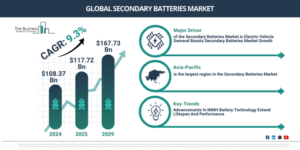
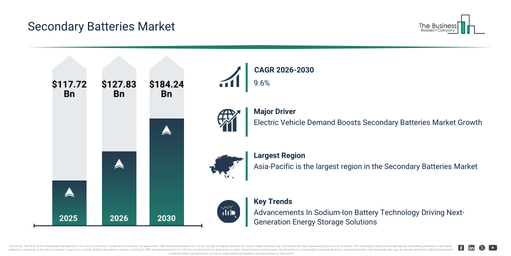
The secondary batteries market has experienced substantial growth in recent years. Its value is projected to rise from $117.72 billion in 2025 to $127.83 billion in 2026, achieving a compound annual growth rate (CAGR) of 8.6%. The historical growth of the market can be linked to the growing demand for rechargeable electronics, early adoption of lead acid batteries in vehicles, expansion of industrial backup power systems, increased penetration of portable consumer devices, and development of foundational lithium ion technologies.
The secondary batteries market is projected to experience robust expansion in the coming years. Its valuation is anticipated to reach $184.24 billion by 2030, exhibiting a compound annual growth rate (CAGR) of 9.6%. This anticipated growth throughout the forecast period stems from several factors, including a significant increase in electric vehicle battery demand, an escalating need for high energy density storage solutions, the proliferation of renewable energy storage installations, the expanding application of batteries in smart devices, and the development of sophisticated chemistries such as solid-state batteries. Key trends during this period are expected to encompass the growing embrace of environmentally friendly battery manufacturing processes, an uptick in EV-focused battery innovations, progress in automated battery production, the spread of IoT-enabled smart battery systems, and the increased implementation of digital battery monitoring technologies.
Get A Free Sample Report With In-Depth Market Insights:
Secondary Batteries Market Growth Drivers: What’s Behind The Acceleration?
The rising demand for electric vehicles is anticipated to favorably impact the secondary batteries market. Secondary batteries are also experiencing increased usage in hybrid vehicles. The broad temperature range of -30°C to +75°C and the rapid charging capability of Nickel Metal Hybride (NiMH) batteries make them ideal for the automotive sector. NiMH batteries are also capable of handling the high-power levels crucial for electric vehicles. For instance, in April 2024, the International Energy Agency (IEA), a France-based intergovernmental organization, reported that new electric car registrations in China reached 8.1 million in 2023, marking a 35% increase compared to 2022. Consequently, the increasing demand for electric vehicles is expected to fuel the expansion of the secondary batteries market.
Secondary Batteries Market Segment Outlook: Which Categories Are Growing Fastest?
The secondary batteries market covered in this report is segmented –
1) By Product Type: Lead Acid, Lithium-Ion (Li-Ion), Nickel Metal Hydride, Nickel-Cadmium (Ni-Cd), Other Product Type
2) By Application: Electronics, Motor Vehicles, Portable Devices, Other Applications
3) By End User: Automotive, Household, Industrial
Subsegments:
1) By Lead Acid: Flooded Lead Acid Batteries, Absorbent Glass Mat (AGM) Batteries, Gel Lead Acid Batteries
2) By Lithium-Ion (Li-Ion): Lithium Iron Phosphate (LiFePO4), Lithium Polymer (LiPo), Lithium Nickel Manganese Cobalt Oxide (NMC)
3) By Nickel Metal Hydride: High-Capacity NiMH Batteries, Rechargeable NiMH Batteries For Consumer Electronics
4) By Nickel-Cadmium (Ni-Cd): Standard Ni-Cd Batteries, Rechargeable Ni-Cd Batteries For Power Tools And Emergency Lighting
5) By Other Product Types: Sodium-Sulfur Batteries, Flow Batteries, Zinc-Air Batteries
Secondary Batteries Market Trends: What’s Defining The Industry’s Next Phase?
Leading companies in the Secondary Batteries market are prioritizing the development of innovative solutions, such as sodium-ion battery technology, to enhance energy density, reduce costs, and improve performance sustainability for electric vehicles and large-scale energy storage applications. Sodium-ion battery technology is an emerging energy storage method that functions on principles similar to lithium-ion batteries but employs sodium ions (Na?) rather than lithium ions (Li?) as charge carriers. For instance, in April 2025, Contemporary Amperex Technology Co., Limited (CATL), a China-based battery manufacturer, introduced the “Naxtra” sodium-ion battery brand, an innovative sodium-ion battery system scheduled for mass production. The Naxtra product line encompasses a passenger EV sodium-ion battery and a 24 V heavy-duty truck start/stop sodium-ion battery. The EV version achieves an energy density of around 175 Wh/kg, retains 90% usable capacity at –40-°C, supports over 10,000 cycles, and enables a driving range of up to roughly 500 km. This design aims to reduce dependence on lithium, provide safer thermal behavior (intrinsic safety), maintain performance in extreme cold (-40 °C to +70 °C), thereby broadening EV and heavy-vehicle battery adoption in challenging environments.
Secondary Batteries Market Leading Companies And Competitive Benchmarking
Major companies operating in the secondary batteries market are LG Chem Co. Ltd., Contemporary Amperex Technology Co., Limited, Samsung SDI Co. Ltd., TDK Corporation, Panasonic Corporation, BYD Company Ltd., Murata Manufacturing Co., Ltd., Toshiba Corporation, SK Innovation Co., Ltd., Energizer Holdings Inc., Eveready, Duracell, Nippo, Kodak, Powercell, Hitachi Maxell, Johnson Controls, EnerSys, GP Batteries, Guangdong Zhenglong Battery Industry Company Limited, Guangzhou Tiger Head Battery Group, Hefei Guoxuan Hi-Tech Power Energy Co., Ltd., Tianjin Lishen Battery Co., Ltd., AVIC Lithium Battery, Sony Corporation, ShanghAI White Elephant Swan Battery Co. Ltd., GBP International, Saft batteries, Varta Consumer Batteries, Monbat, Umicore, A123 Systems LLC, AES Group, Ultralife Corporation, Rayovac, Exide Industries Ltd, Mobisol Kenya, Associated Battery Manufacturers (E.A) Ltd, Yuasa Battery Limited, ABMkenya, Potensa
View The Full Secondary Batteries Market Report:
Secondary Batteries Market Regional Analysis: Which Geography Leads On Revenue?
Asia-Pacific was the largest region in the secondary batteries market in 2025. North America was the second-largest region in the global secondary batteries market share. The regions covered in the secondary batteries market report are Asia-Pacific, South East Asia, Western Europe, Eastern Europe, North America, South America, Middle East, Africa.
Reach Out To Our Team:
The Business Research Company: https://www.thebusinessresearchcompany.com/
Americas: +1 310-496-7795
Asia: +44 7882 955267 & +91 8897263534
Europe: +44 7882 955267
Email us at: marketing@tbrc.info
Follow us on:
LinkedIn: https://in.linkedin.com/company/the-business-research-company
YouTube: https://www.youtube.com/channel/UC24_fI0rV8cR5DxlCpgmyFQ
Global Market Model: https://www.thebusinessresearchcompany.com/global-market-model

Wasay has over a decade of experience in market research, data modelling, and analytics, with prior experience at GlobalData and Decision Tree Consulting Services. At The Business Research Company , he leads research operations across syndicated studies, customized consulting engagements, and the Global Market Model platform. His professional experience includes supporting organizations such as Boston Consulting Group, KPMG, and Ernst & Young. Wasay holds a degree in Electronics and Communications Engineering, postgraduate management qualifications from International Management Institute Belgium and Indian School of Business and Entrepreneurship, and completed the Integrated Program in Business Analytics from Indian Institute of Management Indore.