
Featuring market attractiveness scoring, total addressable market sizing, company benchmarking matrices, interactive Excel dashboards, deeper supply chain intelligence, emerging startup tracking, and granular product-level insights, The Business Research Company’s 2026 market reports are built to deliver research that is both more actionable and more strategically valuable.
Seismic Monitoring Equipment Market Size Outlook: How Quickly Will Revenue Expand Through 2030?
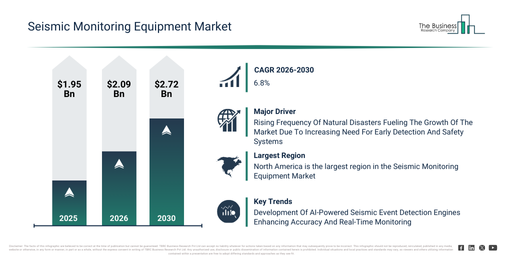
The seismic monitoring equipment market has seen substantial growth in recent years. This market is set to expand from $1.95 billion in 2025 to $2.09 billion by 2026, exhibiting a compound annual growth rate (CAGR) of 7.0%. The past growth can be linked to factors including the rising occurrence of natural disasters, an increasing requirement for earthquake early warning systems, the expansion of oil and gas exploration, the need for enhanced mining safety monitoring, and continuous advancements in analog and digital seismometers.
The seismic monitoring equipment market is projected to experience substantial expansion over the coming years, reaching a value of $2.72 billion by 2030, driven by a compound annual growth rate (CAGR) of 6.8%. This anticipated growth during the forecast period can be attributed to several key factors, including the increasing integration of IoT-enabled seismic sensors, the expansion of urban infrastructure monitoring initiatives, a heightened emphasis on the analysis of induced seismicity, the incorporation of AI-based predictive modeling, and the proliferation of seismic projects funded by governments and research institutions. Significant trends expected within this period encompass the deployment of wireless seismic monitoring systems particularly for remote areas, the incorporation of sophisticated digital seismometers featuring real-time data acquisition capabilities, the deployment of structural health monitoring solutions to enhance infrastructure safety, the creation of advanced predictive analytics and event detection software specifically for seismic occurrences, and the delivery of comprehensive end-to-end services, which cover installation, maintenance, and calibration.
Get A Free Sample Report With In-Depth Market Insights:
Seismic Monitoring Equipment Market Growth Factors: What’s Supporting Expansion?
The escalating frequency and severity of natural disasters are anticipated to drive the expansion of the seismic monitoring equipment market in the coming period. Natural disasters are defined as catastrophic occurrences resulting from Earth’s natural processes, such as earthquakes, floods, and hurricanes, leading to widespread destruction and loss of life. The increasing incidence of these events is influenced by climate change, which intensifies extreme weather phenomena like floods and storms, alongside elevated seismic activity in earthquake-prone areas. Seismic monitoring equipment is indispensable for disaster readiness, as it detects earthquakes and other ground movements, issuing timely warnings to protect individuals and property. For example, in March 2023, the British Red Cross, a UK-based humanitarian charity, reported that roughly 1.9 million people in the country live in areas at substantial risk of flooding, a figure that could potentially double by the 2050s. Thus, the growing frequency and impact of natural disasters are fueling the growth of the seismic monitoring equipment market.
Seismic Monitoring Equipment Market Segment Analysis And Revenue Potential
The seismic monitoring equipment market covered in this report is segmented –
1) By Component: Hardware, Software, Services
2) By Product Type: Seismometers, Accelerometers, Data Acquisition Units, Recorders, Digitizers, Other Product Types
3) By Technology: Analog Technology, Digital Technology, Advanced Seismic Monitoring Systems, Wireless Seismic Monitoring Systems
4) By Application: Earthquake Monitoring, Volcanic Activity Monitoring, Structural Health Monitoring, Ambient Vibration Analysis, Induced Seismicity Monitoring, Other Applications
5) By End-User: Oil And Gas, Mining And Construction, Aerospace And Defense, Government And Research Institutions, Other End-Users
Subsegments:
1) By Hardware: Seismometers, Data Loggers, Accelerometers, Telemetry Units, Recorders
2) By Software: Data Acquisition Software, Seismic Data Analysis Software, Real-Time Monitoring Software, Visualization And Interpretation Software, Event Detection Software
3) By Services: Installation And Integration Services, Maintenance And Calibration Services, Data Management Services, Training And Consulting Services, System Upgradation Services
Seismic Monitoring Equipment Market Industry Trends: What’s Reshaping Demand?
Leading companies within the seismic monitoring equipment market are actively pursuing the development of technologically advanced solutions, notably AI-driven seismic event detection engines. These initiatives aim to bolster real-time seismic analysis, refine the precision of event detection, and mitigate the need for manual data processing. An AI-powered seismic event detection engine represents a sophisticated system that employs artificial intelligence to automatically identify and analyze seismic activities, thus enabling faster and more accurate recognition of earthquakes and related events. For example, in June 2023, Nanometrics Inc., a Canada-based geophysical instrumentation company, unveiled a next-generation automated AI-powered engine for seismic event detection. This system incorporates a new Deep Learning Picker algorithm, which was trained on extensive seismic event data. This advancement significantly improves seismic event detection by achieving higher accuracy, faster processing, and fewer false positives, ultimately allowing for more precise event localization in near real-time. The enhanced infrastructure supporting this system offers improved computational efficiency and data handling, facilitating rapid detection and reporting of seismic events. This AI-powered engine is currently being deployed across all private and subscriber arrays, promising a more dependable and comprehensive seismic event catalogue to enhance seismic hazard assessment and inform better decision-making.
Seismic Monitoring Equipment Market Key Players Shaping Industry Direction
Major companies operating in the seismic monitoring equipment market are Baker Hughes Company, Halliburton Company, Teledyne Instruments Inc., Trimble Inc., Sercel S.A.S., Geospace Technologies Corporation, Campbell Scientific Inc., MIND Technology Inc., PASCO Scientific Inc., Landtech Geophysics Limited, Avalon Sciences Limited, Paragon Geophysical Services Ltd., Wilcoxon Sensing Technologies, STRYDE Limited, Metrix Vibration Inc., Seismic Source International Ltd., PASI S.r.l., NORSAR AS, Solgeo S.r.l., DMT Group GmbH, Febus Optics S.A.S., GeoSIG Ltd., Raspberry Shake S.A.
View The Full Seismic Monitoring Equipment Market Report:
Seismic Monitoring Equipment Market Geographic Landscape: Which Region Leads Industry Growth?
North America was the largest region in the seismic monitoring equipment market in 2025. Asia-Pacific is expected to be the fastest-growing region in the forecast period. The regions covered in the seismic monitoring equipment market report are Asia-Pacific, South East Asia, Western Europe, Eastern Europe, North America, South America, Middle East, Africa.
Reach Out To Our Team:
The Business Research Company: https://www.thebusinessresearchcompany.com/
Americas: +1 310-496-7795
Asia: +44 7882 955267 & +91 8897263534
Europe: +44 7882 955267
Email us at: marketing@tbrc.info
Follow us on:
LinkedIn: https://in.linkedin.com/company/the-business-research-company
YouTube: https://www.youtube.com/channel/UC24_fI0rV8cR5DxlCpgmyFQ
Global Market Model: https://www.thebusinessresearchcompany.com/global-market-model

Wasay has over a decade of experience in market research, data modelling, and analytics, with prior experience at GlobalData and Decision Tree Consulting Services. At The Business Research Company , he leads research operations across syndicated studies, customized consulting engagements, and the Global Market Model platform. His professional experience includes supporting organizations such as Boston Consulting Group, KPMG, and Ernst & Young. Wasay holds a degree in Electronics and Communications Engineering, postgraduate management qualifications from International Management Institute Belgium and Indian School of Business and Entrepreneurship, and completed the Integrated Program in Business Analytics from Indian Institute of Management Indore.