Delivering more actionable and strategically valuable research, The Business Research Company’s 2026 market reports feature market attractiveness analysis, total addressable market evaluation, company benchmarking matrices, interactive Excel dashboards, expanded supply chain intelligence, emerging startup coverage, and detailed product insights.
Semiconductor Chemical Market Expansion Outlook: What Revenue Opportunities Lie Ahead?
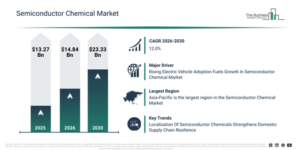
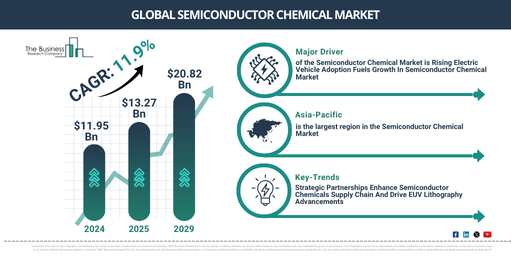
The semiconductor chemical market has seen rapid expansion in recent years. It is expected to increase from $13.27 billion in 2025 to $14.84 billion in 2026, with a compound annual growth rate (CAGR) of 11.9%. In previous periods, this growth was influenced by factors such as the expansion of global semiconductor manufacturing capabilities, the increasing miniaturization of electronic components, the rise in integrated circuit production, the necessity for improved chip performance and reliability, and growing investments in semiconductor fabrication facilities.
The semiconductor chemical market is projected for significant expansion over the coming years, reaching $23.33 billion by 2030 with a compound annual growth rate (CAGR) of 12.0%. This anticipated growth stems from factors such as the greater integration of AI and high-performance computing chips, increased demand for semiconductors in electric vehicles, advancements in packaging technologies, the escalating intricacy of semiconductor production processes, and increased capital flowing into domestic semiconductor fabrication plants. Key developments anticipated during this timeframe involve a heightened need for sophisticated photoresist and etching chemicals, more widespread application of ultra-high purity semiconductor chemicals, increased utilization of chemicals for cutting-edge node fabrication, an expansion of specialized chemicals for intricate chip designs, and an intensified emphasis on chemicals tailored for specific processes and applications.
Download A Free Sample Report For Comprehensive Market Insights:
Semiconductor Chemical Market Demand Drivers: What Is Fueling Industry Growth?
The expanding adoption of electric vehicles is anticipated to drive the semiconductor chemical market’s growth. An electric vehicle, or EV, operates with electric motors drawing power from rechargeable batteries, differing from traditional vehicles that rely on internal combustion engines fueled by gasoline or diesel. The increasing uptake of electric vehicles is attributed to their environmental advantages, reduced operational expenses, progress in battery technology, and escalating government initiatives aimed at curbing greenhouse gas emissions. Semiconductor chemicals are essential in electric vehicles for the production and improvement of vital electronic components, including power management systems, battery controllers, and advanced driver-assistance systems (ADAS). For example, the International Energy Agency, in a report issued in April 2023, indicated that global electric car sales surpassed 10 million in 2023, with expectations for a 35% rise this year, reaching 14 million. Projections further suggest that by 2030, electric cars will constitute roughly 60% of overall sales in China, the EU, and the United States. Consequently, the expanding deployment of electric vehicles is a key driver for the semiconductor chemical market’s expansion.
Semiconductor Chemical Market Segment Analysis And Revenue Opportunities
The semiconductor chemical market covered in this report is segmented –
1) By Type: Acid And Base Chemicals, Adhesives, Solvents, High-Performance Polymers
2) By Application: Cleaning Chemicals, Etching Chemicals, Photoresist Chemical, Deposition Chemicals, Other Applications
3) By End-Users: Discrete Semiconductor, Integrated Circuits
Subsegments:
1) By Acid And Base Chemicals: Hydrofluoric Acid (HF), Nitric Acid (HNO3), Sulfuric Acid (H2SO4), Phosphoric Acid (H3PO4), Ammonium Hydroxide (NH4OH), Potassium Hydroxide (KOH)
2) By Adhesives: Epoxy-Based Adhesives, UV-Curable Adhesives, Silicone-Based Adhesives, Conductive Adhesives, Non-Conductive Adhesives
3) By Solvents: Acetone, Isopropyl Alcohol (IPA), N-Methyl-2-Pyrrolidone (NMP), Dimethylformamide (DMF), Toluene, Methanol
4) By High-Performance Polymers: Polyimide (PI), Fluoropolymers (PTFE, PFA), Polyurethane (PU), Polyphenylene Sulfide (PPS), Polyether Ether Ketone (PEEK), Polycarbonate (PC)
Semiconductor Chemical Market Innovation Trends Driving Future Development
Leading entities within the semiconductor chemical market are prioritizing the development of in-country manufacturing capacities to bolster supply chain resilience and lessen reliance on foreign sources. The indigenous manufacturing of crucial compounds is vital for guaranteeing continuous functioning within the microelectronics sector. An example is the launch, in September 2025, of the inaugural industrial-scale production of sodium tartrate dihydrate specifically for microelectronics by the Engineering Chemical and Technological Center of Tomsk State University, an entity located in Russia. This production line facilitates the yearly creation of several hundred kilograms of the compound, thereby entirely satisfying the internal requirements of Russian companies. The overall capital expenditure for this initiative amounted to approximately ?150 million. Sodium tartrate serves the purpose of cleansing electronic components prior to their incorporation into devices, which ensures superior assembly quality and enhances the dependability of microelectronic goods. This fresh manufacturing plant eradicates Russia’s prior total reliance on imported goods and fortifies the robustness of its national semiconductor supply chain. The pilot facility integrates contemporary chemical processing methods, delivering uniform product quality, the capacity for scaling to meet industrial needs, and dependable performance for vital manufacturing operations. This advancement signifies a pivotal move towards the in-country production of vital semiconductor chemicals within Russia.
Semiconductor Chemical Market Leading Players Shaping Industry Direction
Major companies operating in the semiconductor chemical market are SK Inc., BASF SE, Dow Chemical Co., Honeywell International Inc., Merck KGaA, Sumitomo Chemical Co. Ltd., Fujifilm Holdings Corporation, Parker Hannifin Corp., Solvay SA, Air Products and Chemicals Inc., DuPont de Nemours Inc., Kao Corporation, Eastman Chemical Company, Avantor Inc., Cabot Corporation, Linde Plc, Mitsubishi Chemical Corporation, Oci Company Ltd., JSR Corporation, Tokuyama Corporation, Nippon Kayaku Co. Ltd., Tokyo Ohka Kogyo Co. Ltd., Kanto PPC, Foosung Co. Ltd., Ami Organics Ltd
Access The Complete Semiconductor Chemical Market Report:
Semiconductor Chemical Market Geographic Analysis: Where Is Demand Growing The Fastest?
Asia-Pacific was the largest region in the semiconductor chemical market in 2025. Asia-Pacific is expected to be the fastest-growing region in the forecast period. The regions covered in the semiconductor chemical market report are Asia-Pacific, South East Asia, Western Europe, Eastern Europe, North America, South America, Middle East, Africa.
Get in touch with us:
The Business Research Company: https://www.thebusinessresearchcompany.com/
Americas: +1 310-496-7795
Asia: +44 7882 955267 & +91 8897263534
Europe: +44 7882 955267
Email us at: marketing@tbrc.info
Follow us on:
LinkedIn: https://in.linkedin.com/company/the-business-research-company
YouTube: https://www.youtube.com/channel/UC24_fI0rV8cR5DxlCpgmyFQ
Global Market Model: https://www.thebusinessresearchcompany.com/global-market-model

Wasay has over a decade of experience in market research, data modelling, and analytics, with prior experience at GlobalData and Decision Tree Consulting Services. At The Business Research Company , he leads research operations across syndicated studies, customized consulting engagements, and the Global Market Model platform. His professional experience includes supporting organizations such as Boston Consulting Group, KPMG, and Ernst & Young. Wasay holds a degree in Electronics and Communications Engineering, postgraduate management qualifications from International Management Institute Belgium and Indian School of Business and Entrepreneurship, and completed the Integrated Program in Business Analytics from Indian Institute of Management Indore.