Designed to make market research more actionable and strategically valuable, The Business Research Company’s 2026 market reports feature market attractiveness scoring, total addressable market sizing, company benchmarking matrices, interactive Excel dashboards, deeper supply chain intelligence, emerging startup tracking, and granular product-level insights.
Semiconductor Chip Ecosystem Market Forecast 2026–2030: Size, Value And Compound Annual Growth Rate
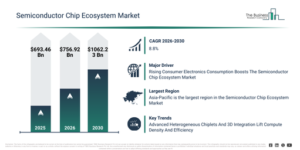
The semiconductor chip ecosystem market has experienced robust growth in recent years. Its expansion is projected from $693.46 billion in 2025 to $756.92 billion in 2026, demonstrating a compound annual growth rate (CAGR) of 9.2%. Historically, this growth can be ascribed to several factors, including the surging demand for consumer electronics, the expansion of PC and smartphone markets, the increasing number of semiconductor fabrication plants, a rise in the adoption of digital devices, and continuous advancements in wafer fabrication technologies.
The semiconductor chip ecosystem market is projected to experience substantial expansion in the coming years. Its size is forecast to reach $1062.23 billion in 2030, demonstrating a compound annual growth rate (CAGR) of 8.8%. This anticipated growth during the forecast period is driven by factors such as the increasing prevalence of AI and machine learning applications, the proliferation of autonomous vehicles, greater uptake of IoT devices, a heightened demand for high-performance computing, and the creation of energy-efficient semiconductor solutions. Key trends expected over the forecast period encompass chip miniaturization, innovative packaging solutions, high-performance computing chips, energy-efficient semiconductors, and chips optimized for edge computing.
Try Before You Buy: Free Sample Of The Semiconductor Chip Ecosystem Market Report:
Semiconductor Chip Ecosystem Market Growth Engine: The Factor Boosting Demand Globally
The expanding usage of various consumer electronics is anticipated to boost the semiconductor chip ecosystem market’s expansion in the future. These devices, designed for individual use, primarily serve entertainment, communication, and personal organization purposes, emphasizing simplified daily living through accessible technology. The demand for consumer electronics is increasing due to factors such as enhanced connectivity, the rise of remote work and education, greater affordability, and improved accessibility. Semiconductor chips function as the core processing units within devices, performing operations and ensuring smooth performance; furthermore, they manage connectivity and optimize power usage to extend battery life in mobile electronics. For example, data from the Japan Electronics and Information Technology Industries Association, a Japanese trade group, revealed that consumer electronics production in May 2023 reached $204.67 million (¥32,099 million), representing a 127% rise from the prior year. Consequently, the growing adoption of diverse consumer electronics is a key driver for the expansion of the semiconductor chip ecosystem market.
Which Categories And Subcategories Shape The Semiconductor Chip Ecosystem Market?
The semiconductor chip ecosystem market covered in this report is segmented –
1) By Product: Microprocessors, Memory Chips, Graphic Processing Units (GPUs), Analog Chips, Digital Signal Processors (DSPs), Application-Specific Integrated Circuits (ASICs), Field-Programmable Gate Arrays (FPGAs), System-On-Chip (SoC)
2) By Applications: Smartphones, Internet Of Things (IoT) Devices, Medical Devices
3) By End-Use Industry: Consumer Electronics, Communications, Computing, Automotive, Industrial
Subsegments:
1) By Microprocessors: General-Purpose Microprocessors, Embedded Microprocessors, Multi-Core Microprocessors
2) By Memory Chips: DRAM (Dynamic Random-Access Memory), SRAM (Static Random-Access Memory), Flash Memory, EEPROM (Electrically Erasable Programmable Read-Only Memory)
3) By Graphic Processing Units (GPUs): Integrated GPUs, Discrete GPUs, Mobile GPUs
4) By Analog Chips: Operational Amplifiers, Voltage Regulators, Analog-to-Digital Converters (ADCs), Digital-to-Analog Converters (DACs)
5) By Digital Signal Processors (DSPs): Fixed-Point DSPs, Floating-Point DSPs, Application-Specific DSPs
6) By Application-Specific Integrated Circuits (ASICs): Standard ASICs, Custom ASICs, Semi-Custom ASICs
7) By Field-Programmable Gate Arrays (FPGAs): Low-Density FPGAs, Mid-Density FPGAs, High-Density FPGAs
8) By System-On-Chip (SoC): Microcontroller SoCs, Application Processor SoCs, Power Management SoCs
Semiconductor Chip Ecosystem Market Trend Insights: Strategic Focus Areas Of Leading Companies
Leading companies operating in the semiconductor chip ecosystem market are developing advanced microchips to enable next-generation technologies in consumer electronics and various other industries. A microchip, also termed a microprocessor chip, is a compact semiconductor device that houses electronic circuits on a small silicon wafer. These circuits perform tasks such as data processing, information storage, and controlling other electronic components. For instance, in December 2024, Lawrence Livermore National Laboratory (LLNL), a U.S. Department of Energy laboratory, introduced “El Capitan,” an HPE Cray EX supercomputer. This system is powered by AMD Instinct MI300A APUs, which are devices that combine CPU, GPU, and HBM in one package. LLNL documents this as enabling unified HBM3 memory of 128 GB per socket, 3D chiplet integration, and a verified system performance of 1.742 exaFLOPS, with a peak of 2.79 exaFLOPS and approximately 35 MW peak power. These characteristics highlight how chiplet-based APUs improve compute density and energy efficiency for AI-HPC convergence in production systems.
Leading Organizations In The Semiconductor Chip Ecosystem Market
Major companies operating in the semiconductor chip ecosystem market are Taiwan Semiconductor Manufacturing Company Limited, Qualcomm Incorporated, Samsung Electronics Co. Ltd., Intel Corporation, Micron Technology Inc., NVIDIA Corporation, Toshiba Corporation, Advanced Micro Devices Inc., Texas Instruments Incorporated, STMicroelectronics N.V., Infineon Technologies AG, NXP Semiconductors N.V., Analog Devices Inc., Renesas Electronics Corporation, ON Semiconductor Corporation, Microchip Technology Inc., Marvell Technology Group Ltd., Cadence Design Systems Inc., Nuvoton Technology Corporation, Silicon Laboratories, Cypress Semiconductor Corporation
Continue Reading: The Full Semiconductor Chip Ecosystem Market Report:
Semiconductor Chip Ecosystem Market Regional Spotlight: Top Geography And Report Coverage
Asia-Pacific was the largest region in the semiconductor chip ecosystem market in 2025. North America is expected to be the fastest-growing region in the forecast period. The regions covered in the semiconductor chip ecosystem market report are Asia-Pacific, South East Asia, Western Europe, Eastern Europe, North America, South America, Middle East, Africa.
Reach Out To Our Team:
The Business Research Company: https://www.thebusinessresearchcompany.com/
Americas: +1 310-496-7795
Asia: +44 7882 955267 & +91 8897263534
Europe: +44 7882 955267
Email us at: marketing@tbrc.info
Follow us on:
LinkedIn: https://in.linkedin.com/company/the-business-research-company
YouTube: https://www.youtube.com/channel/UC24_fI0rV8cR5DxlCpgmyFQ
Global Market Model: https://www.thebusinessresearchcompany.com/global-market-model

Wasay has over a decade of experience in market research, data modelling, and analytics, with prior experience at GlobalData and Decision Tree Consulting Services. At The Business Research Company , he leads research operations across syndicated studies, customized consulting engagements, and the Global Market Model platform. His professional experience includes supporting organizations such as Boston Consulting Group, KPMG, and Ernst & Young. Wasay holds a degree in Electronics and Communications Engineering, postgraduate management qualifications from International Management Institute Belgium and Indian School of Business and Entrepreneurship, and completed the Integrated Program in Business Analytics from Indian Institute of Management Indore.