Backed by market attractiveness analysis, total addressable market sizing, company benchmarking matrices, interactive Excel dashboards, wider supply chain intelligence, emerging startup coverage, and detailed product-level insights, The Business Research Company’s 2026 market reports are designed to offer research that is more actionable and strategically valuable than ever.
Silicon Photonics Market CAGR Outlook And Future Development
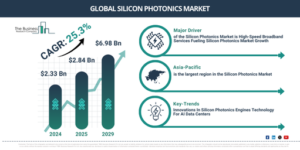
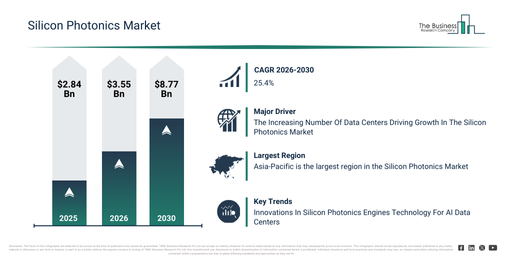
The silicon photonics market has observed considerable expansion recently. It is anticipated to increase from $2.84 billion in 2025 to $3.55 billion in 2026, at a compound annual growth rate (CAGR) of 25.1%. This historical growth stems from factors such as increasing demand for high-performance computing, expansion in fiber-optic communication, initial deployment in data centers, dependence on semiconductor-grade silicon, and wider application in telecommunications.
The silicon photonics market is projected to experience rapid expansion over the coming years. Its value is anticipated to reach $8.77 billion by 2030, demonstrating a compound annual growth rate (CAGR) of 25.4%. This anticipated growth is driven by factors such as the proliferation of cloud and hyperscale data centers, a heightened need for 400g and more advanced transceivers, the proliferation of integrated photonic circuits, the creation of energy-efficient optical interconnects, and increased implementation in AI and high-performance computing (HPC) infrastructure. Key trends identified for the forecast period encompass advancements in high-speed optical data links, the broadening of IoT-enabled photonic integration, the evolution of AI-enhanced optical computing, the rise of intelligent photonic manufacturing systems, and the embrace of autonomous optical network technologies.
Get A Free Sample Report With In-Depth Market Insights:
Silicon Photonics Market Industry Drivers: What’s Behind The Revenue Growth?
The silicon photonics market is projected to experience growth driven by the increasing proliferation of data centers. These facilities are crucial for housing computer systems, servers, and networking equipment, which are essential for storing, processing, and managing vast volumes of digital information, thereby supporting diverse online services and applications. In such environments, silicon photonics significantly improves high-speed data transmission through the integration of optical components onto silicon chips, facilitating faster, more energy-efficient communication between servers and effectively reducing latency. A pertinent example is the report from the World Economic Forum, a Switzerland-based international organization, which stated in April 2025 that the global data center industry was estimated to be worth $242.72 billion and is anticipated to more than double, reaching over $584 billion, by 2032. This substantial expansion of data centers is thus expected to propel the silicon photonics market throughout the forecast period.
Silicon Photonics Market Segment Landscape: Which Areas Lead Development?
The silicon photonics market covered in this report is segmented –
1) By Product: Transceivers, Variable Optical Attenuators, Switches, Cables, Sensors
2) By Component: Laser, Modulator, Photodetector, Filter, Wave Guide
3) By Application: Data Centers And High-Performance Computing, Telecommunication, Military, Defense And Aerospace, Medical And Life Science, Other Applications
Subsegments:
1) By Transceivers: 40G Transceivers, 100G Transceivers, 400G Transceivers, Others
2) By Variable Optical Attenuators: Fixed Attenuators, Dynamic Attenuators
3) By Switches: Optical Packet Switches, Optical Circuit Switches
4) By Cables: Active Optical Cables (AOCs), Passive Optical Cables
5) By Sensors: Biosensors, Temperature Sensors, Pressure Sensors
#Silicon Photonics Market Growth Trends: What’s Shaping The Future Outlook?
Companies within the silicon photonics market are concentrating on creating high-speed solutions, specifically silicon photonics engines, to boost data transmission rates and energy efficiency in telecommunication. A silicon photonics engine represents a high-performance component, combining optical and electronic elements on a singular chip to facilitate rapid and efficient data transmission across telecommunications, data centers, and AI applications. As an illustration, in September 2024, DustPhotonics, an optical products manufacturer from Israel, introduced the inaugural merchant silicon photonics engine designed for 1.6 TB/s DR8 applications, targeting AI and hyperscale data centers. This particular engine incorporates 8 channels, each supporting 224G, alongside an alternative version with 4 channels for 800Gb/s DR4 applications. Both configurations integrate on-board lasers utilizing DustPhotonics’ patented L3C technology, which provides advantages like a simpler design, reduced power consumption, minimized optical loss, and decreased expenses. The standard iteration supports distances up to 2 km, whereas a more economical version intended for short-reach uses (up to 100 m) employs a singular laser. Furthermore, these devices are appropriate for linear receive optics (LRO), linear pluggable optics (LPO) applications, and environments with immersion cooling.
Silicon Photonics Market Industry Leaders And Competitive Landscape
Major companies operating in the silicon photonics market are Acacia Communications Inc., Broadcom Inc., Cisco Systems Inc., MACOM Technology Solutions Holdings Inc., Finisar Corporation, Globalfoundries Inc., International Business Machines Corporation (IBM), II-VI Incorporated, Inphi Corporation, Intel Corporation, Juniper Networks Inc., Mellanox Technologies Ltd., NeoPhotonics Corporation, Ranovus Inc., Rockley Photonics Ltd., Sicoya GmbH, Luxtera Inc., Reflex Photonics Inc., Lumentum Operations LLC, Hamamatsu Photonics K.K., Fujitsu Limited, AIO Core Co. Ltd., NKT Photonics A/S, Infinera Corporation, IPG Photonics Corporation, STMicroelectronics N.V., Ciena Corporation, Kotura Inc., Oclaro Inc., Skorpios Technologies Inc., Silicon Line GmbH, Lightwave Logic Inc., Kaiam Corporation, O-Net Technologies (Group) Limited, POET Technologies Inc.
View The Full Silicon Photonics Market Report:
Silicon Photonics Market Geographic Analysis: Where Is Demand Rising Fastest?
Asia-Pacific was the largest region in the silicon photonics market in 2025. Asia-Pacific is expected to be the fastest-growing region in the forecast period. The regions covered in the silicon photonics market report are Asia-Pacific, South East Asia, Western Europe, Eastern Europe, North America, South America, Middle East, Africa.
Reach Out To Our Team:
The Business Research Company: https://www.thebusinessresearchcompany.com/
Americas: +1 310-496-7795
Asia: +44 7882 955267 & +91 8897263534
Europe: +44 7882 955267
Email us at: marketing@tbrc.info
Follow us on:
LinkedIn: https://in.linkedin.com/company/the-business-research-company
YouTube: https://www.youtube.com/channel/UC24_fI0rV8cR5DxlCpgmyFQ
Global Market Model: https://www.thebusinessresearchcompany.com/global-market-model

Wasay has over a decade of experience in market research, data modelling, and analytics, with prior experience at GlobalData and Decision Tree Consulting Services. At The Business Research Company , he leads research operations across syndicated studies, customized consulting engagements, and the Global Market Model platform. His professional experience includes supporting organizations such as Boston Consulting Group, KPMG, and Ernst & Young. Wasay holds a degree in Electronics and Communications Engineering, postgraduate management qualifications from International Management Institute Belgium and Indian School of Business and Entrepreneurship, and completed the Integrated Program in Business Analytics from Indian Institute of Management Indore.