Through market attractiveness analysis, total addressable market evaluation, company benchmarking matrices, interactive Excel dashboards, expanded supply chain intelligence, emerging startup coverage, and detailed product insights, The Business Research Company’s 2026 market reports provide more actionable and strategically valuable research.
Smart Air Conditioners Market Growth From $22.85 Billion In 2026 To $34.99 Billion By 2030 At A CAGR Of 11.2%
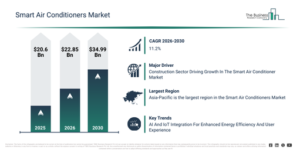
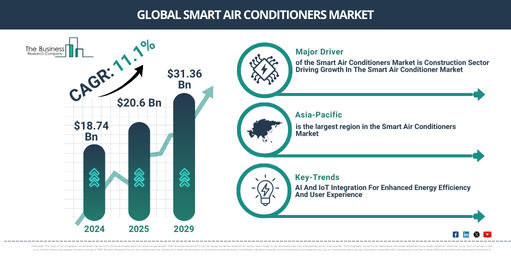
The smart air conditioners market size has seen rapid expansion in recent years. It is projected to grow from $20.6 billion in 2025 to $22.85 billion in 2026, exhibiting a compound annual growth rate (CAGR) of 10.9%. The market’s historic growth can be attributed to factors such as the increasing demand for residential cooling solutions, the early adoption of programmable AC technologies, a rising consumer preference for convenience-based appliances, the expansion of urban housing infrastructure, and advancements in inverter and compressor technologies.
The smart air conditioners market size is projected for swift expansion over the coming years. This market is anticipated to reach $34.99 billion by 2030, exhibiting a compound annual growth rate (CAGR) of 11.2%. Factors contributing to this growth during the forecast period include a heightened emphasis on energy-efficient smart appliances, the increasing integration of connected home ecosystems, the advancement of HVAC systems with predictive maintenance capabilities, the proliferation of smart building installations, and growing consumer desire for automated temperature management. Key trends anticipated for the forecast period encompass a wider uptake of app-controlled and interconnected air conditioning systems, an increase in the utilization of energy monitoring and automation functionalities, the surging appeal of smart home-integrated cooling options, an expansion of remote diagnostics and predictive maintenance practices, and a move towards adaptive cooling determined by user behavior and occupancy.
Download A Free Sample Report For Comprehensive Market Insights:
Smart Air Conditioners Market Development Factors: Which Trends Are Supporting Demand?
The expansion of the construction industry is anticipated to boost the smart air conditioner market’s growth in the future. This sector involves a range of activities, including the planning, design, construction, and upkeep of buildings, infrastructure, and various physical structures. Growth within the construction industry is being observed, driven by rising investments in infrastructure, ongoing urbanization, and a demand for sustainable building approaches. As the construction sector undertakes new developments, particularly in residential, commercial, and industrial areas, the need for HVAC (Heating, Ventilation, and Air Conditioning) systems, such as smart air conditioners, will rise to ensure comfortable interior conditions. Modern amenities and technologies, including smart home functionalities, are frequently integrated into new construction projects, which in turn fuels the uptake of smart air conditioners. For example, a report from the Office for National Statistics, a UK-based official statistics producer, indicated that in August 2023, the projected monthly construction output volume increased by 1.6% in June 2023. This rise was due to increases in new construction work (2.0%) and repair and maintenance activities (1.1%). When comparing quarterly data for April to June 2023 with January to March 2023, construction output registered a 0.3% increase. Significantly, this growth was solely a result of June 2023’s performance, specifically a 0.9% uptick in repair and maintenance activities. Consequently, the expanding construction sector is propelling the growth of the smart air conditioner market.
Smart Air Conditioners Market Segmentation And Category Breakdown
The smart air conditioners market covered in this report is segmented –
1) By Type: Split, Window, Portable, Other Types
2) By Connectivity: Wi-Fi, Bluetooth, Other Connectivities
3) By Application: Residential, Buildings, Industrial Buildings, Commercial Buildings
Subsegments:
1) By Split: Wall-Mounted Split Air Conditioners, Floor-Mounted Split Air Conditioners
2) By Window: Vertical Window Air Conditioners, Horizontal Window Air Conditioners
3) By Portable: Compact Portable Air Conditioners, Dual-Hose Portable Air Conditioners
4) By Other Types: Central Air Conditioning Systems, Smart Mini-Split Systems
Smart Air Conditioners Market Trends Reshaping Industry Growth
Leading businesses within the smart air conditioner sector are innovating advanced technologies that combine artificial intelligence (AI) with the Internet of Things (IoT) to improve energy efficiency and offer greater user convenience. Such technological progress facilitates functions like predictive maintenance, allowing systems to foresee potential malfunctions and fine-tune their operation, ultimately resulting in decreased energy use and reduced operational expenditures. An illustrative example occurred in April 2024 when Voltas, an India-based firm, introduced its latest HVAC product range at ACREX 2024, equipped with sophisticated AI functionalities that empower users to remotely observe and manage their systems via a dedicated mobile application. This introduction not only showcases Voltas’ dedication to sustainability and efficient energy use but also elevates the user experience by delivering immediate insights and analytical data concerning system performance and energy consumption.
Smart Air Conditioners Market Competitive Analysis Of Major Industry Participants
Major companies operating in the smart air conditioners market are Samsung Electronics Co. Ltd., Robert Bosch GmbH, Hitachi Ltd., LG Electronics Inc., Panasonic Corporation, Haier Group Corporation, Midea Group Co. Ltd., Mitsubishi Electric Corporation, Toshiba Corporation, Gree Electric Appliances Inc., Daikin Industries Ltd., Johnson Controls International plc, Fujitsu General Ltd., Carrier Global Corporation, Whirlpool Corporation, Trane Technologies Plc, Electrolux AB, AUX Group Co. Ltd., Godrej Industries Limited, Lennox International Inc., Hisense Kelon Electrical Holdings Company Limited, Havells India Limited, Rheem Manufacturing Company, Blue Star Limited, Voltas Limited, Chigo Holding Ltd., Friedrich Air Conditioning Co. Ltd., Chunlan Group, Videocon Industries Limited, Bryant Ltd
Access The Complete Smart Air Conditioners Market Report:
Smart Air Conditioners Market Geographic Landscape: Which Region Dominates Industry Growth?
Asia-Pacific was the largest region in the smart air conditioner market in 2025. North America is expected to be the fastest-growing region in the forecast period. The regions covered in the smart air conditioners market report are Asia-Pacific, South East Asia, Western Europe, Eastern Europe, North America, South America, Middle East, Africa.
Get in touch with us:
The Business Research Company: https://www.thebusinessresearchcompany.com/
Americas: +1 310-496-7795
Asia: +44 7882 955267 & +91 8897263534
Europe: +44 7882 955267
Email us at: marketing@tbrc.info
Follow us on:
LinkedIn: https://in.linkedin.com/company/the-business-research-company
YouTube: https://www.youtube.com/channel/UC24_fI0rV8cR5DxlCpgmyFQ
Global Market Model: https://www.thebusinessresearchcompany.com/global-market-model

Wasay has over a decade of experience in market research, data modelling, and analytics, with prior experience at GlobalData and Decision Tree Consulting Services. At The Business Research Company , he leads research operations across syndicated studies, customized consulting engagements, and the Global Market Model platform. His professional experience includes supporting organizations such as Boston Consulting Group, KPMG, and Ernst & Young. Wasay holds a degree in Electronics and Communications Engineering, postgraduate management qualifications from International Management Institute Belgium and Indian School of Business and Entrepreneurship, and completed the Integrated Program in Business Analytics from Indian Institute of Management Indore.