The Business Research Company’s 2026 market reports combine market attractiveness scoring, total addressable market sizing, company benchmarking matrices, interactive Excel dashboards, deeper supply chain intelligence, emerging startup tracking, and granular product-level insights to deliver research that is more actionable and strategically valuable.
What Is The Smart EV Charger Market Growth Rate? A 25% CAGR Outlook Through 2030
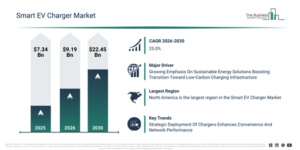
The smart EV charger market size has demonstrated substantial growth in recent years. This market is expected to expand from $7.34 billion in 2025 to $9.19 billion in 2026, exhibiting a compound annual growth rate (CAGR) of 25.2%. Historically, the market’s expansion was fueled by elements including the initial deployment of AC chargers with fundamental connectivity, an increase in commercial EV charging stations, the uptake of fast charging solutions in urban areas, the early integration of app-controlled functionalities, and the progress in low-power wireless charging prototype development.
The smart EV charger market is projected to experience substantial expansion in the coming years. It is set to reach $22.45 billion in 2030, exhibiting a compound annual growth rate (CAGR) of 25.0%. This anticipated growth during the forecast period stems from factors such as the increasing deployment of high-power DC chargers, escalating governmental incentives for intelligent EV infrastructure, greater integration with renewable energy sources, the extension of wireless and dynamic charging networks, and the rising uptake of connected fleet and shared mobility solutions. Significant developments expected in the forecast period encompass the integration of real-time energy monitoring and dynamic load balancing systems, the increasing use of mobile application-based remote control for EV charging, the deployment of mid- and high-power smart chargers in commercial settings, the broadening of wireless and inductive charging technologies, and the implementation of demand response and grid-supportive charging approaches.
Access A Free Sample Of The Latest Smart EV Charger Market Analysis:
Why Is The Smart EV Charger Market Growing? The Key Demand Driver Explained
The increasing focus on environmentally friendly energy methods is anticipated to boost the expansion of the smart EV charger market. Such solutions involve implementing clean, renewable, and low-emission energy systems, which helps lessen environmental harm and decreases reliance on fossil fuels over time. This heightened focus on sustainable energy stems from progressing worldwide decarbonization targets and governmental initiatives promoting renewable transitions, all aimed at reducing greenhouse gas emissions. Smart EV chargers facilitate this shift by enabling smart energy allocation, efficient charging processes, integration of renewable power sources, and effective management of grid load, thus aligning electric vehicle charging with broader sustainability objectives. For instance, in June 2024, according to the U.S. Energy Information Administration (EIA), a U.S.-based federal government statistical agency, renewable electricity constituted 22% of the total U.S. generation in 2023, an increase from 21% in 2022, indicating a steady rise in clean energy uptake. Consequently, the growing emphasis on sustainable energy solutions is a key driver for the growth of the smart EV charger market.
What Are The Main Segments Of The Smart EV Charger Market?
The smart ev charger market covered in this report is segmented –
1) By Type, Alternating Current Chargers, Direct Current Chargers, Wireless Chargers
2) By Connectivity, Wi-Fi Enabled, Bluetooth Enabled, Other Connectivity Features
3) By Charging Power, Low Power, Medium Power, High Power
4) By End-User, Commercial Charging Station, Passenger Charging Unit
Subsegments:
1) By Alternating Current Chargers: Slow Charging, Fast Charging, Rapid Charging
2) By Direct Current Chargers: Fast Charging, Ultra Fast Charging, High Power Charging
3) By Wireless Chargers: Inductive Charging, Resonant Charging, Dynamic Charging
Smart EV Charger Market Trend Analysis: Where Leading Companies Are Focusing
Leading companies in the smart EV charger market are concentrating on technological advancements, such as data-driven optimization, to boost charging efficiency, enhance user experience, forecast demand patterns, and ensure consistent network performance across various locations. Data-driven optimization in EV charging involves using real-time and historical data to predict energy demand, fine-tune charging schedules, and improve overall system performance. For instance, in August 2025, Ford Motor Company, a U.S.-based automaker, launched the Ford Charge DC Fast Charging Network, commencing with nearly 1,200 fast chargers installed across more than 320 Ford dealerships in the United States and Canada. Each charger is equipped with smart features like app-based activation, digital payment options, and real-time performance monitoring to improve operational efficiency and user convenience. This initiative not only expands Ford’s charging infrastructure but also showcases how data-driven technologies are being deployed to optimize charging operations, accelerate EV adoption, and support the increasing demand for sustainable mobility.
Which Companies Are Major Players In The Smart EV Charger Market?
Major companies operating in the smart ev charger market are Tesla, Inc., ABB Ltd., Siemens AG, Schneider Electric SE, Robert Bosch GmbH, Delta Electronics, Inc., Eaton Corporation plc, Huawei Technologies Co., Ltd., Wallbox N.V., EVBox Group N.V., ChargePoint Holdings, Inc., KEBA AG, Alfen N.V., myenergi Ltd., EO Charging Ltd., AddÉnergie Technologies, Blink Charging Co., Tritium DCFC Ltd., Heliox Energy, Webasto Group, Delta-Q Technologies Corp., BYD Company Ltd., WanBang Digital Energy, Sinexcel, Phihong Technology Co., Ltd.
Get The Complete Smart EV Charger Market Analysis Here:
Which Region Held The Largest Share Of The Smart EV Charger Market In 2025?
North America was the largest region in the smart EV charger market in 2025. Asia-Pacific is expected to be the fastest-growing region in the forecast period. The regions covered in the smart ev charger market report are Asia-Pacific, South East Asia, Western Europe, Eastern Europe, North America, South America, Middle East, Africa.
Reach Out To Our Team:
The Business Research Company: https://www.thebusinessresearchcompany.com/
Americas: +1 310-496-7795
Asia: +44 7882 955267 & +91 8897263534
Europe: +44 7882 955267
Email us at: marketing@tbrc.info
Follow us on:
LinkedIn: https://in.linkedin.com/company/the-business-research-company
YouTube: https://www.youtube.com/channel/UC24_fI0rV8cR5DxlCpgmyFQ
Global Market Model: https://www.thebusinessresearchcompany.com/global-market-model

Wasay has over a decade of experience in market research, data modelling, and analytics, with prior experience at GlobalData and Decision Tree Consulting Services. At The Business Research Company , he leads research operations across syndicated studies, customized consulting engagements, and the Global Market Model platform. His professional experience includes supporting organizations such as Boston Consulting Group, KPMG, and Ernst & Young. Wasay holds a degree in Electronics and Communications Engineering, postgraduate management qualifications from International Management Institute Belgium and Indian School of Business and Entrepreneurship, and completed the Integrated Program in Business Analytics from Indian Institute of Management Indore.