
Built to provide research that’s more actionable and strategically valuable, The Business Research Company’s 2026 market reports include market attractiveness analysis, total addressable market sizing, company benchmarking matrices, interactive Excel dashboards, broader supply chain intelligence, emerging startup tracking, and in-depth product insights.
Smart Glass And Smart Window Market Size And Revenue Outlook Through 2030
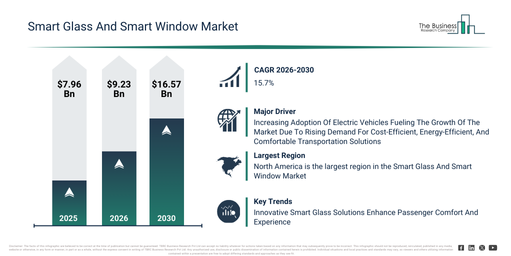
The smart glass and smart window market has witnessed significant expansion in recent years. Its valuation is predicted to climb from $7.96 billion in 2025 to $9.23 billion in 2026, exhibiting a compound annual growth rate (CAGR) of 16.0%. This historical increase can be ascribed to several factors, including the rising acceptance of electrochromic glass in commercial constructions, the proliferation of automotive sunroofs equipped with smart tinting, the emergence of photochromic eyewear innovations, experimental ventures in marine and aerospace smart glazing, and the progress in polymer dispersed liquid crystal (PDLC) panels.
The smart glass and smart window market is projected to experience swift expansion over the coming years. This market is forecast to reach $16.57 billion by 2030, demonstrating a compound annual growth rate (CAGR) of 15.7%. Key drivers for this growth during the forecast period include increasing demand for energy-efficient smart buildings, the integration with IoT-enabled home and office automation systems, wider adoption in electric and autonomous vehicles, significant advancements in MEMS and nanostructured smart coatings, and a growing regulatory emphasis on green building certifications. Noteworthy trends anticipated in the same period encompass the integration of smart glass with building automation systems, the ongoing development of energy-efficient electrochromic and thermochromic glazing, a surge in the adoption of smart windows within the automotive and aerospace industries, the emergence of enhanced user-controlled and sensor-driven tinting technologies, and the growing deployment of solutions aimed at enhancing privacy and reducing glare.
Get A Free Sample Report With In-Depth Market Insights:
Smart Glass And Smart Window Market Opportunity Drivers: What’s Unlocking New Revenue Potential?
The expanding prevalence of electric vehicles is projected to boost the future expansion of the smart glass and smart window market. Electric vehicles (EVs) are motor cars that run on electric motors, utilizing power from rechargeable batteries, thereby providing transportation that is cleaner, quieter, and more efficient than traditional fuel-powered automobiles. The growing consumer interest in electric vehicles stems from rising fuel expenses, with EVs presenting a more economical choice compared to conventional gasoline-fueled cars. Within electric vehicle interiors, smart glass and smart windows improve the cabin experience by providing flexible light and privacy management, enhancing occupant comfort, and mitigating glare. They also contribute to energy conservation through their ability to regulate heat and light transfer, aligning with sustainable and contemporary vehicle aesthetics. As an illustration, in May 2025, the International Energy Agency, a France-based intergovernmental organization, reported that electric car sales surpassed 17 million units in 2024, marking a growth of over 25% and an increment of approximately 3.5 million vehicles when contrasted with 2023. Consequently, the increasing adoption of electric vehicles is fueling the growth of the smart glass and smart window market.
Smart Glass And Smart Window Market Segmentation And Category Overview
The smart glass and smart window market covered in this report is segmented –
1) By Technology: Electrochromic, Photochromic, Thermochromic, Suspended Particle Devices, Polymer Dispersed Liquid Crystal, Other Technologies
2) By Functionality: Active, Passive
3) By Application: Architectural, Automotive, Aerospace, Marine, Other Applications
4) By End-User: Residential, Commercial, Industrial, Transportation, Other End-Users
Subsegments:
1) Electrochromic: Inorganic Electrochromic Glass, Organic Electrochromic Glass, Hybrid Electrochromic Glass, Nanocrystal-Based Electrochromic Glass
2) Photochromic: Silver Halide-Based Photochromic Glass, Organic Photochromic Glass, Inorganic Oxide-Based Photochromic Glass
3) Thermochromic: Vanadium Dioxide (VO2)-Based Thermochromic Glass, Tungsten Oxide-Based Thermochromic Glass, Polymer-Based Thermochromic Glass, Hybrid Thermochromic Materials
4) Suspended Particle Devices (SPD): Light-Blocking SPD Glass, Sunlight-Control SPD Glass, Automotive SPD Panels, Architectural SPD Windows
5) Polymer Dispersed Liquid Crystal (PDLC): Droplet-Type PDLC, Polymer Network Liquid Crystal (PNLC), Polymer Stabilized Liquid Crystal (PSLC), Reverse Mode PDLC
6) Other Technologies: Micro-Blinds Technology, Liquid Crystal On Silicon (LCoS), Micro-Electro-Mechanical Systems (MEMS)-Based Smart Glass, Nanostructured Smart Coatings
Smart Glass And Smart Window Market Innovation Trends Shaping Future Development
Major companies operating in the smart glass and smart window market are concentrating on developing advanced solutions, such as dual smart glass technology solutions, to improve energy efficiency, comfort, and privacy, thereby supporting sustainable and modern vehicle designs. Dual smart glass technology solutions are defined as glazing systems that incorporate two smart glass functionalities, for instance, tint control and privacy switching, to optimize light, heat, and privacy management within buildings or vehicles. As an illustration, in April 2025, Gauzy Ltd., an Israel-based smart glass technology company, launched dual smart glass technology, which combines suspended particle device (SPD) and polymer-dispersed liquid crystal (PDL) and has been integrated into approximately 75% of the Mercedes-Benz Vision V show car’s glazing. This marks Mercedes-Benz’s first use of Gauzy’s dual smart glass stack, enabling dynamic control of transparency, shading, and privacy while also enhancing comfort and energy efficiency. The technology further supports immersive passenger experiences through projection-capable surfaces and adaptive partitions.
Smart Glass And Smart Window Market Competitive Analysis Of Leading Industry Participants
Major companies operating in the smart glass and smart window market are Saint-Gobain S.A., Merck kgA, PPG Industries Inc., Asahi Glass Co. (AGC), Corning Incorporated, Pro Display, Skyline Design, View Inc., Halio Inc., Gauzy Ltd., Inno Glass Technology (Qingdao) Co. Ltd., Kinestral Technologies Inc., Jiangsu All Brilliant Technology, Miru Smart Technologies, Smartglass International Ltd., DMDisplay Co. Ltd., LTI Smart Glass, Chiefway Optoelectronics, Chromogenics AB, Citala, Innovative Glass Corporation, Ravenbrick LLC, Scienstry Inc., uniteglass, Research Frontiers Inc.
View The Full Smart Glass And Smart Window Market Report:
Smart Glass And Smart Window Market Geographic Landscape: Which Region Leads Industry Growth?
North America was the largest region in the smart glass and smart window market in 2025. Asia-Pacific is expected to be the fastest-growing region in the forecast period. The regions covered in the smart glass and smart window market report are Asia-Pacific, South East Asia, Western Europe, Eastern Europe, North America, South America, Middle East, Africa.
Reach Out To Our Team:
The Business Research Company: https://www.thebusinessresearchcompany.com/
Americas: +1 310-496-7795
Asia: +44 7882 955267 & +91 8897263534
Europe: +44 7882 955267
Email us at: marketing@tbrc.info
Follow us on:
LinkedIn: https://in.linkedin.com/company/the-business-research-company
YouTube: https://www.youtube.com/channel/UC24_fI0rV8cR5DxlCpgmyFQ
Global Market Model: https://www.thebusinessresearchcompany.com/global-market-model

Wasay has over a decade of experience in market research, data modelling, and analytics, with prior experience at GlobalData and Decision Tree Consulting Services. At The Business Research Company , he leads research operations across syndicated studies, customized consulting engagements, and the Global Market Model platform. His professional experience includes supporting organizations such as Boston Consulting Group, KPMG, and Ernst & Young. Wasay holds a degree in Electronics and Communications Engineering, postgraduate management qualifications from International Management Institute Belgium and Indian School of Business and Entrepreneurship, and completed the Integrated Program in Business Analytics from Indian Institute of Management Indore.