
Through market attractiveness analysis, total addressable market evaluation, company benchmarking matrices, interactive Excel dashboards, expanded supply chain intelligence, emerging startup coverage, and detailed product insights, The Business Research Company’s 2026 market reports provide more actionable and strategically valuable research.
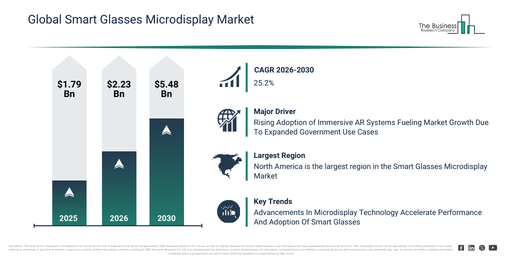
Smart Glasses Microdisplay Market Growth From $2.23 Billion In 2026 To $5.48 Billion By 2030 At A CAGR Of 25.2%
The smart glasses microdisplay market size has seen significant expansion in recent years. It is anticipated to grow from $1.79 billion in 2025 to $2.23 billion in 2026, reflecting a compound annual growth rate (CAGR) of 24.9%. This historical growth can be attributed to factors such as an increase in AR wearable devices, the initial launches of smart glasses, the miniaturization of display components, demand for defense head mounted displays, and enterprise wearable pilots.
The smart glasses microdisplay market is projected to experience substantial growth over the upcoming years. This market is anticipated to reach $5.48 billion by 2030, demonstrating a compound annual growth rate (CAGR) of 25.2%. Factors contributing to this expansion during the forecast period include the increasing adoption of consumer AR glasses, the use of enterprise field service wearables, the commercialization of microLED technology, the rising demand for immersive interfaces, and advancements in lightweight optics. Key trends identified for the forecast period encompass ultra high brightness microdisplays, display engines with low power consumption, waveguide-optimized microdisplay modules, smart glass displays leveraging microLED technology, and the integration of compact optical engines.
Download A Free Sample Report For Comprehensive Market Insights:
#Smart Glasses Microdisplay Market Growth Factors: Which Forces Are Supporting Market Expansion?
The increasing integration of immersive AR systems is anticipated to fuel the expansion of the smart glasses microdisplay market in the future. These immersive AR technologies involve lightweight, head-mounted devices that superimpose digital content onto the physical world, allowing for hands-free viewing and interaction across diverse training and operational scenarios. The uptake of immersive AR systems is growing, driven by broadening applications in public sector training and operational processes, which align with wider demands from the metaverse and wearable technology ecosystems. Smart-glasses microdisplays provide crisp digital visuals directly in the user’s field of vision, integrating virtual information smoothly into the actual surroundings. Their excellent brightness and minimal latency ensure precise object alignment, thereby boosting the realism and immersive quality of AR experiences. As an example, in August 2024, the United States Government Accountability Office (GAO), a US-based federal agency, stated that 17 of 23 U.S. federal civilian agencies engaged in activities utilizing immersive technologies (such as AR and VR) during fiscal years 2022–2023, with 16 agencies planning further expansion of their usage through 2028. This illustrates an increasing governmental dependence on wearable AR systems for practical applications. Consequently, the expanding use of immersive AR technologies is fueling the advancement of the smart glasses microdisplay market.
Smart Glasses Microdisplay Market Segment Analysis: What Are The Major Market Categories?
The smart glasses microdisplay market covered in this report is segmented –
1) By Display Technology: Organic Light-Emitting Diode (OLED); Liquid Crystal Display (LCD); Liquid Crystal On Silicon (LCoS); Digital Light Processing (DLP); Micro Light-Emitting Diode (MicroLED); Other Display Technologies
2) By Application: Consumer Electronics; Healthcare; Industrial; Military And Defense; Sports And Fitness; Other Applications
3) By Distribution Channel: Online; Offline
4) By End-User: Enterprises; Individuals; Other End-Users
Subsegments:
1) By Organic Light-Emitting Diode (OLED): Active Matrix; Passive Matrix
2) By Liquid Crystal Display (LCD): Twisted Nematic; In-Plane Switching; Advanced Fringe Field Switching
3) By Liquid Crystal On Silicon (LCoS): Ferroelectric; Nematic
4) By Digital Light Processing (DLP): Single Panel; Three Panel
5) By Micro Light-Emitting Diode (MicroLED): Direct View; Quantum Dot Enhanced
6) By Other Display Technologies: Laser Beam Scanning; Virtual Retinal Display; Electrowetting Display
Smart Glasses Microdisplay Market Industry Trends: What Changes Are Reshaping Demand?
Leading companies in the smart glasses microdisplay market are prioritizing the development of advanced display solutions, including ultra-low-power single-chip full-color microdisplay panels, with the aim of enhancing visual performance, decreasing power consumption, and reducing manufacturing complexity and costs. Ultra-low-power single-chip microdisplay panels refer to integrated display technologies that consolidate the display array, driver circuitry, and memory onto a single compact chip. This design enables higher resolution and wider fields of view while simultaneously minimizing energy usage and simplifying system integration for smart glasses manufacturers. For instance, in December 2025, OmniVision, a US-based semiconductor and imaging technology company, unveiled the OP03021 liquid crystal on silicon (LCOS) microdisplay panel, an industry-leading single-chip solution. This panel offers a resolution of 1632 × 1536 at a 90 Hz refresh rate within a compact 0.26-inch optical format, integrates the display array, driver, and memory on a single die, and supports advanced smart glasses designs by improving image quality and field of view while lowering power consumption and overall component costs.
Smart Glasses Microdisplay Market Leading Companies Driving Competitive Growth
Major companies operating in the smart glasses microdisplay market are Hon HAI Precision Industry Co. Ltd., Sony Group Corporation, LG Corporation, BOE Technology Group Co. Ltd., Texas Instruments Incorporated, Goertek Inc., Seiko Epson Corporation, Innolux Corporation, Samsung Display Co. Ltd., MicroOLED S.A., OMNIVISION Technologies Inc., Magic Leap Inc., Himax Technologies Inc., Jade Bird Display, SeeYA Technology Co. Ltd., Kopin Corporation, FRAMOS GmbH, MICLEDI Microdisplays B.V., RAONTECH Inc., MicroVision Inc., and Vuzix Corporation.
Access The Complete Smart Glasses Microdisplay Market Report:
Smart Glasses Microdisplay Market Global Footprint: Which Region Holds Market Leadership?
North America was the largest region in the smart glasses microdisplay market in 2025. Asia-Pacific is expected to be the fastest-growing region in the forecast period. The regions covered in the smart glasses microdisplay market report are Asia-Pacific, South East Asia, Western Europe, Eastern Europe, North America, South America, Middle East, Africa.
Get in touch with us:
The Business Research Company: https://www.thebusinessresearchcompany.com/
Americas: +1 310-496-7795
Asia: +44 7882 955267 & +91 8897263534
Europe: +44 7882 955267
Email us at: marketing@tbrc.info
Follow us on:
LinkedIn: https://in.linkedin.com/company/the-business-research-company
YouTube: https://www.youtube.com/channel/UC24_fI0rV8cR5DxlCpgmyFQ
Global Market Model: https://www.thebusinessresearchcompany.com/global-market-model

Wasay has over a decade of experience in market research, data modelling, and analytics, with prior experience at GlobalData and Decision Tree Consulting Services. At The Business Research Company , he leads research operations across syndicated studies, customized consulting engagements, and the Global Market Model platform. His professional experience includes supporting organizations such as Boston Consulting Group, KPMG, and Ernst & Young. Wasay holds a degree in Electronics and Communications Engineering, postgraduate management qualifications from International Management Institute Belgium and Indian School of Business and Entrepreneurship, and completed the Integrated Program in Business Analytics from Indian Institute of Management Indore.