Delivering more actionable and strategically valuable research, The Business Research Company’s 2026 market reports feature market attractiveness analysis, total addressable market evaluation, company benchmarking matrices, interactive Excel dashboards, expanded supply chain intelligence, emerging startup coverage, and detailed product insights.
Smart TV Market Size Forecast: How Large Could The Market Become By 2030?
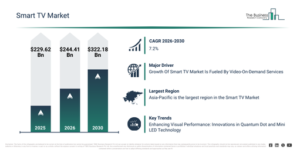
The smart tv market size has shown strong growth in recent years. It is forecast to expand from $229.62 billion in 2025 to $244.41 billion in 2026, with a compound annual growth rate (CAGR) of 6.4%. The expansion observed in the historical period can be attributed to the increasing adoption of digital entertainment, a rise in broadband penetration, the competitive pricing of smart tvs, the growth of streaming services, and advancements in display technology.
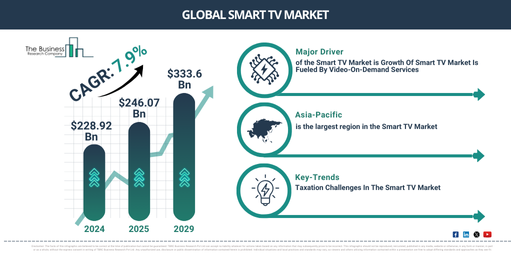
The smart tv market size is expected to show significant expansion in the next few years. It is projected to reach $322.18 billion in 2030, with a compound annual growth rate (CAGR) of 7.2%. This growth during the forecast period can be attributed to the integration of AI and IoT devices, the spread of cloud-based streaming, a rising consumer demand for immersive content, advancements in 8K and OLED technologies, and the broader expansion of the smart home ecosystem. Key trends anticipated in the forecast period include AI-powered content recommendations, voice-activated TV controls, diverse cloud-based streaming platforms, interactive AR/VR television experiences, and comprehensive smart home integration.
Download A Free Sample Report For Comprehensive Market Insights:
#Smart TV Market Growth Factors: Which Forces Are Supporting Market Expansion?
The smart TV market is projected to expand due to the increasing popularity of video-on-demand (VoD) services. VoD, an innovative feature of Internet Protocol TV (IPTV), allows consumers to select and watch a wide array of videos, with content delivered via the Real-Time Streaming Protocol. In recent years, VoD services have gained significant momentum, leading to higher adoption rates for smart TVs. For instance, according to Netflix Inc., a US-based media services provider, total paid memberships reached 80.13 million in December 2023, an increase from 74.30 million at the end of December 2022. Therefore, the growing trend of video-on-demand services is a key driver for the smart TV market’s growth.
Smart TV Market Segmentation: How Is The Market Structured Across Key Categories?
The smart tv market covered in this report is segmented –
1) By Product Type: 4K UHD TV, Full HD TV, HDTV, 8K TV
2) By Panel Type: LCD, LED, OLED, QLED
3) By End User: Home, Offices, Education Institutions, Other End-Users
Subsegments:
1) By 4K UHD TV: LED 4K UHD TV, OLED 4K UHD TV, QLED 4K UHD TV
2) By Full HD TV: LED Full HD TV, LCD Full HD TV, OLED Full HD TV
3) By HDTV: LED HDTV, LCD HDTV, Plasma HDTV
4) By 8K TV: LED 8K TV, OLED 8K TV, QLED 8K TV
Smart TV Market Trends: What Is Shaping Future Industry Growth?
Major companies operating within the smart TV market are increasingly concentrating on the development of sophisticated display technologies to elevate viewer experiences and broaden entertainment options. Advanced display technology encompasses innovative systems designed to boost visual performance through enhanced color accuracy, luminosity, and contrast, frequently utilizing techniques such as quantum dots, mini LEDs, and OLEDs to provide superior image quality and immersive viewing experiences. For instance, in May 2024, TCL Technology, a China-based consumer electronics firm, unveiled its QD-Mini LED TVs. These QD-Mini LED TVs signify a cutting-edge advancement in smart TV technology, integrating Quantum Dot and Mini LED innovations to deliver exceptional picture quality with vibrant colors and remarkable brightness. They incorporate thousands of local dimming zones, facilitating precise control over contrast and deeper blacks, which significantly enhances the overall viewing experience. Additionally, these TVs are equipped with advanced processing capabilities, making them ideal for gaming and cinematic enjoyment while supporting features like Dolby Atmos for immersive audio.
Smart TV Market Competitive Landscape And Leading Companies
Major companies operating in the smart tv market are Sony Corporation, LG Corporation, TCL Corporation, Koninklijke Philips NV, Haier Electronics Group Co. Ltd., Panasonic Corporation, Samsung Electronics Co. Ltd., Toshiba Corporation, Intex Technologies Ltd., Vizio Inc., Sharp Corporation, Sichuan Changhong Electric Co. Ltd, FunAI Electric Co. Ltd., JVC Kenwood Holdings Inc., Loewe Technology GmbH, Mitsubishi Electric Corporation, Onida Electronics, Sanyo Electric Co. Ltd., Seiki Digital, Skyworth Group Ltd., Vestel Elektronik Sanayi ve Ticaret AS, Xiaomi Inc., Grundig Intermedia GmbH, Hisense Kelon Electrical Holdings Co. Ltd.
Access The Complete Smart TV Market Report:
Smart TV Market Leading Geography: Which Region Generates The Most Revenue?
Asia-Pacific was the largest region in the smart TV market in 2025. North America was the second-largest region in the smart TV market. The regions covered in the smart tv market report are Asia-Pacific, South East Asia, Western Europe, Eastern Europe, North America, South America, Middle East, Africa.
Get in touch with us:
The Business Research Company: https://www.thebusinessresearchcompany.com/
Americas: +1 310-496-7795
Asia: +44 7882 955267 & +91 8897263534
Europe: +44 7882 955267
Email us at: marketing@tbrc.info
Follow us on:
LinkedIn: https://in.linkedin.com/company/the-business-research-company
YouTube: https://www.youtube.com/channel/UC24_fI0rV8cR5DxlCpgmyFQ
Global Market Model: https://www.thebusinessresearchcompany.com/global-market-model

Wasay has over a decade of experience in market research, data modelling, and analytics, with prior experience at GlobalData and Decision Tree Consulting Services. At The Business Research Company , he leads research operations across syndicated studies, customized consulting engagements, and the Global Market Model platform. His professional experience includes supporting organizations such as Boston Consulting Group, KPMG, and Ernst & Young. Wasay holds a degree in Electronics and Communications Engineering, postgraduate management qualifications from International Management Institute Belgium and Indian School of Business and Entrepreneurship, and completed the Integrated Program in Business Analytics from Indian Institute of Management Indore.