Built to provide research that’s more actionable and strategically valuable, The Business Research Company’s 2026 market reports include market attractiveness analysis, total addressable market sizing, company benchmarking matrices, interactive Excel dashboards, broader supply chain intelligence, emerging startup tracking, and in-depth product insights.
Smart Ultraviolet (UV) Index Sensor Market Size, Value And Growth Trajectory Through 2030
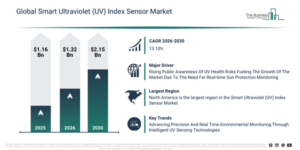
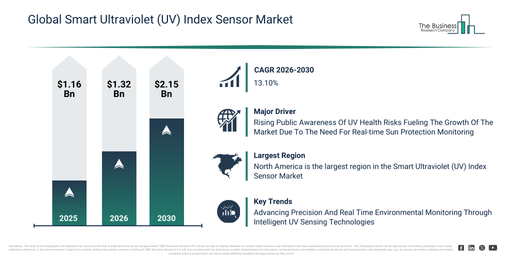
The smart ultraviolet index sensor market has undergone substantial expansion recently. Its size is expected to climb from $1.16 billion in 2025 to $1.32 billion in 2026, demonstrating a compound annual growth rate (CAGR) of 13.4%. The historical increase in this market can be attributed to factors such as a heightened understanding of UV exposure hazards, the early adoption of wearable health devices, an increase in environmental monitoring programs, the initial inclusion of UV sensors in consumer electronics, and a rise in outdoor recreational activities.
The smart ultraviolet index sensor market is poised for significant expansion over the coming years. It is projected to reach $2.15 billion by 2030, demonstrating a compound annual growth rate (CAGR) of 13.1%. This anticipated growth is driven by several factors, including the rising need for cloud-based UV analytics, the development of smart city environmental networks, greater application of UV monitoring in dermatology and skincare, the integration of sensors in agriculture for crop enhancement, and the spread of wireless IoT connectivity. Key developments during this period will involve the incorporation of UV sensors into multi-sensor systems, the reduction in size of low-power UV components, the proliferation of mobile UV tracking applications, the introduction of solar-powered UV monitoring solutions, and broader deployment in industrial outdoor safety systems.
Get A Free Sample Report With In-Depth Market Insights:
Smart Ultraviolet (UV) Index Sensor Market Opportunity Drivers: What’s Unlocking New Revenue Potential?
Increased public understanding of the dangers posed by ultraviolet (UV) radiation is anticipated to drive expansion in the smart ultraviolet (UV) index sensor market in the future. These UV health risks encompass the potential negative consequences of excessive sun exposure, such as sunburn, accelerated skin aging, and a heightened chance of developing skin cancer. This heightened public awareness stems from growing educational campaigns and health initiatives, which prompt individuals to take preventative steps for sun protection during times of high radiation. Smart ultraviolet (UV) index sensors contribute to this public awareness by continuously monitoring environmental data and notifying users of hazardous radiation levels, because they can offer tailored, location-specific safety advice through connected devices. For example, data from September 2024, provided by the Australian Bureau of Statistics, a national statistical agency based in Australia, indicated that almost two in five individuals aged 15 years and over applied sunscreen on most days from November 2023 to February 2024, with usage at 38.1%. Furthermore, females exhibited considerably greater regular use compared to males, at 48.8% versus 27.0%. The largest difference was observed among women aged 35 to 44, reaching 60.0% in contrast to 31.8% for males in the identical age group. Consequently, the increased public understanding of UV health risks is fueling the expansion of the smart ultraviolet (UV) index sensor market.
Smart Ultraviolet (UV) Index Sensor Market Breakdown By Product Type And Application
The smart ultraviolet (uv) index sensor market covered in this report is segmented –
1) By Product Type: Wearable Ultraviolet Index Sensors, Portable Ultraviolet Index Sensors, Fixed Ultraviolet Index Sensors
2) By Connectivity: Wired, Wireless
3) By Distribution Channel: Online, Offline
4) By Application: Consumer Electronics, Healthcare, Environmental Monitoring, Industrial, Other Applications
5) By End-User: Individuals, Commercial, Industrial, Research Institutes
Subsegments:
1) By Wearable Ultraviolet Index Sensors: Wristbands, Smart Watches, Clip-On Devices
2) By Portable Ultraviolet Index Sensors: Handheld Devices, Pocket Sensors, Travel Monitors
3) By Fixed Ultraviolet Index Sensors: Wall-Mounted Sensors, Stationary Outdoor Sensors, Roof-Mounted Sensors
Smart Ultraviolet (UV) Index Sensor Market Innovation Trends Shaping Future Development
Leading companies in the smart ultraviolet (UV) index sensor market are concentrating on advanced technologies, such as iEdge 4.0 technology, to facilitate highly precise UV radiation measurement, real time data processing, and seamless integration across diverse monitoring environments. iEdge 4.0 technology signifies a sophisticated sensing and data integration framework designed to enhance measurement accuracy, reliability, and responsiveness for environmental and health-related applications. For instance, in September 2024, Polysense Technologies Inc., a US-based environmental sensing solutions company, unveiled its iEdge 4.0 enabled full covered UV sensor portfolio, which includes UVA, UVB, UVC, and broad spectrum UVABC sensors. These sensors are engineered to provide high accuracy, real time ultraviolet radiation monitoring for both indoor and outdoor environments, supporting applications in healthcare, agriculture, manufacturing, and environmental science. The indoor variants offer an expansive detection range suitable for UV disinfection, curing processes, and laboratory research, while the outdoor models are built for harsh conditions and feature multiple output options for straightforward system integration.
Smart Ultraviolet (UV) Index Sensor Market Leading Companies And Competitive Benchmarking
Major companies operating in the smart ultraviolet (uv) index sensor market are Panasonic Corporation, Broadcom Inc., Honeywell International Inc., Texas Instruments Incorporated, STMicroelectronics N.V., TE Connectivity Ltd., Murata Manufacturing Co. Ltd., Analog Devices Inc., AMS OSRAM, Vishay Intertechnology Inc., ROHM Co. Ltd., Hamamatsu Photonics K.K., Silicon Laboratories Inc., Sensirion AG, Bosch Sensortec GmbH, Seeed Studio Inc., SparkFun Electronics, Adafruit Industries LLC, Libelium Comunicaciones S.L., Solar Light Company LLC
View The Full Smart Ultraviolet (UV) Index Sensor Market Report:
Smart Ultraviolet (UV) Index Sensor Market Largest Region By Revenue And Market Share
North America was the largest region in the smart ultraviolet index sensor market in 2025. Asia-Pacific is expected to be the fastest-growing region in the forecast period. The regions covered in the smart ultraviolet (uv) index sensor market report are Asia-Pacific, South East Asia, Western Europe, Eastern Europe, North America, South America, Middle East, Africa.
Reach Out To Our Team:
The Business Research Company: https://www.thebusinessresearchcompany.com/
Americas: +1 310-496-7795
Asia: +44 7882 955267 & +91 8897263534
Europe: +44 7882 955267
Email us at: marketing@tbrc.info
Follow us on:
LinkedIn: https://in.linkedin.com/company/the-business-research-company
YouTube: https://www.youtube.com/channel/UC24_fI0rV8cR5DxlCpgmyFQ
Global Market Model: https://www.thebusinessresearchcompany.com/global-market-model

Wasay has over a decade of experience in market research, data modelling, and analytics, with prior experience at GlobalData and Decision Tree Consulting Services. At The Business Research Company , he leads research operations across syndicated studies, customized consulting engagements, and the Global Market Model platform. His professional experience includes supporting organizations such as Boston Consulting Group, KPMG, and Ernst & Young. Wasay holds a degree in Electronics and Communications Engineering, postgraduate management qualifications from International Management Institute Belgium and Indian School of Business and Entrepreneurship, and completed the Integrated Program in Business Analytics from Indian Institute of Management Indore.