With a focus on actionable insights and strategic value, The Business Research Company’s 2026 market reports include market attractiveness scoring, total addressable market sizing, company benchmarking matrices, interactive Excel dashboards, deeper supply chain intelligence, emerging startup tracking, and granular product-level insights.
Stationary Energy Storage Market Size Analysis: Historical Growth And Future Revenue Projections
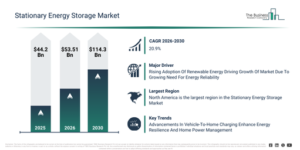
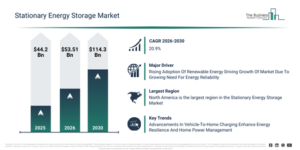
The stationary energy storage market has recently shown significant expansion. This market is expected to increase from $44.2 billion in 2025 to $53.51 billion in 2026, demonstrating a compound annual growth rate (CAGR) of 21.1%. Factors contributing to its past growth include the growing number of renewable energy installations, the need for grid stabilization, the embrace of lithium-ion batteries, advantageous energy policy incentives, and rising industrial electricity consumption.
The stationary energy storage market is projected to experience substantial growth in the next few years. It is expected to reach $114.3 billion in 2030, exhibiting a compound annual growth rate (CAGR) of 20.9%. This expansion during the forecast period can be attributed to developments in flow and solid-state batteries, the integration with smart grids, the broadening of electric mobility infrastructure, increasing adoption of residential energy storage, and government subsidies for clean energy storage. Key trends anticipated in the forecast period include AI-enabled energy management, the development of sustainable energy storage solutions, continued smart grid integration, enhanced industrial automation for storage systems, and storage deployment driven by electrification efforts.
Preview The Stationary Energy Storage Market Report With A Free Sample:
Stationary Energy Storage Market Drivers: What Is Fueling Demand Through 2030?
The rising integration of renewable energy sources is anticipated to fuel the future expansion of the stationary energy storage market. These sources, including solar, wind, hydro, geothermal, and biomass, are naturally regenerative resources employed for environmentally sound electricity generation. The greater embrace of renewable energy is driven by environmental concerns, as it reduces carbon emissions and helps mitigate climate change. Stationary energy storage is utilized by renewable energy systems to hold surplus power produced during high generation times, to be released when generation is low or demand is high. For instance, the US-based government agency, Energy Information Administration, reported in January 2024 that US solar power generation is projected to climb by 75%, from 163 billion kilowatt-hours (kWh) in 2023 to 286 billion kWh in 2025. Concurrently, wind power generation is forecasted to expand by 11%, increasing from 430 billion kWh in 2023 to 476 billion kWh in 2025. Consequently, the expanding utilization of renewable energy sources is a key factor propelling the expansion of the stationary energy storage market.
Stationary Energy Storage Market Segmentation Analysis: Core Categories And Subcategories
The stationary energy storage market covered in this report is segmented –
1) By Type Of Energy Storage: Hydrogen And Ammonia Storage, Gravitational Energy Storage, Compressed Air Energy Storage, Liquid Air Storage, Thermal Energy Storage
2) By Battery: Lithium Ion, Sodium Sulphur, Lead Acid, Flow Battery
3) By Application: Grid Services, Behind The Meter
4) By End-User: Residential, Commercial And Industrial, Other End Users
Subsegments:
1) By Hydrogen And Ammonia Storage: Liquid Hydrogen Storage, Gaseous Hydrogen Storage, Liquid Ammonia Storage, Solid-state Hydrogen Storage
2) By Gravitational Energy Storage: Pumped Hydroelectric Storage, Solid Block-Based Gravitational Systems, Tower-Based Gravitational Systems
3) By Compressed Air Energy Storage (CAES): Diabatic Compressed Air Storage, Adiabatic Compressed Air Storage, Isothermal Compressed Air Storage
4) By Liquid Air Storage: Liquid Air Tanks, Heat Exchanger Systems, Cryogenic Compressors
5) By Thermal Energy Storage: Sensible Heat Storage, Latent Heat Storage, Thermochemical Energy Storage
Which Trends Will Define The Stationary Energy Storage Market Through 2030?
Leading firms within the stationary energy storage market are prioritizing technological innovations, including integrated vehicle-to-home (V2H) charging, to improve energy stability, optimize power consumption, and empower consumers with enhanced command over their household energy systems. Vehicle-to-home (V2H) charging, specifically, is a system allowing electric vehicles to deliver power to residences, thus providing energy backup during blackouts and optimizing electricity consumption. As an example, in October 2024, GM Energy LLC, an industrial machinery manufacturing company based in the US, introduced the power bank. This stationary energy storage unit is engineered to store and move energy from the grid for electric vehicle customers. Offered in capacities of 10.6 kWh and 17.7 kWh, it offers emergency power during grid failures and helps decrease electricity expenses. Users have the option to combine two power banks, achieving up to 35.4 kWh of storage, which is sufficient to supply power to an average U.S. home for 20 hours. This system forms part of the GM energy home system bundle, featuring integration with GM vehicle applications for managing energy remotely and facilitating vehicle-to-home (V2H) charging.
Stationary Energy Storage Market Major Companies And Industry Participants
Major companies operating in the stationary energy storage market are Engie S.A., Tesla Inc., Siemens AG, General Electric Company, BYD Company Limited, Panasonic Holdings Corporation, Contemporary Amperex Technology Co. Limited (CATL), LG Chem Ltd., Mitsubishi Heavy Industries Ltd., ABB Ltd., Eaton Corporation plc, Johnson Controls International plc, Samsung SDI Co. Ltd., The AES Corporation, Fluence Energy Inc., Saft Groupe S.A., Duracell Power Center, Enel X S.r.l., Sonnen Batterie GmbH, 24M Technologies Inc.
Buy The Full Stationary Energy Storage Global Market Report 2026:
Stationary Energy Storage Market Geographic Analysis: Which Region Accounts For The Biggest Share?
North America was the largest region in the stationary energy storage market in 2025. Asia-Pacific is expected to be the fastest-growing region in the forecast period. The regions covered in the stationary energy storage market report are Asia-Pacific, South East Asia, Western Europe, Eastern Europe, North America, South America, Middle East, Africa.
Reach Out To Our Team:
The Business Research Company: https://www.thebusinessresearchcompany.com/
Americas: +1 310-496-7795
Asia: +44 7882 955267 & +91 8897263534
Europe: +44 7882 955267
Email us at: marketing@tbrc.info
Follow us on:
LinkedIn: https://in.linkedin.com/company/the-business-research-company
YouTube: https://www.youtube.com/channel/UC24_fI0rV8cR5DxlCpgmyFQ
Global Market Model: https://www.thebusinessresearchcompany.com/global-market-model

Wasay has over a decade of experience in market research, data modelling, and analytics, with prior experience at GlobalData and Decision Tree Consulting Services. At The Business Research Company , he leads research operations across syndicated studies, customized consulting engagements, and the Global Market Model platform. His professional experience includes supporting organizations such as Boston Consulting Group, KPMG, and Ernst & Young. Wasay holds a degree in Electronics and Communications Engineering, postgraduate management qualifications from International Management Institute Belgium and Indian School of Business and Entrepreneurship, and completed the Integrated Program in Business Analytics from Indian Institute of Management Indore.