Built to provide research that’s more actionable and strategically valuable, The Business Research Company’s 2026 market reports include market attractiveness analysis, total addressable market sizing, company benchmarking matrices, interactive Excel dashboards, broader supply chain intelligence, emerging startup tracking, and in-depth product insights.
Stationary Fuel Cell Market Size Outlook: How Quickly Will Revenue Expand Through 2030?
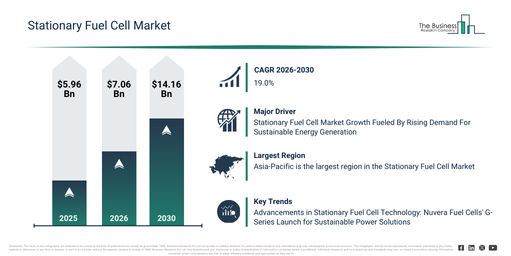
The stationary fuel cell market size has experienced swift expansion recently. It is forecast to increase from $5.96 billion in 2025 to $7.06 billion in 2026, achieving a compound annual growth rate (CAGR) of 18.5%. This historical progression is attributable to factors such as the initial uptake of stationary power solutions, a heightened reliance on uninterrupted power systems, the proliferation of distributed energy generation, ongoing advancements in electrochemical technologies, and the growing demand for off-grid residential power.
The stationary fuel cell market is projected for significant expansion over the coming years, reaching a valuation of $14.16 billion by 2030, exhibiting a compound annual growth rate (CAGR) of 19.0%. This anticipated growth is driven by factors such as the increasing move towards clean energy systems, a rise in residential fuel cell installations, the escalating need for dependable backup power, innovations in low-emission power technologies, and the broader incorporation of hybrid renewable energy systems. Key developments expected during this period involve the increasing rollout of clean distributed power systems, greater uptake of high-efficiency fuel cell technologies, expanded application of stationary fuel cells for both backup and primary power, ongoing progress in electrochemical power generation solutions, and wider deployment of fuel cells in both homes and industries.
Get A Free Sample Report With In-Depth Market Insights:
Stationary Fuel Cell Market Opportunity Drivers: What’s Unlocking New Revenue Potential?
The escalating requirement for sustainable energy generation is anticipated to fuel the expansion of the stationary fuel cell market in the future. Sustainable energy refers to power derived from sources capable of supporting current operations without harming the environment or compromising the energy needs of future generations. Stationary fuel cells present a sustainable, clean substitute for traditional power generation methods by producing electricity through an electrochemical reaction rather than a combustion process. For instance, in July 2023, the International Energy Agency, a France-based independent intergovernmental organization, stated that by 2024, wind and solar energy will surpass hydropower. By 2025, renewable sources will exceed coal, with wind generation outpacing nuclear. Furthermore, by 2028, renewables are projected to account for over 42% of global electricity. Additionally, in June 2023, the International Energy Agency, a France-based independent intergovernmental organization, noted that global renewable capacity upgrades are expected to increase by 107 gigatons (GW), representing the largest absolute growth in history, to more than 440 GW by 2023. Consequently, the rising demand for sustainable energy generation is a key driver for the stationary fuel cell market.
Stationary Fuel Cell Market Segmentation And Category Overview
The stationary fuel cell market covered in this report is segmented –
1) By Type: Proton Exchange Membrane Fuel Cell (PEMFC), Phosphoric Acid Fuel Cell (PAFC), Molten Carbonate Fuel Cell (MCFC), Solid Oxide Fuel Cell (SOFC), Direct Methanol Fuel Cell (DMFC), Other Types
2) By Capacity: 1kW To 5kW, 5kW To 250kW, 250kW To 1MW, More Than 1MW, Less Than 1kW
3) By Application: Combined Heat And Power (CHP), Prime Power, Uninterrupted Power Supply (UPS), Other Applications
4) By End-Use Industry: Transportation, Defense, Oil And Gas, Utilities, Other End-Use Industries
Subsegments:
1) By Proton Exchange Membrane Fuel Cell (PEMFC): Low-Temperature PEMFC, High-Temperature PEMFC
2) By Phosphoric Acid Fuel Cell (PAFC): Fuel Cell Power Plants, Combined Heat And Power Systems
3) By Molten Carbonate Fuel Cell (MCFC): Intermediate Temperature MCFC, High-Temperature MCFC
4) By Solid Oxide Fuel Cell (SOFC): Planar SOFC, Tubular SOFC
5) By Direct Methanol Fuel Cell (DMFC): Portable DMFC, Stationary DMFC
6) By Other Types: Alkaline Fuel Cells, Regenerative Fuel Cells
Stationary Fuel Cell Market Innovation Trends Shaping Future Development
Major companies operating within the stationary fuel cell market are prioritizing the development of technologically advanced solutions. An example of this is the Fuel Cell Stationary Power Generator, designed to enhance grid stability and enable the seamless incorporation of renewable energy sources into power supply systems. These stationary fuel cell generators offer multiple benefits, including providing emergency power, generating electricity and heat, supporting renewable energy efforts, and decreasing emissions. They can also serve as a power source for electric vehicle (EV) charging stations. As an illustration, in January 2023, Nuvera Fuel Cells LLC, a US-based fuel cell technology enterprise, launched its G-Series Fuel Cell Power Generators. These units are engineered for stationary power generation, available in capacities of 360 kW and 470 kW. The G-Series generators are modular, produce no emissions, utilize hydrogen, and are suitable for commercial and industrial uses like data centers and microgrids. Equipped with remote monitoring functionalities and a containerized construction that permits scalability up to megawatt levels, the G-Series can effectively harness hydrogen produced from renewable energy sources. This product launch underscores Nuvera’s commitment to delivering clean, reliable power solutions, thereby responding to the increasing demand for sustainable energy options.
Stationary Fuel Cell Market Competitive Analysis Of Leading Industry Participants
Major companies operating in the stationary fuel cell market are Posco Energy Co.Ltd., Panasonic Holdings Corporation, Denso Corporation, Aisin Seiki Co. Ltd., Mitsubishi Heavy Industries Ltd., Toshiba Corporation, Cummins Inc., Bloom Energy Corporation, Plug Power Inc., Fuji Electric Co Ltd., Fuelcell Energy Inc, SFC Energy AG, Ballard Power Systems Inc., Nuvera Fuel Cells LLC, Hydrogenics Corporation, Altergy Systems, Ceres Power Holdings plc, Elcore GmbH, Horizon Fuel Cell Technologies Pte Ltd., Intelligent Energy Limited, Advent Technologies Holdings Inc., ITM Power plc, FC TecNrgy Pvt Ltd, Aris Renewable Energy LLC, Nedstack Fuel Cell Technology B.V., Sainergy Tech Inc, AFC Energy PLC, Amogy Inc., GenCell Ltd., Convion Ltd.
View The Full Stationary Fuel Cell Market Report:
Stationary Fuel Cell Market Geographic Analysis: Where Is Demand Rising Fastest?
Asia-Pacific was the largest region in the stationary fuel cell market in 2025. The regions covered in the stationary fuel cell market report are Asia-Pacific, South East Asia, Western Europe, Eastern Europe, North America, South America, Middle East, Africa.
Reach Out To Our Team:
The Business Research Company: https://www.thebusinessresearchcompany.com/
Americas: +1 310-496-7795
Asia: +44 7882 955267 & +91 8897263534
Europe: +44 7882 955267
Email us at: marketing@tbrc.info
Follow us on:
LinkedIn: https://in.linkedin.com/company/the-business-research-company
YouTube: https://www.youtube.com/channel/UC24_fI0rV8cR5DxlCpgmyFQ
Global Market Model: https://www.thebusinessresearchcompany.com/global-market-model

Wasay has over a decade of experience in market research, data modelling, and analytics, with prior experience at GlobalData and Decision Tree Consulting Services. At The Business Research Company , he leads research operations across syndicated studies, customized consulting engagements, and the Global Market Model platform. His professional experience includes supporting organizations such as Boston Consulting Group, KPMG, and Ernst & Young. Wasay holds a degree in Electronics and Communications Engineering, postgraduate management qualifications from International Management Institute Belgium and Indian School of Business and Entrepreneurship, and completed the Integrated Program in Business Analytics from Indian Institute of Management Indore.