Delivering more actionable and strategically valuable research, The Business Research Company’s 2026 market reports feature market attractiveness analysis, total addressable market evaluation, company benchmarking matrices, interactive Excel dashboards, expanded supply chain intelligence, emerging startup coverage, and detailed product insights.
Structural Electronics Market Size, Value And Growth Trends Through 2030
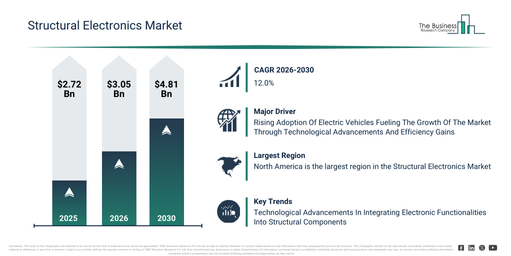
The structural electronics market size has seen rapid expansion in recent years. It is projected to increase from $2.72 billion in 2025 to $3.05 billion in 2026, demonstrating a compound annual growth rate (CAGR) of 12.3%. This historical growth can be largely attributed to advancements in flexible substrates, the proliferation of wearable electronics, the miniaturization of electronic components, the increasing number of IoT-connected devices, and the ongoing development of conductive inks.
The structural electronics market is poised for significant expansion in the coming years. This market is projected to reach $4.81 billion by 2030, demonstrating a compound annual growth rate (CAGR) of 12.0%. This anticipated growth is driven by factors such as the increasing demand for energy-efficient devices, the integration of smart infrastructure, the rise of electric mobility, the expansion of embedded healthcare electronics, and the broadening scope of aerospace and defense applications. Key trends anticipated during this period encompass the integration of structural electronics, advancements in embedded sensor technology, the adoption of flexible displays, innovations in energy harvesting, and progress in nanoelectronics.
Download A Free Sample Report For Comprehensive Market Insights:
Structural Electronics Market Industry Drivers: What Is Driving Revenue Growth?
The expanding uptake of electric vehicles (EVs) is anticipated to generate significant prospects for the structural electronics market. Electric vehicles (EVs) are defined as automobiles powered entirely or partially by electric motors, drawing energy from batteries, rather than depending exclusively on internal combustion engines. The growing embrace of electric vehicles (EVs) is largely attributed to heightened environmental awareness and governmental initiatives encouraging eco-friendly transport. Within the realm of EVs, structural electronics are increasingly being investigated for embedding electronic capabilities directly into foundational elements like body panels, batteries, and chassis. This integration leads to decreased vehicle mass, enhanced energy efficiency, and facilitates multi-functional designs that boost overall performance and sustainability. As an illustration, in 2023, the International Energy Agency (IEA), a France-based intergovernmental organization, reported that around 14 million new electric vehicles (EVs) were registered worldwide, bringing the total EV fleet on roads to 40 million units. This marked a year-on-year increase of 3.5 million vehicles, translating to 35% growth, with electric cars accounting for approximately 18% of total global car sales, up from 14% in 2022. Consequently, the rising adoption of electric vehicles (EVs) is fueling the expansion of the structural electronics market.
Structural Electronics Market Segment Performance And Strategic Opportunities
The structural electronics market covered in this report is segmented –
1) By Component: Embedded Sensors, Conductive Inks, Flexible Displays, Energy Harvesting, Other Components
2) By Technology-Based: Printable Electronics, Flexible Electronics, Embedded Electronics, Nanoelectronics, Thin-Film Transistors
3) By Functionality: Power Generation, Power Storage, Energy Harvesting, Signal Transmission, Smart Sensors
4) By Application: Automotive, Aerospace And Defense, Consumer Electronics, Healthcare, Building And Architecture, Other Applications
5) By End-User-Based: Original Equipment Manufacturers (OEMs), Research and Development Institutions, Contract Manufacturers, End-Consumers, Equipment Suppliers
Subsegments:
1) By Embedded Sensors: Pressure Sensors, Temperature Sensors, Proximity Sensors, Motion And Accelerometers, Biosensors
2) By Conductive Inks: Silver Inks, Copper Inks, Carbon Inks, Nanoparticle-based Inks, Polymer-based Inks
3) By Flexible Displays: Organic Light Emitting Diode (OLED) Displays, E-Paper Displays, Liquid Crystal Display (LCD) Displays, Micro-Light Emitting Diode (LED) Displays
4) By Energy Harvesting: Photovoltaic (Solar Cells), Piezoelectric Devices, Thermoelectric Generators, Radio Frequency (RF) Harvesting
5) By Other Components: Printed Batteries, Antennas, Circuit Interconnects, Conductive Adhesives
Structural Electronics Market Trends Driving Strategic Industry Expansion
Leading companies in the structural electronics market are progressing technologies that integrate electronic capabilities directly into structural components, allowing for decreased weight, enhanced energy efficiency, and improved reliability. This method incorporates circuits, sensors, and other functional elements into load-bearing materials, enabling them to provide both mechanical strength and electronic functionality simultaneously, thus reducing the necessity for separate enclosures or assemblies. For instance, in September 2023, Avery Dennison, a US-based materials science company, launched its Volt Tough portfolio of electrical insulation tapes for EV battery packs. These materials bolster structural integrity and safety by mitigating the risks of electrical arcing while also supporting higher energy density and better thermal management. Such innovations exemplify how manufacturers are developing multifunctional materials that unify mechanical and electronic performance, a pivotal trend influencing the structural electronics market.
Structural Electronics Market Key Players: Which Companies Shape Industry Competition?
Major companies operating in the structural electronics market are The Boeing Company, Panasonic Corporation, Nano Dimension Ltd., Continental Aktiengesellschaft, Flex Ltd., Heraeus Holding GmbH, 3M Company, Henkel AG & Co. KGaA, E. I. du Pont de Nemours and Company, Avery Dennison Corporation, Sun Chemical Corporation, Rogers Corporation, Zetwerk Pte. Ltd., PragmatIC Semiconductor Limited, TactoTek Oy, NovaCentrix Inc., Optomec Inc., Canatu Oy, Blue Spark Technologies Ltd., Neotech AMT AG
Access The Complete Structural Electronics Market Report:
Structural Electronics Market Geographic Distribution And Regional Opportunities
North America was the largest region in the structural electronics market in 2025. The regions covered in the structural electronics market report are Asia-Pacific, South East Asia, Western Europe, Eastern Europe, North America, South America, Middle East, Africa.
Get in touch with us:
The Business Research Company: https://www.thebusinessresearchcompany.com/
Americas: +1 310-496-7795
Asia: +44 7882 955267 & +91 8897263534
Europe: +44 7882 955267
Email us at: marketing@tbrc.info
Follow us on:
LinkedIn: https://in.linkedin.com/company/the-business-research-company
YouTube: https://www.youtube.com/channel/UC24_fI0rV8cR5DxlCpgmyFQ
Global Market Model: https://www.thebusinessresearchcompany.com/global-market-model

Wasay has over a decade of experience in market research, data modelling, and analytics, with prior experience at GlobalData and Decision Tree Consulting Services. At The Business Research Company , he leads research operations across syndicated studies, customized consulting engagements, and the Global Market Model platform. His professional experience includes supporting organizations such as Boston Consulting Group, KPMG, and Ernst & Young. Wasay holds a degree in Electronics and Communications Engineering, postgraduate management qualifications from International Management Institute Belgium and Indian School of Business and Entrepreneurship, and completed the Integrated Program in Business Analytics from Indian Institute of Management Indore.