Built to provide research that’s more actionable and strategically valuable, The Business Research Company’s 2026 market reports include market attractiveness analysis, total addressable market sizing, company benchmarking matrices, interactive Excel dashboards, broader supply chain intelligence, emerging startup tracking, and in-depth product insights.
Telepresence Robot Market Expansion Outlook: What Revenue Opportunities Are Ahead?
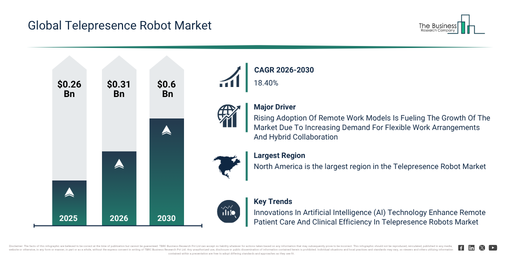
The telepresence robot market size has experienced rapid expansion in recent years. It is anticipated to increase from $0.26 billion in 2025 to $0.31 billion in 2026, achieving a compound annual growth rate (CAGR) of 18.1%. This historic growth is primarily attributable to the rise in remote communication technologies, the increasing adoption of robotics within enterprises, the advancement of high-speed internet connectivity, a growing demand for remote monitoring solutions, and the expansion of digital workplaces.
The telepresence robot market is anticipated to experience substantial expansion in the coming years. It is projected to reach $0. 6 billion by 2030, exhibiting a compound annual growth rate (CAGR) of 18. 4%. This growth during the forecast period is fueled by several factors, including the rising demand for hybrid work settings, increased deployment in telehealth and remote diagnostics, progress in autonomous navigation features, expanding investments in robotics innovation, and the broadening of applications across industrial and public domains. Key trends expected within this timeframe encompass a surge in the embrace of remote collaboration tools within businesses, an escalating need for virtual presence in medical consultations, a greater utilization of telepresence robots in educational and distance learning scenarios, the extended reach of telepresence into security and surveillance uses, and the creation of more streamlined and intuitive telepresence robot designs.
Get A Free Sample Report With In-Depth Market Insights:
Telepresence Robot Market Growth Factors Behind Sustained Expansion
The escalating embrace of remote work arrangements is poised to stimulate the expansion of the telepresence robot market in the foreseeable future. Remote work models characterize the increasing shift of both individuals and entities towards executing professional duties from geographically dispersed locations, leveraging digital communication tools. This growing trend of remote work is fueled by a heightened desire for adaptable employment structures that enhance personal well-being and corporate efficiency. A telepresence robot empowers staff working remotely to navigate, engage, and collaborate synchronously within physical office or industrial settings, thereby bolstering engagement and ensuring continuous operations in hybrid work environments. As an illustration, in December 2024, data from the U. S. Office of Personnel Management, a US-based federal government agency, indicated a rise in federal government employees eligible for remote work, increasing from 52% in fiscal year 2022 to 57% in fiscal year 2023. Consequently, the increasing prevalence of remote work models is acting as a catalyst for the growth within the telepresence robot market.
Telepresence Robot Market Segmentation And Category Overview
The telepresence robot market covered in this report is segmented –
1) By Robot Type: Mobile Telepresence Robots, Stationary Or Desktop Telepresence Robots, Humanoid Telepresence Robots, Specialized Form Factors
2) By Interface: Hardware, Software
3) By Navigation Capability: Manually Controlled Telepresence Robots, Semi Autonomous Telepresence Robots, Fully Autonomous Telepresence Robots
4) By Connectivity: Wi Fi Enabled, Ethernet Connection, Cellular Connectivity
5) By End Use Industry: Healthcare, Education, Corporate And Enterprise, Manufacturing And Industrial Facilities, Retail And Hospitality, Government And Public Sector, Other End Use Industries
Subsegments:
1) By Mobile Telepresence Robots: Wheeled Navigation Robots, Autonomous Navigation Robots, Remote Controlled Navigation Robots, Indoor Mobility Robots, Outdoor Mobility Robots, Multi Floor Mobility Robots
2) By Stationary Or Desktop Telepresence Robots: Desk Mounted Communication Robots, Tabletop Conferencing Robots, Wall Mounted Telepresence Robots, Kiosk Based Telepresence Robots, Podium Integrated Telepresence Robots
3) By Humanoid Telepresence Robots: Bipedal Humanoid Telepresence Robots, Service Oriented Humanoid Robots, Social Interaction Humanoid Robots, Reception Assistance Humanoid Robots, Caregiving Support Humanoid Robots
4) By Specialized Form Factors: Compact Inspection Telepresence Robots, Rugged Industrial Telepresence Robots, Security Patrol Telepresence Robots, Medical Assistance Telepresence Robots, Educational Engagement Telepresence Robots, Custom Application Telepresence Robots
Telepresence Robot Market Industry Trends Fueling Future Revenue Growth
Major companies engaged in the telepresence robot market are prioritizing the development of advanced solutions, such as autonomous AI-powered telehealth robots, to enhance remote patient monitoring, refine clinical workflows, and broaden access to healthcare services. Autonomous AI telehealth robots are intelligent robotic systems designed to independently navigate healthcare environments while facilitating virtual consultations between patients and healthcare providers. For instance, in March 2026, VSee, a US-based digital health and telemedicine company, launched VSee Robot, which it presented as the world’s first autonomous AI telehealth robot. This innovation aims to streamline virtual care delivery by merging telepresence capabilities with artificial intelligence-driven navigation and interaction features. The solution allows healthcare professionals to more efficiently assess, communicate with, and monitor patients remotely, thereby boosting accessibility and operational productivity in clinical settings.
Telepresence Robot Market Industry Leaders And Competitive Landscape
Major companies operating in the telepresence robot market are Kompai Robotics SAS, Endurance Robots LLC, Orbis Robotics Pty Ltd., Blue Ocean Robotics ApS, Anybots Inc., Swivl Inc., Vecna Technologies Inc., Awabot SAS, Mantaro Networks Inc., FutureRobot Co. Ltd., Temi Global Ltd., Ava Robotics Inc., Double Robotics Inc., SuperDroid Robots Inc., AXYN Robotique Inc., Enova Robotics S. A., Collaborate i/o LLC, Xaxxon Technologies LLC, Inbot Technology Ltd., Shenzhen Paibot Technology Co. Ltd.
View The Full Telepresence Robot Market Report:
Telepresence Robot Market Regional Analysis And Top Geography
North America was the largest region in the telepresence robots market in 2025. Asia-Pacific is expected to be the fastest-growing region in the forecast period. The regions covered in the telepresence robot market report are Asia-Pacific, South East Asia, Western Europe, Eastern Europe, North America, South America, Middle East and Africa.
Reach Out To Our Team:
The Business Research Company: https://www.thebusinessresearchcompany.com/
Americas: +1 310-496-7795
Asia: +44 7882 955267 & +91 8897263534
Europe: +44 7882 955267
Email us at: marketing@tbrc.info
Follow us on:
LinkedIn: https://in.linkedin.com/company/the-business-research-company
YouTube: https://www.youtube.com/channel/UC24_fI0rV8cR5DxlCpgmyFQ
Global Market Model: https://www.thebusinessresearchcompany.com/global-market-model

Wasay has over a decade of experience in market research, data modelling, and analytics, with prior experience at GlobalData and Decision Tree Consulting Services. At The Business Research Company , he leads research operations across syndicated studies, customized consulting engagements, and the Global Market Model platform. His professional experience includes supporting organizations such as Boston Consulting Group, KPMG, and Ernst & Young. Wasay holds a degree in Electronics and Communications Engineering, postgraduate management qualifications from International Management Institute Belgium and Indian School of Business and Entrepreneurship, and completed the Integrated Program in Business Analytics from Indian Institute of Management Indore.