Built to provide research that’s more actionable and strategically valuable, The Business Research Company’s 2026 market reports include market attractiveness analysis, total addressable market sizing, company benchmarking matrices, interactive Excel dashboards, broader supply chain intelligence, emerging startup tracking, and in-depth product insights.
Thermal Interface Materials Market Growth Potential: How Will Market Size Shift Through 2030?
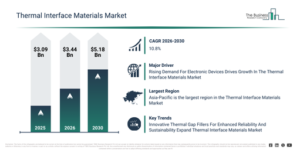
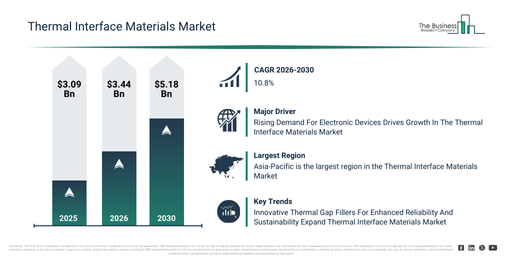
The thermal interface materials market size has seen rapid growth in recent years. It is projected to expand from $3.09 billion in 2025 to $3.44 billion in 2026, demonstrating a compound annual growth rate (CAGR) of 11.1%. This historical growth can be attributed to increasing deployment in computer processors, early adoption within telecom cooling systems, a rise in medical device thermal management, growth in industrial machinery applications, and expanding use in consumer durables.
The thermal interface materials market is anticipated to experience substantial growth over the next few years. It is projected to expand to $5.18 billion by 2030, exhibiting a compound annual growth rate (CAGR) of 10.8%. This expansion during the forecast period can be attributed to the increasing demand for high-performance heat dissipation, the growth of electric vehicle electronics, the ongoing development of advanced phase change materials, wider adoption in high-density computing, and the proliferation of thermally conductive lightweight materials. Significant trends during this forecast period encompass the advancement of intelligent thermal management systems, the rise of cloud-enhanced TIM performance analytics, the spread of sustainable high-conductivity materials, the emergence of IoT-integrated heat dissipation solutions, and the integration of TIMs into electrified mobility platforms.
Get A Free Sample Report With In-Depth Market Insights:
Thermal Interface Materials Market Development Factors: What’s Supporting Demand?
The escalating need for electronic devices is projected to propel the demand within the thermal interface materials market in the coming years. Electronic devices are those that harness electrical energy to execute various functions, including computing, communication, or control. Thermal interface materials are employed in electronic gadgets such as tablets, computers, smartphones, and video games, leveraging their thermal conductive properties to enhance the efficiency and lifespan of these electronics, a factor expected to contribute to market growth. For instance, in May 2023, data from the Japan Electronics and Information Technology Industries Association, a Japan-based trade association, indicated that the total electronic equipment production in Japan reached $52,36,535 million (¥771,457 million). Furthermore, consumer electronics production ascended to $2,178,430 million (¥32,099 million) in May 2023, up from $1,714,724 million (¥25,268 million) in May 2022. Thus, the rising demand for electronic devices and appliances is anticipated to generate increased revenues for the thermal interface materials market.
Thermal Interface Materials Market Segment Analysis Spotlighting Growth Areas
The thermal interface materials market covered in this report is segmented –
1) By Type: Greases & Adhesives, Tapes & Films, Gap Fillers, Metal-Based TIMs, Phase Change Materials, Other Types
2) By Chemistry: Silicone, Epoxy, Polyimide, Other Chemistries
3) By Application: Telecom, Computer, Medical Devices, Industrial Machinery, Consumer Durables, Automotive Electronics, Other Applications
Subsegments:
1) By Greases And Adhesives: Thermal Greases, Thermal Adhesives, Conductive Adhesives
2) By Tapes And Films: Thermal Conductive Tapes, Thermal Interface Films, Self-Adhesive Thermal Tapes
3) By Gap Fillers: Soft Gap Fillers, Rigid Gap Fillers, Liquid Gap Fillers
4) By Metal-Based TIMs: Metal Foils, Metal Pads, Metal Paste
5) By Phase Change Materials: PCM Compounds, PCM Pads, PCM Coatings,
6) By Other Types: Thermal Conductive Pads, Thermally Conductive Coatings, Specialty Thermal Interface Materials.
Thermal Interface Materials Market Transformation Trends: What Innovations Are Driving Change?
Leading companies in the thermal interface materials market are concentrating on developing innovative products to expand their offerings, fulfill the demands of various end-use industries, and maintain their position in the competitive business landscape. For example, in September 2023, Henkel AG & Co. KGaA, a Germany-based chemical company, introduced a next-generation line of thermal gap fillers, including the Bergquist gap filler TGF 4400LVO. This product delivers an easily dispensable gap filler solution with a thin bond line, providing high reliability against thermal shock. It features a typical thermal conductivity of 4.4W/mK, and its very low volatile siloxane content makes it a more sustainable choice for protecting sensitive electronic components. Additionally, in January 2023, Henkel AG & Co. KGaA, the German chemical firm, also launched the Bergquist gap filler TGF 2900LVO. The Bergquist gap filler TGF 2900LVO is a silicone-based, two-component, room-temperature curable gap filler suitable for a broad spectrum of electronic assembly applications.
Thermal Interface Materials Market Leading Companies: Who Holds The Strongest Market Presence?
Major companies operating in the thermal interface materials market are The 3M Company, Zalman Tech Co. Ltd., Wakefield-Vette Inc., Indium Corporation, The Berquist Company Inc., Momentive Performance Materials Inc., Laird Technologies Inc., DOW Corning Corporation, Parker Hannifin Corporation, Henkel AG & Co. KGAA, Fujipoly Industries Co Ltd., DK Thermal Metal Circuit Technology Ltd., AI Technology Inc., AIM Specialty Materials, AOS Thermal Compounds LLC., Denka Company Limited., Universal Science, Dymax Corporation, Ellsworth Adhesives, Enerdyne Devices Private Limited., European Thermodynamics Ltd, Inkron Oy, Kitagawa Industries, LORD, M. A. Electronics Private Limited., MH&W International Corporation., Minerals Technologies Inc., Chomerics Inc., Robnor ResinLab Ltd., Schlegel Electronics Materials, Shin-Etsu Chemical Co. Ltd., Honeywell International Inc., Panasonic Corporation, Advanced Thermal Solutions Inc., MG Chemicals, Thermal Grizzly, Aavid Thermalloy LLC, Arctic Silver Inc., Thermalright Inc., Cooler Master Co. Ltd., GELID Solutions Ltd., Master Bond Inc., Kerafol Keramische Folien GmbH & Co. KG
View The Full Thermal Interface Materials Market Report:
Thermal Interface Materials Market Top Region By Revenue And Market Share
Asia-Pacific was the largest region in the thermal interface materials market in 2025. The regions covered in the thermal interface materials market report are Asia-Pacific, South East Asia, Western Europe, Eastern Europe, North America, South America, Middle East, Africa.
Reach Out To Our Team:
The Business Research Company: https://www.thebusinessresearchcompany.com/
Americas: +1 310-496-7795
Asia: +44 7882 955267 & +91 8897263534
Europe: +44 7882 955267
Email us at: marketing@tbrc.info
Follow us on:
LinkedIn: https://in.linkedin.com/company/the-business-research-company
YouTube: https://www.youtube.com/channel/UC24_fI0rV8cR5DxlCpgmyFQ
Global Market Model: https://www.thebusinessresearchcompany.com/global-market-model

Wasay has over a decade of experience in market research, data modelling, and analytics, with prior experience at GlobalData and Decision Tree Consulting Services. At The Business Research Company , he leads research operations across syndicated studies, customized consulting engagements, and the Global Market Model platform. His professional experience includes supporting organizations such as Boston Consulting Group, KPMG, and Ernst & Young. Wasay holds a degree in Electronics and Communications Engineering, postgraduate management qualifications from International Management Institute Belgium and Indian School of Business and Entrepreneurship, and completed the Integrated Program in Business Analytics from Indian Institute of Management Indore.