
Delivering more actionable and strategically valuable research, The Business Research Company’s 2026 market reports feature market attractiveness analysis, total addressable market evaluation, company benchmarking matrices, interactive Excel dashboards, expanded supply chain intelligence, emerging startup coverage, and detailed product insights.
Thin Film Solar Cell Market Size, Value And Growth Trends Through 2030
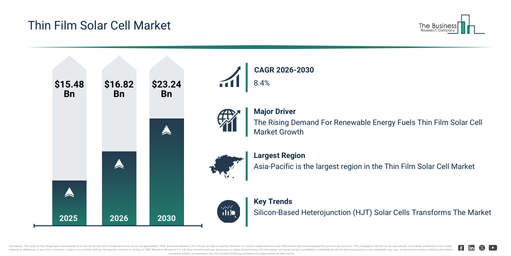
The thin film solar cell market size has shown significant expansion in recent years. Its value is anticipated to rise from $15.48 billion in 2025 to $16.82 billion in 2026, reflecting a compound annual growth rate (CAGR) of 8.6%. The historical increase can be attributed to several factors, including the heightened adoption of lightweight solar modules, an increase in commercial rooftop installations, the continued reliance on conventional silicon photovoltaics, the development of early thin-film research prototypes, and the expansion of utility-scale solar projects.
The thin film solar cell market is projected to experience robust expansion over the coming years. This market is anticipated to reach $23.24 billion by 2030, driven by a compound annual growth rate (CAGR) of 8.4%. Key factors contributing to this growth include the increasing need for flexible photovoltaic materials, the expanded use of thin-film modules in distributed energy systems, advancements in perovskite and organic PV technologies, higher uptake in both residential and commercial applications, and the evolution of bifacial and tandem thin-film designs. Significant trends during this time involve the embrace of sustainable thin-film solar solutions, greater integration of renewable energy into power grids, the creation of advanced automated solar manufacturing processes, the incorporation of IoT-enabled solar monitoring platforms, and improvements in digital solar performance analytics.
Download A Free Sample Report For Comprehensive Market Insights:
Thin Film Solar Cell Market Expansion Drivers: What Is Shaping Future Growth?
The escalating need for renewable energy sources is anticipated to drive the expansion of the thin film solar cell market moving forward. These energy resources are naturally restored and virtually endless, presenting a sustainable and environmentally conscious alternative to traditional fossil fuels. Thin film solar cells harness renewable energy sources to capture sunlight through their semiconductor layers, enabling the cells to generate electricity without depleting finite resources. For instance, in February 2024, according to the U.S. Energy Information Administration (EIA), a US-based federal statistical agency under the Department of Energy, it was documented that in 2023 approximately 4,178 billion kilowatt-hours (kWh) of electricity were produced at utility-scale facilities across the United States. Furthermore, around 60% originated from fossil fuels such as coal, natural gas, petroleum, and other gases, while 19% was generated from nuclear energy sources. Renewable energy accounted for about 21% of total generation, illustrating the continuous progression towards cleaner power options. Additionally, small-scale solar photovoltaic systems contributed an estimated 73.62 billion kWh of electricity generation in 2023, further supporting the nation’s growth in renewable energy. Therefore, the increasing demand for renewable energy sources is a primary factor driving the growth of the thin film solar cell market.
Thin Film Solar Cell Market Categorization By Product Type And Application
The thin film solar cell market covered in this report is segmented –
1) By Type: Cadmium Telluride, Amorphous Thin-Film Silicon, Copper Indium Gallium Selenide, Microcrystalline Tandem Cells, Thin-film Polycrystalline Silicon, Other Types
2) By Technology: On-Grid, Off-Grid
3) By Application: Residential, Commercial, Utility
Subsegments:
1) By Cadmium Telluride (CdTe): CdTe Thin Film Modules, CdTe Bifacial Modules
2) By Amorphous Thin-film Silicon (a-Si): Single Junction a-Si, Tandem a-Si
3) By Copper Indium Gallium Selenide (CIGS): CIGS Thin Film Modules, Bifacial CIGS Modules
4) By Microcrystalline Tandem Cells: Tandem Cells With Microcrystalline Layers, Tandem Structures With Silicon And CIGS
5) By Thin-Film Polycrystalline Silicon: Polycrystalline Thin Film Modules, Bifacial Polycrystalline Modules
6) By Other Types: Organic Photovoltaics (OPV), Perovskite Solar Cells, Flexible Thin Film Technologies
#Thin Film Solar Cell Market Trends Influencing Long-Term Demand
Leading companies in the thin film solar cell market are concentrating on innovative products, such as silicon-based heterojunction (HJT) solar cells, to gain a competitive edge. Silicon-based heterojunction (HJT) solar cells are photovoltaic devices designed to boost efficiency by utilizing a combination of different semiconductor materials with varied bandgaps. For example, in June 2023, Anhui Huasun Energy Co., Ltd., a solar company based in China, introduced N-type silicon-based heterojunction (HJT) solar cells. N-type silicon-based heterojunction (HJT) solar cells are a type of photovoltaic cell technology that merges two technologies into one cell, featuring a crystalline silicon cell sandwiched between two layers of amorphous thin-film silicon. These N-type silicon-based heterojunction (HJT) solar cells rely on an emitter and back surface field (BSF) created by the low-temperature growth of ultra-thin layers of amorphous silicon (a-Si:H) on both sides of meticulously cleaned monocrystalline silicon wafers. They incorporate bifacial microcrystalline technology for improved efficiency.
Thin Film Solar Cell Market Company Landscape And Strategic Competition
Major companies operating in the thin film solar cell market are Ascent Solar Technologies Inc., Filsom AG, First Solar Inc., Hanergy Mobile Energy Group Ltd., Miasole Hi-Tech Corp., Mitsubishi Heavy Industries Ltd., Shunfeng International Clean Energy Limited, Solar Frontier K.K., NanoPV Solar Inc., Oxford Photovoltaics Ltd., Global Solar Inc., Solara GmbH, Toledo Solar Inc., Flisom Ltd., ENN Energy Holdings Ltd., Sharp Corp., Kaneka Corp., NexPower Technology Corp., Greatcell Solar Ltd., Exeger Operations AB, Fujikura Europe Ltd., G24 Power Ltd., Heliatek GmbH, Hanwha Qcells Co. Ltd., AVANCIS GmbH, Solbian Energie Alternative Srl, JA Solar Technology Co. Ltd.
Access The Complete Thin Film Solar Cell Market Report:
Thin Film Solar Cell Market Leading Geography: Which Region Generates The Most Revenue?
Asia-Pacific was the largest region in the thin film solar cell market in 2025. Asia-Pacific is expected to be the fastest growing region in the forecast period. The regions covered in the thin film solar cell market report are Asia-Pacific, South East Asia, Western Europe, Eastern Europe, North America, South America, Middle East, Africa.
Get in touch with us:
The Business Research Company: https://www.thebusinessresearchcompany.com/
Americas: +1 310-496-7795
Asia: +44 7882 955267 & +91 8897263534
Europe: +44 7882 955267
Email us at: marketing@tbrc.info
Follow us on:
LinkedIn: https://in.linkedin.com/company/the-business-research-company
YouTube: https://www.youtube.com/channel/UC24_fI0rV8cR5DxlCpgmyFQ
Global Market Model: https://www.thebusinessresearchcompany.com/global-market-model

Wasay has over a decade of experience in market research, data modelling, and analytics, with prior experience at GlobalData and Decision Tree Consulting Services. At The Business Research Company , he leads research operations across syndicated studies, customized consulting engagements, and the Global Market Model platform. His professional experience includes supporting organizations such as Boston Consulting Group, KPMG, and Ernst & Young. Wasay holds a degree in Electronics and Communications Engineering, postgraduate management qualifications from International Management Institute Belgium and Indian School of Business and Entrepreneurship, and completed the Integrated Program in Business Analytics from Indian Institute of Management Indore.
