Delivering more actionable and strategically valuable research, The Business Research Company’s 2026 market reports feature market attractiveness analysis, total addressable market evaluation, company benchmarking matrices, interactive Excel dashboards, expanded supply chain intelligence, emerging startup coverage, and detailed product insights.
Torque Sensor Market Forecast Highlighting Growth From $15.66 Billion To $28.46 Billion
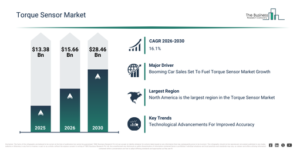
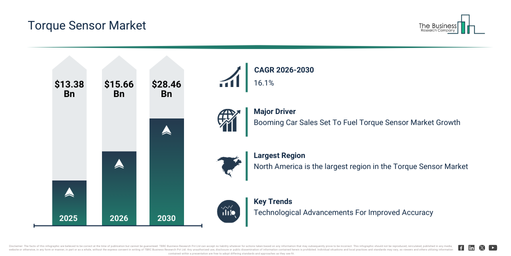
The torque sensor market has experienced rapid expansion in recent years. It is projected to grow from $13.38 billion in 2025 to $15.66 billion in 2026, achieving a compound annual growth rate (CAGR) of 17.0%. This historical growth can be ascribed to several factors, including the increasing deployment in automotive testing systems, the early adoption of strain gauge torque sensors, the expansion in aerospace torque validation, the rising use in industrial torque control, and the broadening of rotary sensor applications.
The torque sensor market is projected for swift expansion over the coming years, reaching a valuation of $28.46 billion by 2030, driven by a compound annual growth rate (CAGR) of 16.1%. This anticipated growth during the forecast period is due to a rising need for high-precision non-contact torque sensors, advancements in magnetoelastic technologies, increased torque monitoring within EV drivetrains, the broadening of smart factory torque diagnostics, and greater integration into medical and robotics torque applications. Key trends expected over the forecast period encompass the broadening of smart mobility torque sensing, the advancement of intelligent manufacturing torque monitoring, the emergence of IoT-enabled torque measurement systems, the uptake of cloud-based torque analytics, and the creation of torque solutions designed for electrified powertrains.
Download A Free Sample Report For Comprehensive Market Insights:
Torque Sensor Market Opportunity Drivers: What Is Creating New Revenue Potential?
The anticipated increase in car sales is expected to propel the torque sensor market. A car commonly refers to a four-wheeled motor vehicle intended for carrying passengers or goods on roads. Torque sensors are utilized in automotive vehicles for optimizing engine performance, bolstering safety and stability, enhancing fuel efficiency, and enabling the efficient functioning of various systems. For instance, in July 2023, FinMasters, a Europe-based financial information provider, reported that in the United States, roughly 13.74 million cars and light trucks were sold in 2022. Auto sales in the U.S. totaled 2.13 million units during January-February 2023, and a projection estimates sales to reach 14.8 million for the entire year in 2023. Therefore, the rising car sales are expected to stimulate the growth of the torque sensor market moving forward.
#Torque Sensor Market Segment Landscape And Growth Potential
The torque sensor market covered in this report is segmented –
1) By Type: Reaction Torque Sensor, Rotary Torque Sensor
2) By Technology: Strain Gauge, Surface Acoustic Wave (SAW), Optical, Magnetoelastic
3) By Application: Automotive, Industrial, Aerospace and Defense, Healthcare
Subsegments:
1) By Reaction Torque Sensor: Static Torque Sensors, Dynamic Torque Sensors
2) By Rotary Torque Sensor: Contact Rotary Torque Sensors, Non-Contact Rotary Torque Sensors
Torque Sensor Market Growth Trends Influencing Competitive Dynamics
Leading companies active in the torque sensor market are concentrating on developing innovative solutions, such as next-generation torque sensors, to enhance measurement accuracy, simplify integration, and overcome challenges in test bench and powertrain testing. Next-generation torque sensors are defined as advanced devices that integrate telemetry and flexible stator designs to provide precise, real-time torque data for various applications, including electric vehicles. For instance, in June 2024, Hottinger Brüel & Kjær (HBK), a technology company based in Denmark, launched the T110/100 torque sensor, which features integrated telemetry and a one-size-fits-all flexible stator. This sensor assists engineers in optimizing powertrain testing, streamlining measurement processes, and improving testing efficiency for electric vehicle development.
Torque Sensor Market Competitive Landscape: Who Are The Leading Companies?
Major companies operating in the torque sensor market are ABB Group, Applied Measurements Ltd., Crane Electronics Ltd., FUTEK Advanced Sensor Technology Inc., Honeywell International Inc., Kistler Group, MagCanica Inc., Datum Electronics Limited, Hottinger Baldwin Messtechnik GmbH, PCB Piezotronics Inc., Interface Inc., TE Connectivity Ltd., Bota Systems, HITEC Sensor Solutions, Mountz Inc., S. Himmelstein & Company, Transense Technologies plc, ATI Industrial Automation Inc., HBK Benelux, Sensor Technology Ltd., Norbar Torque Tools Ltd., Magtrol SA, Scaime SAS, Lorenz Messtechnik GmbH, KTR Systems GmbH, Manner Sensortelemetrie GmbH, RDP Electronics Ltd.
Access The Complete Torque Sensor Market Report:
Torque Sensor Market Geographic Analysis: Where Is Demand Growing The Fastest?
North America was the largest region in the torque sensor market in 2025. Asia-Pacific is expected to be the fastest-growing region in the forecast period. The regions covered in the torque sensor market report are Asia-Pacific, South East Asia, Western Europe, Eastern Europe, North America, South America, Middle East, Africa.
Get in touch with us:
The Business Research Company: https://www.thebusinessresearchcompany.com/
Americas: +1 310-496-7795
Asia: +44 7882 955267 & +91 8897263534
Europe: +44 7882 955267
Email us at: marketing@tbrc.info
Follow us on:
LinkedIn: https://in.linkedin.com/company/the-business-research-company
YouTube: https://www.youtube.com/channel/UC24_fI0rV8cR5DxlCpgmyFQ
Global Market Model: https://www.thebusinessresearchcompany.com/global-market-model

Wasay has over a decade of experience in market research, data modelling, and analytics, with prior experience at GlobalData and Decision Tree Consulting Services. At The Business Research Company , he leads research operations across syndicated studies, customized consulting engagements, and the Global Market Model platform. His professional experience includes supporting organizations such as Boston Consulting Group, KPMG, and Ernst & Young. Wasay holds a degree in Electronics and Communications Engineering, postgraduate management qualifications from International Management Institute Belgium and Indian School of Business and Entrepreneurship, and completed the Integrated Program in Business Analytics from Indian Institute of Management Indore.