Market attractiveness scoring, total addressable market sizing, company benchmarking matrices, interactive Excel dashboards, deeper supply chain intelligence, emerging startup tracking, and granular product-level insights are among the key offerings featured in The Business Research Company’s 2026 market reports, designed to deliver more actionable and strategically valuable research.
Ultra-Low-Power Microcontroller Market Size Estimate For 2026 And Revenue Forecast Through 2030
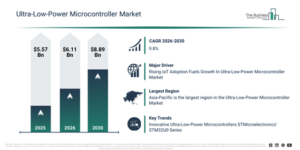
The ultra-low-power microcontroller market size has shown significant expansion in recent years. Its valuation is predicted to rise from $5.57 billion in 2025 to $6.11 billion in 2026, achieving a compound annual growth rate (CAGR) of 9.7%. This historical increase can be ascribed to factors such as the rise of battery-operated consumer electronics, progress in low-power semiconductor design, a growing need for portable medical devices, the initial establishment of wireless sensor networks, and the increasing incorporation of embedded systems into industrial automation.
The ultra-low-power microcontroller market is projected to experience substantial expansion over the coming years, with its size anticipated to reach $8.89 billion by 2030, driven by a compound annual growth rate (CAGR) of 9.8%. This projected increase is fueled by factors such as the expanding reach of IoT sensor networks, the growing implementation of smart meters and smart cities, greater uptake of wearables and hearables, advancements in remote healthcare monitoring, and the increasing demand for ultra-low-power chips in edge AI applications. Key trends influencing this period encompass the wider adoption of battery-operated embedded systems, a heightened need for energy-efficient edge computing, increased incorporation of ultra-low-power controllers into wearable technology, the proliferation of remote monitoring and sensing solutions, and a strong emphasis on maximizing battery longevity and optimizing power consumption.
Free Ultra-Low-Power Microcontroller Market Report Sample Available For Download:
Why Is Demand In The Ultra-Low-Power Microcontroller Market Expected To Keep Rising?
The future expansion of the ultra-low-power microcontroller market is anticipated to be driven by the rising uptake of Internet of Things (IoT) devices. These IoT devices represent networked instruments that gather, relay, and process data using the internet or various other network infrastructures. Their increased usage stems from several factors, including the widespread availability of high-speed internet and mobile connectivity, the development of cloud platforms, capabilities for real-time tracking, and enhanced user convenience along with tailored experiences. In this context, ultra-low-power microcontrollers are vital for the operation and effectiveness of IoT technology, as they reduce energy usage without compromising the required performance for IoT applications. Illustratively, data from Ericsson, a telecommunications firm based in Sweden, indicated in April 2025 that worldwide IoT connections totaled 18.8 billion in 2024, with projections for this figure to climb to 43.0 billion connections by 2030. Consequently, the growing integration of Internet of Things (IoT) devices is a significant catalyst for the expansion of the ultra-low-power microcontroller market.
How Is The Ultra-Low-Power Microcontroller Market Divided Across Segments And Subsegments?
The ultra-low-power microcontroller market covered in this report is segmented –
1) By Component: Hardware, Software, Services
2) By Peripheral: Devices, Analog Devices, Digital Devices
3) By Packaging Type: 8-Bit Packaging, 16-Bit Packaging, 32-Bit Packaging
4) By Application: General Test And Measurement, Sensing, Flow Measurement, Other Applications
5) By End-User Industry: Aerospace And Defense, Automotive, Servers And Data Centers, Consumer Electronics, Telecommunications, Healthcare, Media And Entertainment, Manufacturing, Other End-Users
Subsegments:
1) By Hardware: Microcontroller Units, Power Management ICs, Memory, Analog Components, Communication Modules
2) By Software: Firmware For Microcontrollers, Operating Systems, Development Tools, Middleware And Communication Protocols, Security Software For Low-Power Devices
3) By Services: Design And Development Services, Integration And Testing Services, Custom Firmware Development, Embedded System Consulting, Maintenance And Support Services
Ultra-Low-Power Microcontroller Market Trends Reshaping Customer Demand And Business Strategies
Leading companies in the ultra-low-power microcontrollers market are concentrating on creating advanced solutions, such as energy-efficient ultra-low-power microcontrollers, to meet the increasing demand for energy-saving and high-performance devices. Energy-efficient ultra-low-power microcontrollers are defined as microcontroller units (MCUs) built to function using very little power while still delivering strong performance. For instance, in March 2024, STMicroelectronics NV, a Switzerland-based semiconductor manufacturing corporation, introduced the STM32U0 series, a new range of ultra-low-power microcontrollers intended to enhance energy efficiency across diverse applications. These microcontrollers are capable of cutting energy consumption by up to 50% compared to previous models. This allows devices to operate for extended periods with the identical battery capacity, making them suitable for industrial sensors, smart meters, and consumer electronics such as wearables. Built on the Arm Cortex-M0+ core, the STM32U0 series supports frequencies up to 64 MHz, offers up to 256 KB of Flash memory and 32 KB of SRAM, and includes numerous communication interfaces along with extensive analog peripherals.
Ultra-Low-Power Microcontroller Market Major Players: Companies At The Forefront Of The Industry
Major companies operating in the ultra-low-power microcontroller market are Broadcom Inc., Cypress Semiconductor Corporation, Texas instruments, MediaTek Inc., STMicroelectronics N.V., Infineon Technologies AG, NXP Semiconductors N.V., Analog Devices Inc, Renesas Electronics Corporation, EPSON Semiconductor Solutions Corporation, ON Semiconductor Corporation, Microchip Technology Incorporated, Freescale Semiconductor Inc, Rohm Semiconductors Co Ltd, Nuvoton Technology Corporation, Silicon Laboratories Inc., Nordic Semiconductor, Espressif Systems, Holtek Semiconductor Inc., Zilog Inc, Atmel Corporation, Ambiq Micro Inc, EM Microelectronic, Seiko Instruments, LAPIS Semiconductor Co Ltd, Parallax Inc., Cypress Semiconductor Corporation
Read More About The Ultra-Low-Power Microcontroller Market In The Full Report:
Ultra-Low-Power Microcontroller Market Regional Share Analysis For 2025
Asia-Pacific was the largest region in the ultra-low-power microcontroller market in 2025. The regions covered in the ultra-low-power microcontroller market report are Asia-Pacific, South East Asia, Western Europe, Eastern Europe, North America, South America, Middle East, Africa.
Reach Out To Our Team:
The Business Research Company: https://www.thebusinessresearchcompany.com/
Americas: +1 310-496-7795
Asia: +44 7882 955267 & +91 8897263534
Europe: +44 7882 955267
Email us at: marketing@tbrc.info
Follow us on:
LinkedIn: https://in.linkedin.com/company/the-business-research-company
YouTube: https://www.youtube.com/channel/UC24_fI0rV8cR5DxlCpgmyFQ
Global Market Model: https://www.thebusinessresearchcompany.com/global-market-model

Wasay has over a decade of experience in market research, data modelling, and analytics, with prior experience at GlobalData and Decision Tree Consulting Services. At The Business Research Company , he leads research operations across syndicated studies, customized consulting engagements, and the Global Market Model platform. His professional experience includes supporting organizations such as Boston Consulting Group, KPMG, and Ernst & Young. Wasay holds a degree in Electronics and Communications Engineering, postgraduate management qualifications from International Management Institute Belgium and Indian School of Business and Entrepreneurship, and completed the Integrated Program in Business Analytics from Indian Institute of Management Indore.