Enhanced with market attractiveness analysis, total addressable market evaluation, company benchmarking matrices, interactive Excel dashboards, expanded supply chain intelligence, emerging startup coverage, and detailed product insights, The Business Research Company’s 2026 market reports deliver more actionable and strategically valuable research.
Ultra-Short Reach Optical Interconnect Market Size Outlook: How Fast Will Revenue Grow Through 2030?
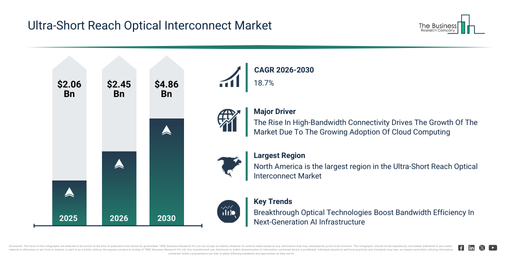
The market size for ultra-short reach optical interconnects has experienced rapid expansion in recent years. It is forecast to increase from $2.06 billion in 2025 to $2.45 billion in 2026, achieving a compound annual growth rate (CAGR) of 19.0%. The expansion observed historically can be linked to factors such as the global rise in data center deployment, the necessity for low-latency high-speed links, the early embrace of VCSEL technology, the demand for power-efficient interconnects, and the initial introduction of optical engine connectors.
The ultra-short reach optical interconnect market size is anticipated to experience substantial growth in the upcoming years. It is projected to expand to $4.86 billion by 2030, demonstrating a compound annual growth rate (CAGR) of 18.7%. This projected growth is driven by the increasing prevalence of HPC and AI workloads, rising bandwidth demands exceeding 100 GBPS, the broadening availability of co-packaged optics solutions, the adoption of silicon photonics interposers, and the escalating demand for energy-efficient ultra-short reach interconnects. Significant trends for the forecast period involve the incorporation of silicon photonics (SiPh) for rapid board-to-board interconnects, the uptake of VCSEL and µ-LED based ultra-short reach optical links, the implementation of co-packaged optics to achieve lower latency and power consumption, the deployment of high-density fiber connectors in rack-to-rack applications, and the wider expansion of optical interconnects within data center and HPC environments.
Download A Free Sample Report For Comprehensive Market Insights:
Ultra-Short Reach Optical Interconnect Market Development Factors: Which Trends Are Supporting Demand?
The ultra-short reach optical interconnect market is projected to expand in the future, driven by the increasing availability of high-bandwidth connectivity. High-bandwidth connectivity signifies a communication link or network capable of transferring substantial data volumes at extremely rapid speeds, facilitating smooth and effective data exchange among devices or systems. This increase in high-bandwidth connectivity stems from the wider embrace of cloud computing, which necessitates quicker and more dependable data transmission for extensive data storage, real-time operations, and uninterrupted access to cloud applications. Ultra-short reach optical interconnect improves high-bandwidth connectivity through its capacity for quicker, more energy-efficient, and low-latency data movement between chips and devices found in data centers and high-performance computing environments. For example, data from November 2024 by the UK Parliament’s House of Commons Library, a UK government entity, indicated that 78% of UK premises possessed gigabit-capable broadband by January 2024. This figure represents a rise from 72% in January 2023 and 64% in January 2022. Consequently, the expanding high-bandwidth connectivity is a key factor propelling the expansion of the ultra-short reach optical interconnect market.
Ultra-Short Reach Optical Interconnect Market Segment Landscape: Which Areas Lead Market Development?
The ultra-short reach optical interconnect market covered in this report is segmented –
1) By Product: Board-To-Board Interconnects, Rack-To-Rack Interconnects
2) By Technology: Vertical-Cavity Surface-Emitting Laser-Based Interconnects (VCSEL), Silicon Photonics (SiPh), Micro Light-Emitting Diode Based Links (µ-LED) Based Links
3) By Data Rate: Less Than 25 Gigabits Per Second (GBPS), 25 – 50 Gigabits Per Second (GBPS), 50 – 100 Gigabits Per Second (GBPS), More Than 100 Gigabits Per Second (GBPS)
4) By Distance: Less Than 1 Meter, 1 – 5 Meter, More Than 5 Meter
Subsegments:
1) By Board-To-Board Interconnects: Embedded Optical Modules, Optical Engine Connectors, Silicon Photonics Interposers, Optical Waveguide Assemblies, Fiber Array Interfaces
2) By Rack-To-Rack Interconnects: Optical Transceiver Modules, Active Optical Cables, Co-Packaged Optics, Pluggable Optical Modules, High-Density Fiber Connectors
Ultra-Short Reach Optical Interconnect Market Transformation Trends: Which Innovations Are Driving Change?
Leading companies in the ultra-short reach optical interconnect market are concentrating on developing innovative solutions, including high-density, low-power optical interconnect technologies, to boost data transfer efficiency in AI and data center infrastructures. These technologies are sophisticated data transmission systems that facilitate faster, energy-efficient communication between closely packed computing components within AI and data center environments. For example, in October 2025, Semtech Limited, a US-based technology company, introduced 1.6T multimode optical chipsets specifically designed for AI infrastructure in data centers. This launch encompassed the sampling of key physical medium dependent (PMD) components like the FiberEdge GN1878 200G-per-channel vertical-cavity surface-emitting laser (VCSEL) driver and the GN1836 200G-per-channel transimpedance amplifier (TIA). These advanced components power ultra-short-reach optical interconnects capable of delivering up to 1.6 terabits per second of aggregate bandwidth, thereby addressing the increasing data transmission demands of AI and machine learning workloads. Featuring a multimode design that optimizes power efficiency and lowers the cost per bit, this solution is well-suited for high-density AI cluster environments. This development reinforces Semtech’s leadership in optical connectivity and establishes a foundation for future scalability toward 3.2T solutions in next-generation data centers.
Ultra-Short Reach Optical Interconnect Market Industry Leaders And Market Competition
Major companies operating in the ultra-short reach optical interconnect market are Cisco Systems Inc., Intel Corporation, Broadcom Inc., Mitsubishi Electric Corporation, Sumitomo Electric Industries Ltd., NVIDIA Corporation, Fujitsu Limited, NEC Corporation, Corning Incorporated, Amphenol Corporation, Molex LLC, Marvell Technology Inc., Ciena Corporation, Lumentum Holdings Inc., Ayar Labs Incorporated, Huawei Technologies Co. Ltd., Celestial AI Incorporated, Skorpios Technologies Incorporated, OpenLight Incorporated, Ranovus Incorporated.
Access The Complete Ultra-Short Reach Optical Interconnect Market Report:
Ultra-Short Reach Optical Interconnect Market Global Footprint: Which Region Holds Market Leadership?
North America was the largest region in the ultra-short reach optical interconnect market in 2025. Asia-Pacific is expected to be the fastest-growing region in the forecast period. The regions covered in the ultra-short reach optical interconnect market report are Asia-Pacific, South East Asia, Western Europe, Eastern Europe, North America, South America, Middle East, Africa.
Get in touch with us:
The Business Research Company: https://www.thebusinessresearchcompany.com/
Americas: +1 310-496-7795
Asia: +44 7882 955267 & +91 8897263534
Europe: +44 7882 955267
Email us at: marketing@tbrc.info
Follow us on:
LinkedIn: https://in.linkedin.com/company/the-business-research-company
YouTube: https://www.youtube.com/channel/UC24_fI0rV8cR5DxlCpgmyFQ
Global Market Model: https://www.thebusinessresearchcompany.com/global-market-model

Wasay has over a decade of experience in market research, data modelling, and analytics, with prior experience at GlobalData and Decision Tree Consulting Services. At The Business Research Company , he leads research operations across syndicated studies, customized consulting engagements, and the Global Market Model platform. His professional experience includes supporting organizations such as Boston Consulting Group, KPMG, and Ernst & Young. Wasay holds a degree in Electronics and Communications Engineering, postgraduate management qualifications from International Management Institute Belgium and Indian School of Business and Entrepreneurship, and completed the Integrated Program in Business Analytics from Indian Institute of Management Indore.