Featuring market attractiveness scoring, total addressable market sizing, company benchmarking matrices, interactive Excel dashboards, deeper supply chain intelligence, emerging startup tracking, and granular product-level insights, The Business Research Company’s 2026 market reports are built to deliver research that is both more actionable and more strategically valuable.
Wearable Chemical Exposure Sensor Market CAGR Outlook And Future Development
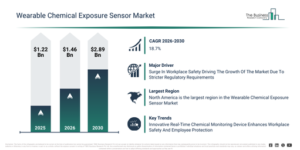
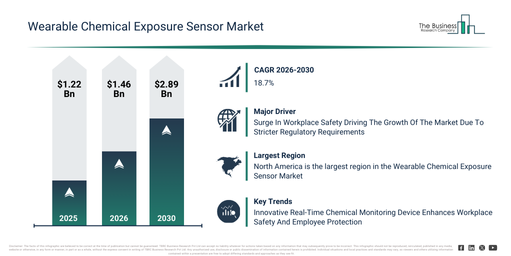
The wearable chemical exposure sensor market size has experienced rapid growth in recent years. It is forecast to expand from $1.22 billion in 2025 to $1.46 billion in 2026, achieving a compound annual growth rate (CAGR) of 19.0%. The expansion observed in the past can be attributed to several factors, including the escalating use of industrial chemicals, more stringent workplace safety regulations, the rise of environmental monitoring efforts, the early acceptance of wearable health devices, and advancements in sensor fabrication technology.
The wearable chemical exposure sensor market size is projected to experience substantial expansion in the coming years. This market is anticipated to reach $2.89 billion by 2030, demonstrating a compound annual growth rate (CAGR) of 18.7%. This projected growth during the forecast period is driven by factors such as a heightened demand for real-time exposure monitoring, the integration of AI and IoT platforms, broadening applications in healthcare and military sectors, advancements in low-power and flexible sensor technology, and an intensifying commitment to environmental sustainability. Key trends anticipated during this period encompass the miniaturization of wearable sensors, capabilities for real-time chemical detection, seamless integration with mobile and cloud platforms, continuous development of advanced sensor materials, and the emergence of personalized exposure analytics.
Get A Free Sample Report With In-Depth Market Insights:
Wearable Chemical Exposure Sensor Market Growth Factors: What’s Supporting Expansion?
A heightened understanding of workplace safety is anticipated to drive the expansion of the wearable chemical exposure sensor market in the future. Workplace safety encompasses measures and practices implemented to safeguard staff from incidents, harms, and health hazards during their work responsibilities. This growing recognition of workplace safety stems from more stringent regulatory mandates, which obligate businesses to implement safer methods and place employee welfare first. The wearable chemical exposure sensor contributes to workplace safety through real-time tracking of dangerous materials, allowing for prompt identification and mitigation of potential health dangers for personnel. As an example, in December 2024, data from HCS Safety, a UK-based health & safety training firm, indicated a slight rise in non-fatal employee injuries, increasing by just over 1,000 cases from 60,645 in 2023 to 61,663 in 2024. Consequently, the heightened focus on workplace safety is fueling the expansion of the wearable chemical exposure sensor market.
Wearable Chemical Exposure Sensor Market Segment Breakdown: Which Categories Lead On Revenue?
The wearable chemical exposure sensor market covered in this report is segmented –
1) By Product Type: Personal Wearable Sensors, Patch Sensors, Wristband Sensors, Clip-On Sensors, Other Product Types
2) By Chemical Type: Volatile Organic Compounds, Particulate Matter, Gases, Heavy Metals, Other Chemical Types
3) By Distribution Channel: Online, Offline
4) By Application: Industrial Safety, Environmental Monitoring, Healthcare, Military And Defense, Other Applications
Subsegments:
1) By Personal Wearable Sensors: Gas Detection Sensors, Liquid Detection Sensors, Multi-Parameter Sensors, Radiation Detection Sensors
2) By Patch Sensors: Adhesive Patch Sensors, Microfluidic Patch Sensors, Electrochemical Patch Sensors, Colorimetric Patch Sensors
3) By Wristband Sensors: Gas Detection Wristbands, Liquid Detection Wristbands, Multi-Parameter Wristbands, Toxic Exposure Wristbands
4) By Clip-On Sensors: Portable Gas Sensors, Portable Liquid Sensors, Multi-Parameter Clip-On Sensors
5) By Other Product Types: Neckband Sensors, Clothing Integrated Sensors, Ring Sensors, Headband Sensors
Wearable Chemical Exposure Sensor Market Industry Trends: What’s Reshaping Demand?
Major companies in the wearable chemical exposure sensor market are prioritizing the development of innovative solutions, such as real-time chemical monitoring devices, to improve workplace safety and protect employee health. Real-time chemical monitoring devices are either wearable or portable sensors that continuously detect and measure hazardous chemicals, offering instant alerts to prevent exposure and ensure safety. For instance, in December 2023, TDA Research Inc., a US-based research and development company, launched a wearable chemical sensor badge specifically for the real-time detection and monitoring of hazardous chemical exposure. This lightweight, durable, and cost-effective device is capable of detecting multiple toxic industrial chemicals at trace levels, providing clear visual, auditory, and vibratory alerts within 10 to 60 seconds. It features replaceable, low-cost sensor cartridges with a one-week lifespan, can monitor gases like hydrogen sulfide, ammonia, phosphine, and hydrogen cyanide, and offers an 11-hour battery life, enhancing first responder safety and situational awareness in hazardous environments.
Wearable Chemical Exposure Sensor Market Leading Players And Competitive Positioning
Major companies operating in the wearable chemical exposure sensor market are Bosch Group, General Electric Company, Honeywell International Inc., 3M Company, Smiths Detection Group Ltd., Drägerwerk AG & Co. KGaA, Gentex Corporation, MSA Safety Incorporated, Industrial Scientific Corporation, Sensirion AG, Blackline Safety Corp., TDA Research Inc., Ion Science Ltd., N5 Sensors, Morphix Technologies Inc., ChemDAQ Inc., LifeLens Technologies Inc., Makel Engineering Inc., PercuSense Inc., SPEC Sensors LLC, PercuSense Inc.
View The Full Wearable Chemical Exposure Sensor Market Report:
Wearable Chemical Exposure Sensor Market Top Region: Where Does Most Revenue Come From?
North America was the largest region in the wearable chemical exposure sensor market in 2025. Asia-Pacific is expected to be the fastest-growing region in the forecast period. The regions covered in the wearable chemical exposure sensor market report are Asia-Pacific, South East Asia, Western Europe, Eastern Europe, North America, South America, Middle East, Africa.
Reach Out To Our Team:
The Business Research Company: https://www.thebusinessresearchcompany.com/
Americas: +1 310-496-7795
Asia: +44 7882 955267 & +91 8897263534
Europe: +44 7882 955267
Email us at: marketing@tbrc.info
Follow us on:
LinkedIn: https://in.linkedin.com/company/the-business-research-company
YouTube: https://www.youtube.com/channel/UC24_fI0rV8cR5DxlCpgmyFQ
Global Market Model: https://www.thebusinessresearchcompany.com/global-market-model

Wasay has over a decade of experience in market research, data modelling, and analytics, with prior experience at GlobalData and Decision Tree Consulting Services. At The Business Research Company , he leads research operations across syndicated studies, customized consulting engagements, and the Global Market Model platform. His professional experience includes supporting organizations such as Boston Consulting Group, KPMG, and Ernst & Young. Wasay holds a degree in Electronics and Communications Engineering, postgraduate management qualifications from International Management Institute Belgium and Indian School of Business and Entrepreneurship, and completed the Integrated Program in Business Analytics from Indian Institute of Management Indore.