Built to provide research that’s more actionable and strategically valuable, The Business Research Company’s 2026 market reports include market attractiveness analysis, total addressable market sizing, company benchmarking matrices, interactive Excel dashboards, broader supply chain intelligence, emerging startup tracking, and in-depth product insights.
Wearable Inertial Sensors Market Size Outlook: How Quickly Will Revenue Expand Through 2030?
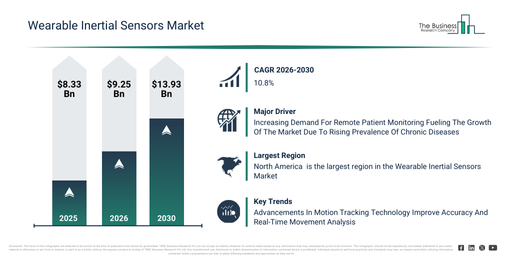
The market for wearable inertial sensors has shown significant growth in recent years. It is anticipated to expand from $8.33 billion in 2025 to $9.25 billion in 2026, exhibiting a compound annual growth rate (CAGR) of 11.0%. This historical expansion can be primarily attributed to the rising adoption of wearable fitness devices, breakthroughs in accelerometer and gyroscope technologies, an increasing public awareness of personal health monitoring, the escalating demand for rehabilitation and elderly care solutions, and the growing field of sports performance analytics.
The wearable inertial sensors market size is anticipated to experience significant growth in the coming years. It is projected to reach a valuation of $13.93 billion by 2030, demonstrating a compound annual growth rate (CAGR) of 10.8%. This expansion throughout the forecast period can be attributed to factors such as the integration with AI-driven health insights, the broadening of telemedicine and remote patient monitoring, advancements in hybrid and quantum sensor technologies, a rise in industrial and worker safety applications, and its utilization in augmented reality/virtual reality (AR/VR) and motion gaming environments. Key developments expected during this forecast timeframe encompass the miniaturization of wearable sensors, enhanced wireless and low-power connectivity solutions, the advent of real-time motion analytics, capabilities for predictive health monitoring, and the integration of multi-sensor fusion.
Get A Free Sample Report With In-Depth Market Insights:
Wearable Inertial Sensors Market Development Factors: What’s Supporting Demand?
The burgeoning need for remote patient monitoring is anticipated to drive expansion in the wearable inertial sensors market going forward. This involves employing digital technologies to gather and relay patient health information from non-traditional clinical environments to medical professionals for evaluation and intervention. The heightened demand stems from the rising occurrence of chronic illnesses, given that individuals with persistent health issues necessitate ongoing observation and prompt actions to enhance their health results. Wearable inertial sensors facilitate remote patient monitoring by allowing uninterrupted tracking of movement, rendering them highly beneficial for medical and geriatric care. These sensors diminish the necessity for regular hospital appointments by supplying live data on mobility and activity, thereby enhancing patient results and the effectiveness of care. For example, data from August 2023 from the World Health Organization, a Switzerland-based intergovernmental body, indicated that 77% of its Member States (39 out of 51) utilize telemedicine or remote patient monitoring. Consequently, the rising requirement for remote patient monitoring is fueling the expansion of the wearable inertial sensors market.
Wearable Inertial Sensors Market Segments: Where Is Growth Concentrated?
The wearable inertial sensors market covered in this report is segmented –
1) By Sensor Type: Accelerometers, Gyroscopes, Magnetometers, Inertial Measurement Units (IMUs), Integrated 3- Or 6-Axis Units, Pressure And Force Sensors, Temperature And Biosensors
2) By Technology: Micro-Electro-Mechanical Systems, Quantum Sensors, Optical Sensors, Hybrid Sensors
3) By Application: Sports And Fitness Tracking, Healthcare And Rehabilitation Monitoring, Industrial And Worker Safety Monitoring, Military And Defense Training Systems, Augmented Reality Or Virtual Reality (VR) And Motion Gaming, Elderly Monitoring And Fall Detection
4) By Distribution Channel: Online Stores, Retail Outlets, Direct Sales, Third-party Distributors
5) By End User: Individuals, Healthcare Providers, Automotive Manufacturers, Defense Organizations
Subsegments:
1) By Accelerometers: Piezoelectric, Capacitive, Microelectromechanical, Servo
2) By Gyroscopes: Optical, Vibratory, Microelectromechanical, Ring Laser
3) By Magnetometers: Fluxgate, Hall Effect, Proton Precession, Anisotropic Magnetoresistive
4) By Inertial Measurement Units: Three Axis, Six Axis, Nine Axis, Multi Sensor
5) By Integrated Three Or Six Axis Units: Three Axis Accelerometer, Three Axis Gyroscope, Six Axis Combination, Sensor Fusion
6) By Pressure And Force Sensors: Capacitive, Piezoelectric, Piezoresistive, Strain Gauge
7) By Temperature And Biosensors: Thermocouple, Resistance Temperature Detector, Thermistor, Enzyme Based
Wearable Inertial Sensors Market Transformation Trends: What Innovations Are Driving Change?
Leading firms within the wearable inertial sensors sector are prioritizing improvements in motion tracking technology, particularly through wireless multi-sensor platforms, aiming to boost precision, decrease lag, and facilitate detailed analysis of complete body movements. These wireless platforms incorporate several inertial measurement units (IMUs) positioned across various body parts to acquire minute motion and posture information, thereby offering an exhaustive understanding of human biomechanics relevant to healthcare, sports, and virtual reality applications. An illustrative example occurred in August 2024, when Bosch Sensortec GmbH, a German sensor technology firm, unveiled its Smart Connected Sensors platform. This represents a cutting-edge IMU-based motion tracking solution, incorporating the BHI380 sensor and supporting connectivity for up to eight synchronized wireless sensor nodes. This system delivers sophisticated functionalities including whole-body motion capture, estimation of body angles, and gesture identification, all enabled by integrated software that removes the dependency on external cameras or specialized suits.
Wearable Inertial Sensors Market Key Participants And Competitive Landscape
Major companies operating in the wearable inertial sensors market are Panasonic Holdings Corporation, Honeywell International Inc., Safran Sensing Technologies SAS, Texas Instruments Incorporated, TDK Corporation, TE Connectivity Ltd., STMicroelectronics N.V., Murata Manufacturing Co. Ltd., NXP Semiconductors N.V., Analog Devices Inc., AMS Osram AG, Garmin Ltd., Polar Electro Oy, Oura Health Oy, MEMSIC Semiconductor Co., Bosch Sensortec GmbH, KINEXON GmbH, Vicon Motion Systems Ltd., MBientLab Inc., Shimmer Sensing
View The Full Wearable Inertial Sensors Market Report:
Wearable Inertial Sensors Market Global Footprint: Which Region Leads The Market?
North America was the largest region in the wearable inertial sensors market in 2025. Asia-Pacific is expected to be the fastest-growing region in the forecast period. The regions covered in the wearable inertial sensors market report are Asia-Pacific, South East Asia, Western Europe, Eastern Europe, North America, South America, Middle East, Africa.
Reach Out To Our Team:
The Business Research Company: https://www.thebusinessresearchcompany.com/
Americas: +1 310-496-7795
Asia: +44 7882 955267 & +91 8897263534
Europe: +44 7882 955267
Email us at: marketing@tbrc.info
Follow us on:
LinkedIn: https://in.linkedin.com/company/the-business-research-company
YouTube: https://www.youtube.com/channel/UC24_fI0rV8cR5DxlCpgmyFQ
Global Market Model: https://www.thebusinessresearchcompany.com/global-market-model

Wasay has over a decade of experience in market research, data modelling, and analytics, with prior experience at GlobalData and Decision Tree Consulting Services. At The Business Research Company , he leads research operations across syndicated studies, customized consulting engagements, and the Global Market Model platform. His professional experience includes supporting organizations such as Boston Consulting Group, KPMG, and Ernst & Young. Wasay holds a degree in Electronics and Communications Engineering, postgraduate management qualifications from International Management Institute Belgium and Indian School of Business and Entrepreneurship, and completed the Integrated Program in Business Analytics from Indian Institute of Management Indore.