Delivering more actionable and strategically valuable research, The Business Research Company’s 2026 market reports feature market attractiveness analysis, total addressable market evaluation, company benchmarking matrices, interactive Excel dashboards, expanded supply chain intelligence, emerging startup coverage, and detailed product insights.
White Goods Market Forecast: What Market Value Is Expected By 2030?
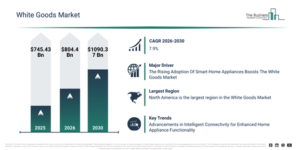
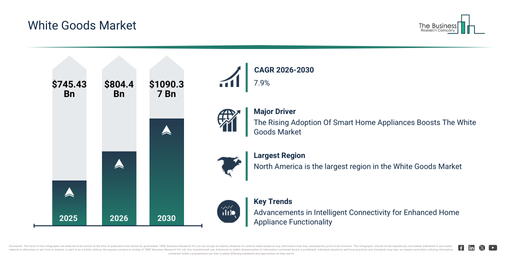
The white goods market size has seen strong growth in recent years. It is expected to expand from $745.43 billion in 2025 to $804.4 billion in 2026, achieving a compound annual growth rate (CAGR) of 7.9%. The market’s historical growth can be ascribed to an increase in household appliance adoption, the growing use of refrigerators and washing machines, the expansion of commercial kitchen equipment, a continued reliance on traditional electric appliances, and the increasing penetration of air conditioners.
The white goods market is projected to experience substantial expansion over the upcoming years. This market is set to reach $1090.37 billion by 2030, demonstrating a compound annual growth rate (CAGR) of 7.9%. This anticipated growth during the forecast period is primarily driven by several factors, including an increasing demand for smart, connected appliances, advancements in energy-efficient cooling and heating solutions, the expanding reach of e-commerce for appliance sales, greater integration into hospitality and corporate settings, and the proliferation of sophisticated home automation ecosystems. Key trends anticipated within this period encompass the widespread adoption of IoT-enabled smart appliances, continuous improvement in the energy efficiency of white goods, the incorporation of AI-powered home automation functionalities, the emergence of interconnected household ecosystems, and the innovation of cloud-managed appliance operations.
Download A Free Sample Report For Comprehensive Market Insights:
White Goods Market Opportunity Drivers: What Is Creating New Revenue Potential?
The white goods market is anticipated to expand, driven by the increasing integration of smart home appliances by consumers, which contributes to a decreased workload. These smart home appliances are electronic units linked to a central system, capable of remote programming or control, or operating independently based on sensor inputs detecting elements like temperature, light, or movement. Typically, these smart devices are engineered to interact with other smart technology, ideally as components of a broader smart home ecosystem. Consequently, a notable demand for white goods is expected to emerge as smart home appliance adoption rises. For example, in November 2023, the Consumer Technology Association (CTA), a US-based trade association, reported that U.S. households had a combined total of 432.6 million smart home devices installed in 2023. Specifically, approximately 19% of homeowners utilized smart appliances like smart refrigerators, washers, dryers, or dishwashers, amounting to around 37.7 million devices. Therefore, the growing uptake of smart home appliances by consumers is projected to stimulate the white goods market.
White Goods Market Segments: Where Are The Largest Growth Opportunities?
The white goods market covered in this report is segmented –
1) By Type: Cleaning Equipment, Preservation And Cooking Equipment, Heating And Cooling Equipment, Other Types
2) By Application: Offline Sales, Online Sales
3) By Distribution Channel: Supermarket And Hypermarket, Specialty Store, Retail Store, E-commerce, Other Distribution Channels
4) By End User: Private Sector, Domestic, Corporate, Public Sector, Government, Hospitals
Subsegments:
1) By Cleaning Equipment: Washing Machines, Dishwashers, Vacuum Cleaners
2) By Preservation And Cooking Equipment: Refrigerators, Freezers, Ovens, Microwaves
3) By Heating And Cooling Equipment: Air Conditioners, Heaters, Dehumidifiers
4) By Other Types: Water Heaters, Food Processors, Other Kitchen Appliances
#White Goods Market Growth Trends: What Is Influencing The Future Outlook?
Major companies in the white goods market are prioritizing the development of intelligent connectivity to facilitate real-time data analysis and support decision-making. Intelligent connectivity blends AI, high-speed networks, and connected devices to foster smarter, more responsive, and efficient digital interactions. For instance, in January 2023, Samsung Electronics, a consumer electronics company based in South Korea, unveiled an expanded range of Bespoke refrigerator models, featuring a larger and more engaging 32-inch display for the Bespoke 4-Door Flex with Family Hub+ and advanced AI Pro Cooking for the Bespoke AI Oven. The Bespoke 4-Door Flex Refrigerator with Family Hub+ is equipped with a 32-inch bezel-free FHD display, almost double the size of previous versions, functioning as a central point for communication, entertainment, and smart home management. Its updated dashboard allows users easy access to SmartThings and enables them to manage connected appliances from one location. The Bespoke AI Oven simplifies cooking through smart technology that adapts to individual dietary needs. With AI Pro Cooking and Sense Inside, it can identify up to 80 dishes, automatically set optimal cooking conditions, and alert users to prevent overcooking.
White Goods Market Major Participants And Competitive Dynamics
Major companies operating in the white goods market are Blue Star Limited, Haier Group Corporation, LG Electronics Inc., Samsung Electronics Co. Ltd., Amica Wronki Spólka Akcyjna, Arçelik A.S., Robert Bosch GmbH, Candy Hoover Group S.r.l., Dacor Inc., Daewoo Electronics Corporation, AB Electrolux, Fisher & Paykel Appliances Holdings Limited, BSH Hausgeräte GmbH, General Electric Company, Groupe SEB, Hisense Group Co. Ltd., Hitachi Ltd., Whirlpool Corporation, Liebherr-International AG, Miele & Cie. KG, Panasonic Corporation, Sharp Corporation, Siemens AG, Smeg S.p.A., Sub-Zero Group Inc., Toshiba Corporation, Vestel Elektronik Sanayi ve Ticaret A.S., Vestfrost Solutions A/S
Access The Complete White Goods Market Report:
#White Goods Market Largest Region: Which Geography Holds The Highest Market Share?
North America was the largest region in the white goods market in 2025. Asia-Pacific is expected to be the fastest-growing region in the white goods market report during the forecast period. The regions covered in the white goods market report are Asia-Pacific, South East Asia, Western Europe, Eastern Europe, North America, South America, Middle East, Africa.
Get in touch with us:
The Business Research Company: https://www.thebusinessresearchcompany.com/
Americas: +1 310-496-7795
Asia: +44 7882 955267 & +91 8897263534
Europe: +44 7882 955267
Email us at: marketing@tbrc.info
Follow us on:
LinkedIn: https://in.linkedin.com/company/the-business-research-company
YouTube: https://www.youtube.com/channel/UC24_fI0rV8cR5DxlCpgmyFQ
Global Market Model: https://www.thebusinessresearchcompany.com/global-market-model

Wasay has over a decade of experience in market research, data modelling, and analytics, with prior experience at GlobalData and Decision Tree Consulting Services. At The Business Research Company , he leads research operations across syndicated studies, customized consulting engagements, and the Global Market Model platform. His professional experience includes supporting organizations such as Boston Consulting Group, KPMG, and Ernst & Young. Wasay holds a degree in Electronics and Communications Engineering, postgraduate management qualifications from International Management Institute Belgium and Indian School of Business and Entrepreneurship, and completed the Integrated Program in Business Analytics from Indian Institute of Management Indore.