Built to provide research that’s more actionable and strategically valuable, The Business Research Company’s 2026 market reports include market attractiveness analysis, total addressable market sizing, company benchmarking matrices, interactive Excel dashboards, broader supply chain intelligence, emerging startup tracking, and in-depth product insights.
Wide Bandgap Semiconductors Market Growth Potential: How Will Market Size Shift Through 2030?
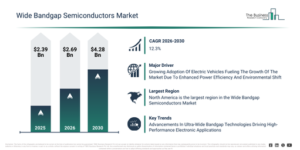
The wide bandgap semiconductors market size has shown significant and swift growth over the past few years. Forecasts predict its expansion from $2.39 billion in 2025 to $2.69 billion in 2026, at a compound annual growth rate (CAGR) of 12.3%. This historical growth is attributable to several factors, including the adoption of silicon carbide and gallium nitride, the expansion of industrial automation, the rising utilization of renewable energy, the need for high-voltage power devices, and the development of telecommunication infrastructure.
The wide bandgap semiconductors market is projected to experience substantial expansion over the coming years. This market is set to reach $4.28 billion by 2030, demonstrating a compound annual growth rate (CAGR) of 12.3%. This anticipated increase during the forecast period is driven by progress in high-efficiency power electronics, the increasing adoption of electric vehicles, the broadening reach of smart grids, an escalating need for high-frequency devices, and the creation of next-generation power modules. Key developments anticipated within this timeframe encompass high-temperature power electronics, wide bandgap power modules, advanced electric vehicle power systems, improvements in renewable energy conversion efficiency, and high-frequency communication devices.
Get A Free Sample Report With In-Depth Market Insights:
Wide Bandgap Semiconductors Market Demand Drivers Opening New Revenue Streams
The expanding adoption of electric vehicles is anticipated to fuel the expansion of the wide bandgap semiconductors market in the foreseeable future. Electric vehicles (EVs) are vehicles that operate either entirely or partially on electricity, utilizing batteries and electric motors rather than or in conjunction with internal combustion engines. The increase in demand for electric vehicles stems from heightened environmental awareness, as both individuals and governments focus on mitigating greenhouse gas emissions and air pollution by transitioning from fossil fuel-dependent transport. The increasing popularity of electric vehicles necessitates wide bandgap semiconductors because these components enhance charging rates and efficiency, reduce energy wastage, and improve overall vehicle performance and range. For example, in 2024, data from the International Energy Agency (IEA), a France-based intergovernmental organization, indicated that electric car sales in 2023 climbed by 3.5 million units compared to 2022, representing a 35% growth from the prior year. Consequently, the escalating demand for electric vehicles is propelling the growth of the wide bandgap semiconductors market.
Wide Bandgap Semiconductors Market Segment Landscape And Growth Outlook
The wide bandgap semiconductors market covered in this report is segmented –
1) By Component: Diodes, Transistors, Modules, Substrates
2) By Material: Silicon Carbide (SiC), Gallium Nitride (GaN), Other Materials
3) By Application: Hybrid Or Electric Vehicles, Photovoltaic Inverters, Railway Tractions, Wind Turbines, Power Supplies, Motor Drives, Other Applications
4) By End-Use Industry: Automotive, Consumer Electronics, Telecommunications, Energy And Utility, Aerospace And Defense, Other End-Use Industries
Subsegments:
1) By Diodes: Schottky Diodes, PIN Diodes, Zener Diodes
2) By Transistors: Field Effect Transistors (FETs), High Electron Mobility Transistors (HEMTs)
3) By Modules: Power Modules, RF Power Modules, Integrated Power Modules (IPMs)
4) By Substrates: Silicon Carbide (SiC) Substrates, Gallium Nitride (GaN) Substrates, Sapphire Substrates, Silicon Substrates
Wide Bandgap Semiconductors Market Trends Powering Strategic Industry Growth
Major companies in the wide bandgap semiconductors market are focusing on developing technologically advanced products, such as ultra-wide bandgap semiconductors based on diamond and aluminum nitride technology, to provide outstanding thermal conductivity. Diamond and aluminum nitride technology involves using these sophisticated materials in semiconductor devices, leveraging their superior thermal, electrical, and mechanical properties to facilitate high-performance and high-power electronic applications. For example, in October 2024, Raytheon, a US-based manufacturer of wide bandgap semiconductors, secured a contract from DARPA, a US-based government agency. This contract is for the introduction of diamond and aluminum nitride-based ultra-wide bandgap semiconductors, or UWBGS, which are expected to revolutionize semiconductor devices by enhancing power delivery and thermal management in sensors and other electronic applications. These materials support the creation of compact, high-power RF switches, limiters, and amplifiers. Their excellent thermal conductivity ensures efficient operation under high temperatures and extreme conditions. The goal is to develop these materials into devices optimized for advanced radar, communication systems, electronic warfare, directed energy, and hypersonic weapon applications.
Wide Bandgap Semiconductors Market Competitive Landscape: Who Leads The Industry?
Major companies operating in the wide bandgap semiconductors market are Panasonic Corporation, Navitas Semiconductor Corporation, Mitsubishi Electric Corporation, Toshiba Corporation, Fujitsu Limited, Texas Instrumennts Inc., STMicroelectronics N.V., Infineon Technologies AG, NXP Semiconductors N.V., Analog Devices Inc., Renesas Electronics Corporation, Microchip Technology Incorporated, Fuji Electric Co. Ltd., Skyworks Solutions Inc., Qorvo Inc., ROHM Co. Ltd, Vishay Intertechnology Inc., II-VI Incorporated, Nexperia B.V., Wolfspeed Inc., GaN Systems Inc., Efficient Power Conversion Corporation.
View The Full Wide Bandgap Semiconductors Market Report:
Wide Bandgap Semiconductors Market Largest Region: Which Geography Holds The Biggest Share?
North America was the largest region in the wide bandgap semiconductors market in 2025. Asia-Pacific is expected to be the fastest-growing region in the forecast period. The regions covered in the wide bandgap semiconductors market report are Asia-Pacific, South East Asia, Western Europe, Eastern Europe, North America, South America, Middle East, Africa.
Reach Out To Our Team:
The Business Research Company: https://www.thebusinessresearchcompany.com/
Americas: +1 310-496-7795
Asia: +44 7882 955267 & +91 8897263534
Europe: +44 7882 955267
Email us at: marketing@tbrc.info
Follow us on:
LinkedIn: https://in.linkedin.com/company/the-business-research-company
YouTube: https://www.youtube.com/channel/UC24_fI0rV8cR5DxlCpgmyFQ
Global Market Model: https://www.thebusinessresearchcompany.com/global-market-model

Wasay has over a decade of experience in market research, data modelling, and analytics, with prior experience at GlobalData and Decision Tree Consulting Services. At The Business Research Company , he leads research operations across syndicated studies, customized consulting engagements, and the Global Market Model platform. His professional experience includes supporting organizations such as Boston Consulting Group, KPMG, and Ernst & Young. Wasay holds a degree in Electronics and Communications Engineering, postgraduate management qualifications from International Management Institute Belgium and Indian School of Business and Entrepreneurship, and completed the Integrated Program in Business Analytics from Indian Institute of Management Indore.