Market attractiveness scoring, total addressable market sizing, company benchmarking matrices, interactive Excel dashboards, deeper supply chain intelligence, emerging startup tracking, and granular product-level insights are among the key offerings featured in The Business Research Company’s 2026 market reports, designed to deliver more actionable and strategically valuable research.
Wind Turbine Automation Market Size Estimate For 2026 And Revenue Forecast Through 2030
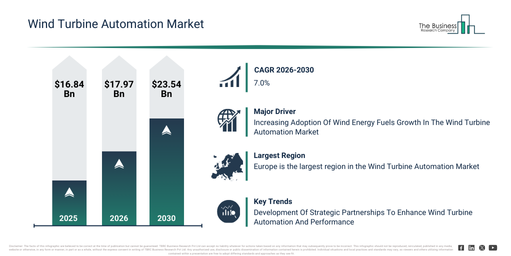
The wind turbine automation market has demonstrated robust expansion in recent years. Its valuation is projected to rise from $16.84 billion in 2025 to $17.97 billion in 2026, achieving a compound annual growth rate (CAGR) of 6.7%. This historic growth can be ascribed to several factors, including the surge in renewable energy installations, the heightened demand for reliable turbine performance, the initial adoption of SCADA systems in wind farms, the broadened scope of onshore turbine deployments, and continuous advancements in mechanical turbine control systems.
The wind turbine automation market is projected to experience substantial expansion over the upcoming years. This market is forecast to reach $23.54 billion by 2030, exhibiting a compound annual growth rate (CAGR) of 7.0%. This projected growth is driven by increased investment in offshore wind power generation, a growing move towards autonomous turbine operations, an escalating need for performance optimization technologies, the broader implementation of large-scale wind farm monitoring, and innovations in condition-based maintenance solutions. Key trends expected during this period involve the increasing adoption of automated blade pitch and power output optimization, the expanded deployment of IoT-enabled real-time wind turbine monitoring systems, enhancements in remote diagnostics and predictive maintenance capabilities, the greater integration of cloud-based platforms for wind farm control, and the broadening application of intelligent automation across both offshore and onshore turbines.
Free Wind Turbine Automation Market Report Sample Available For Download:
Why Is Demand In The Wind Turbine Automation Market Expected To Keep Rising?
The expanding utilization of wind energy is anticipated to propel the growth of the wind turbine automation market going forward. Wind energy is defined as the kinetic energy generated from the movement of air masses across the Earth’s surface, primarily harnessed through wind turbines to produce electricity. The adoption of wind energy is increasing due to its sustainability and cost-effectiveness in renewable energy production. Wind turbine automation enhances efficiency, reliability, and safety in turbine operations. It assists in monitoring, scheduling maintenance, detecting faults, and optimizing turbine performance to increase energy production and reduce operational costs. For instance, in March 2025, the International Renewable Energy Agency, a UAE-based intergovernmental organization, reported that in 2024, wind power in the EU generated 475 TWh, surpassing coal for the second year and providing over 27% of electricity, highlighting the region’s clean energy growth. Consequently, the increasing adoption of wind energy is stimulating the growth of the wind turbine automation market.
How Is The Wind Turbine Automation Market Divided Across Segments And Subsegments?
The wind turbine automation market covered in this report is segmented –
1) By System: Supervisory Control And Data Acquisition (SCADA) Systems, Programmable Logic Controllers (PLC) Systems, Distributed Control Systems (DCS), Condition Monitoring Systems (CMS), Other Systems
2) By Component: Hardware, Software, Services
3) By Application: Offshore Wind Power Generation, Onshore Wind Power Generation, Other Applications
Subsegments:
1) By Supervisory Control And Data Acquisition (SCADA) Systems: Remote Monitoring, Data Acquisition, Data Storage And Reporting, Alarm And Event Management, Data Analytics
2) By Programmable Logic Controllers (PLC) Systems: Control And Automation Of Operations, Real-Time Monitoring And Diagnostics, Communication With SCADA, Fault Detection And Prevention, Performance Optimization
3) By Distributed Control Systems (DCS): Process Control, Safety Instrumented Systems, Network Integration, Remote Control And Monitoring, Performance Management
4) By Condition Monitoring Systems (CMS): Vibration Monitoring, Temperature Monitoring, Oil And Wear Particle Monitoring, Acoustic Monitoring, Power And Load Monitoring
5) By Other Systems: Human-Machine Interface (HMI) Systems, Energy Management Systems (EMS), Fault Detection And Diagnostics Systems, Load Shedding And Power Quality Systems
Wind Turbine Automation Market Trends Reshaping Customer Demand And Business Strategies
Leading companies in the wind turbine automation market are prioritizing strategic partnerships to develop new products and strengthen their positions. A strategic alliance is a collaborative arrangement between two or more entities, typically organizations or businesses, that combine efforts to achieve mutual objectives or strategic goals. For instance, in September 2023, ABB Ltd., a Switzerland-based automation company, announced a partnership with WindESCo Inc., a US-based software company. This strategic alliance includes ABB acquiring a minority stake in WindESCo. ABB seeks to enhance its wind energy portfolio by integrating WindESCo’s digital solutions, thereby improving turbine performance and reliability. WindESCo benefits from ABB’s expertise and market presence to expand its offering in electrical system optimization. The partnership’s goals are to provide end-to-end solutions to wind customers, enhance wind turbine performance and reliability, and open new market channels for digital offerings.
Wind Turbine Automation Market Major Players: Companies At The Forefront Of The Industry
Major companies operating in the wind turbine automation market are Siemens AG, General Electric, Mitsubishi Electric Corporation, Schneider Electric SE, Honeywell International Inc., ABB Ltd., Eaton Corporation, Parker Hannifin Corporation, Vestas Wind Systems A/S, Emerson Electric Co., Danfoss, Rockwell Automation Inc., Nordex SE, Omron Corporation, Fanuc Corporation, Enercon GmbH, Yaskawa Electric Corporation, Yokogawa Electric Corporation, Moog Inc., Suzlon Energy Limited, Axiomtek, Bachmann electronic GmbH, Inox Wind, Prima Automation
Read More About The Wind Turbine Automation Market In The Full Report:
Wind Turbine Automation Market Regional Share Analysis For 2025
Europe was the largest region in the wind turbine automation market in 2025. North America is expected to be the fastest-growing region in the forecast period. The regions covered in the wind turbine automation market report are Asia-Pacific, South East Asia, Western Europe, Eastern Europe, North America, South America, Middle East, Africa.
Reach Out To Our Team:
The Business Research Company: https://www.thebusinessresearchcompany.com/
Americas: +1 310-496-7795
Asia: +44 7882 955267 & +91 8897263534
Europe: +44 7882 955267
Email us at: marketing@tbrc.info
Follow us on:
LinkedIn: https://in.linkedin.com/company/the-business-research-company
YouTube: https://www.youtube.com/channel/UC24_fI0rV8cR5DxlCpgmyFQ
Global Market Model: https://www.thebusinessresearchcompany.com/global-market-model

Wasay has over a decade of experience in market research, data modelling, and analytics, with prior experience at GlobalData and Decision Tree Consulting Services. At The Business Research Company , he leads research operations across syndicated studies, customized consulting engagements, and the Global Market Model platform. His professional experience includes supporting organizations such as Boston Consulting Group, KPMG, and Ernst & Young. Wasay holds a degree in Electronics and Communications Engineering, postgraduate management qualifications from International Management Institute Belgium and Indian School of Business and Entrepreneurship, and completed the Integrated Program in Business Analytics from Indian Institute of Management Indore.