With a focus on actionable insights and strategic value, The Business Research Company’s 2026 market reports include market attractiveness scoring, total addressable market sizing, company benchmarking matrices, interactive Excel dashboards, deeper supply chain intelligence, emerging startup tracking, and granular product-level insights.
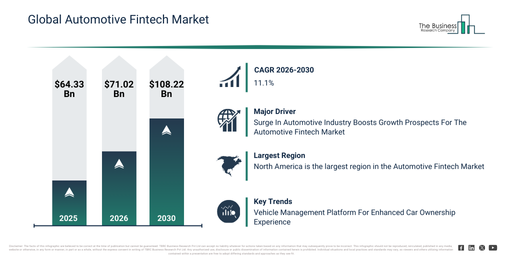
Automotive Fintech Market Size Outlook: A $108.22 Billion Market By 2030, Growing At 11.1% Annually
The automotive fintech market has experienced substantial growth in recent years. It is projected to expand from $64.33 billion in 2025 to $71.02 billion in 2026, achieving a compound annual growth rate (CAGR) of 10.4%. This historical growth can be attributed to factors like the expansion of digital lending ecosystems, the proliferation of online vehicle purchasing platforms, increasing collaboration between fintechs and automakers, the widespread adoption of mobile-first financial services, and rising consumer acceptance of digital payments.
The automotive fintech market is expected to experience significant growth in the coming years. It is projected to reach $108.22 billion in 2030, expanding at a compound annual growth rate (CAGR) of 11.1%. This growth during the forecast period can be attributed to the increasing integration of fintech solutions with connected vehicles, a rising demand for EV-specific digital finance products, the expansion of real-time lending and insurance platforms, the growing utilization of blockchain for transaction security, and an increased emphasis on unified mobility finance ecosystems. Major trends anticipated in this period include the increasing adoption of embedded automotive finance solutions, a rise in the use of AI-driven credit decisioning, growing demand for subscription-based vehicle services, the expansion of in-vehicle payment platforms, and an enhanced focus on seamless digital customer journeys.
Make Data-Driven Decisions With A Free Automotive Fintech Market Sample Report:
Key Demand Driver Expected To Lift Automotive Fintech Market Revenue
The expanding automotive sector is anticipated to drive the future expansion of the automotive fintech market. This industry encompasses the production, design, and distribution of vehicles. Automotive fintech utilizes digital solutions to streamline vehicle financing and insurance processes, offering automotive businesses advantages like improved customer contentment, data insights, and reduced expenditures. A notable example is the global production of 93,546,599 vehicles (with 67,133,570 being passenger vehicles) in 2023, an increase from 84,830,376 vehicles in 2022, as reported in April 2024 by the Serbian Association of Vehicle and Parts Importers, a professional automotive organization based in Serbia. Consequently, the expansion of the automotive industry fuels the demand within the automotive fintech market.
Exploring The Automotive Fintech Market Through Its Key Segments
The automotive fintech market covered in this report is segmented –
1) By Propulsion Type: Internal Combustion Engine (ICE), Electric
2) By Vehicle Type: Passenger Car, Commercial Vehicle
3) By End User: Digital Loans And Purchase, Online Leasing, Online Insurance, In-Vehicle Payments
Subsegments:
1) By Internal Combustion Engine (ICE): Gasoline Vehicles, Diesel Vehicles, Hybrid Vehicles
2) By Electric: Battery Electric Vehicles (BEVs), Plug-In Hybrid Electric Vehicles (PHEVs)
New Trends Redefining Competition In The Automotive Fintech Market
Leading companies operating in the automotive fintech market are concentrating on developing advanced platforms, such as vehicle management solutions, to enable car owners to handle their vehicles more efficiently and experience the joy of driving free from management concerns. A vehicle management platform assists consumers with inquiries regarding maintenance, servicing, and claims. For instance, in September 2023, Dreamplug Technologies Private Limited, an India-based fintech company, introduced a vehicle management platform named CRED Garage. This platform offers a variety of services, including tracking vehicle spending, managing documents, concierge services, 24/7 roadside assistance, support for insurance claims, and integration with DigiLocker. Additionally, it allows members to renew their car insurance, recharge FASTag, and settle traffic challans online.
Automotive Fintech Market Competition: Key Players And Industry Participants
Major companies operating in the automotive fintech market are AutoFi, Lendbuzz, Oodle Car Finance, Creditas, Upstart, Zuto, Carvana, Fair, Clutch, Cuvva, Root Insurance, Clearcover, By Miles, Metromile, Naked Insurance, Bumper, CarMoney, Lendable, RateGenius, AutoGravity
Get The Detailed Automotive Fintech Market Research Report Here:
Automotive Fintech Market Regional Overview: Largest Market And Global Coverage
North America was the largest region in the automotive fintech market in 2025. The regions covered in the automotive fintech market report are Asia-Pacific, South East Asia, Western Europe, Eastern Europe, North America, South America, Middle East, Africa.
Reach Out To Our Team:
The Business Research Company: https://www.thebusinessresearchcompany.com/
Americas: +1 310-496-7795
Asia: +44 7882 955267 & +91 8897263534
Europe: +44 7882 955267
Email us at: marketing@tbrc.info
Follow us on:
LinkedIn: https://in.linkedin.com/company/the-business-research-company
YouTube: https://www.youtube.com/channel/UC24_fI0rV8cR5DxlCpgmyFQ
Global Market Model: https://www.thebusinessresearchcompany.com/global-market-model

Wasay has over a decade of experience in market research, data modelling, and analytics, with prior experience at GlobalData and Decision Tree Consulting Services. At The Business Research Company , he leads research operations across syndicated studies, customized consulting engagements, and the Global Market Model platform. His professional experience includes supporting organizations such as Boston Consulting Group, KPMG, and Ernst & Young. Wasay holds a degree in Electronics and Communications Engineering, postgraduate management qualifications from International Management Institute Belgium and Indian School of Business and Entrepreneurship, and completed the Integrated Program in Business Analytics from Indian Institute of Management Indore.