Built to provide research that’s more actionable and strategically valuable, The Business Research Company’s 2026 market reports include market attractiveness analysis, total addressable market sizing, company benchmarking matrices, interactive Excel dashboards, broader supply chain intelligence, emerging startup tracking, and in-depth product insights.
Claims Avoidance Analytics Artificial Intelligence (AI) Market Poised To Hit $8.16 Billion By 2030 With A 26.9% CAGR
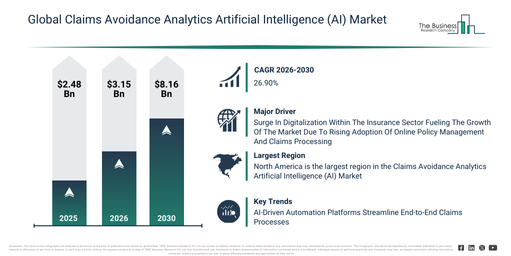
The market size for claims avoidance analytics artificial intelligence (AI) has seen substantial growth in recent years. It is forecast to increase from $2.48 billion in 2025 to $3.15 billion in 2026, achieving a compound annual growth rate (CAGR) of 27.1%. The growth observed in the historical period is attributable to an increase in fraud detection initiatives, a greater adoption of data-driven claims processes, the expanded use of automated risk assessment, the broader implementation of insurance digitalization, and a heightened focus on loss prevention.
The claims avoidance analytics artificial intelligence (AI) market is anticipated to experience significant expansion in the coming years. It is projected to achieve a value of $8.16 billion by 2030, with a compound annual growth rate (CAGR) of 26.9%. This growth throughout the forecast period stems from factors such as increasing demand for automated claims triage, the expanding deployment of advanced analytics platforms, a growing need to reduce claim processing costs, the broadening scope of real-time risk monitoring, and an increased focus on claim accuracy and transparency. Notable trends during this period include advancements in predictive analytics models, innovations in real-time risk scoring, developments in AI-driven decision engines, research and development efforts in automated claims review, enhancements in natural language processing for claims, and innovations in behavioural analytics tools.
Get A Free Sample Report With In-Depth Market Insights:
Claims Avoidance Analytics Artificial Intelligence (AI) Market Growth Catalysts And Demand Drivers
The increased pace of digitalization within the insurance industry is anticipated to fuel the growth of the claims avoidance analytics artificial intelligence (AI) market moving forward. Digitalization involves the adoption of digital technologies and platforms to streamline operations, enhance customer engagement, and improve service delivery across all insurance functions. The rise of digitalization in the insurance sector is driven by a growing preference for online policy management and claims processing, as consumers increasingly seek faster, more convenient, and paperless methods to manage their insurance needs. Claims Avoidance Analytics Artificial Intelligence (AI) strengthens digitalization within the insurance sector by enabling data-driven decision-making and automating claims assessment processes. This technology enhances operational efficiency, reduces fraudulent or unnecessary claims, and supports proactive risk management, thereby reinforcing the comprehensive digital transformation of insurance operations. For instance, in June 2025, Guidewire Software Inc., a US-based insurtech company, observed that the proportion of customers using AI tools for insurance at least once a week escalated from 21% in 2024 to 33% in 2025. Therefore, the surge in digitalization within the insurance sector is a primary driver for the expansion of the claims avoidance analytics artificial intelligence (AI) market.
Claims Avoidance Analytics Artificial Intelligence (AI) Market Segment Analysis: What Are The Core Market Categories?
The claims avoidance analytics artificial intelligence (AI) market covered in this report is segmented –
1) By Component: Software, Hardware, Services
2) By Deployment Mode: On-Premises, Cloud
3) By Organization Size: Small And Medium Enterprises, Large Enterprises
4) By Application: Healthcare, Insurance, Banking And Financial Services, Retail, Manufacturing, Other Applications
5) By End-User: Insurance Companies, Healthcare Providers, Financial Institutions, Other End-Users
Subsegments:
1) By Software: Predictive Analytics, Fraud Detection, Risk Assessment, Claims Workflow Automation, Reporting And Visualization
2) By Hardware: Servers, Storage Devices, Networking Equipment, Processing Units, Data Centers
3) By Service: Consulting, Implementation, Integration, Training And Support, Maintenance And Monitoring
Claims Avoidance Analytics Artificial Intelligence (AI) Market Trends Shaping Long-Term Demand
Leading companies in the claims avoidance analytics artificial intelligence (AI) market are prioritizing the development of advanced solutions, such as AI-driven automation platforms, to boost efficiency, improve accuracy, and reduce operational costs. AI-driven automation platforms refer to intelligent systems that simplify the end-to-end claims process through task automation, data extraction and analysis, and decision-making facilitation. For instance, in March 2024, EIS Group Ltd., a US-based provider of core insurance software, launched ClaimSmart. This AI-powered, cloud-native claims automation platform is engineered to drive down claims costs. It leverages AI and machine learning to automate up to 80% of claims tasks, from First Notice of Loss (FNOL) to payment, and includes features like automatic document ingestion, fraud scoring, and reserve setting, enabling seamless and accurate claims handling with minimal manual intervention. The platform also integrates predictive analytics to identify high-risk or potentially fraudulent claims early, assisting insurers in proactively mitigating losses. It supports seamless integration with existing core insurance systems, ensuring scalability and enhanced operational efficiency across the enterprise.
Claims Avoidance Analytics Artificial Intelligence (AI) Market Competitive Landscape: Who Leads The Industry?
Major companies operating in the claims avoidance analytics artificial intelligence (AI) market are International Business Machines Corporation, Oracle Corporation, Verisk Analytics Inc., Palantir Technologies Inc., Fair Isaac Corporation, Guidewire Software Inc., CCC Intelligent Solutions Inc., DataRobot Inc., Duck Creek Technologies Inc., Matterport Inc., Shift Technology Inc., H2O.ai Inc., Tractable Inc., FRISS Inc., Gradient AI Inc., EagleView Technologies Inc., CLARA Analytics Inc., RightIndem Ltd., SAS Institute Inc., EIS Group Inc.
View The Full Claims Avoidance Analytics Artificial Intelligence (AI) Market Report:
Claims Avoidance Analytics Artificial Intelligence (AI) Market Geographic Landscape: Which Region Leads Industry Growth?
North America was the largest region in the claims avoidance analytics artificial intelligence (AI) market in 2025. Asia-Pacific is expected to be the fastest-growing region in the forecast period. The regions covered in the claims avoidance analytics artificial intelligence (AI) market report are Asia-Pacific, South East Asia, Western Europe, Eastern Europe, North America, South America, Middle East, Africa.
Reach Out To Our Team:
The Business Research Company: https://www.thebusinessresearchcompany.com/
Americas: +1 310-496-7795
Asia: +44 7882 955267 & +91 8897263534
Europe: +44 7882 955267
Email us at: marketing@tbrc.info
Follow us on:
LinkedIn: https://in.linkedin.com/company/the-business-research-company
YouTube: https://www.youtube.com/channel/UC24_fI0rV8cR5DxlCpgmyFQ
Global Market Model: https://www.thebusinessresearchcompany.com/global-market-model

Wasay has over a decade of experience in market research, data modelling, and analytics, with prior experience at GlobalData and Decision Tree Consulting Services. At The Business Research Company , he leads research operations across syndicated studies, customized consulting engagements, and the Global Market Model platform. His professional experience includes supporting organizations such as Boston Consulting Group, KPMG, and Ernst & Young. Wasay holds a degree in Electronics and Communications Engineering, postgraduate management qualifications from International Management Institute Belgium and Indian School of Business and Entrepreneurship, and completed the Integrated Program in Business Analytics from Indian Institute of Management Indore.