Market attractiveness scoring, total addressable market sizing, company benchmarking matrices, interactive Excel dashboards, deeper supply chain intelligence, emerging startup tracking, and granular product-level insights are among the key offerings featured in The Business Research Company’s 2026 market reports, designed to deliver more actionable and strategically valuable research.
What Is The Code Supply Chain Insurance Market Size In 2026, And Where Is It Heading By 2030?
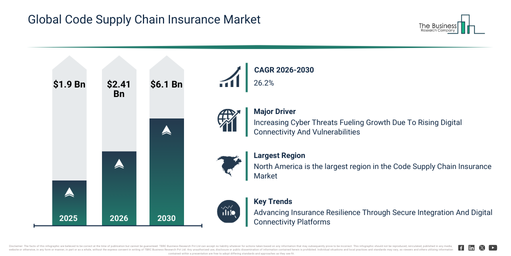
The code supply chain insurance market size has experienced substantial expansion in recent years. It is forecast to grow from $1.9 billion in 2025 to $2.41 billion in 2026, achieving a compound annual growth rate (CAGR) of 26.5%. This historical growth can be attributed to several factors, including an increasing reliance on third-party software components, a rise in software supply chain attacks, the expansion of cloud-native application development, a growing awareness of cyber insurance products, and early adoption by technology firms.
The code supply chain insurance market size is projected to experience substantial expansion over the coming years. It is anticipated to reach $6.1 billion by 2030, exhibiting a compound annual growth rate (CAGR) of 26.2%. This growth during the projection period is linked to heightened regulatory scrutiny on software security responsibility, a greater need for extensive cyber risk transfer solutions, increased adoption of DevSecOps, expanding integration of insurance with security tools, and growing reliance on software across various sectors. Key developments expected during this timeframe involve the increasing uptake of software supply chain risk protection, a greater call for open-source vulnerability safeguards, the broader availability of incident response insurance plans, a stronger emphasis on evaluating third-party code risks, and improved integration with DevSecOps methodologies.
Request Your Free Code Supply Chain Insurance Market Sample With Segment And Regional Data:
Code Supply Chain Insurance Market Growth Drivers And Their Impact On Future Demand
The escalating cyber threats are projected to stimulate the expansion of the code supply chain insurance market in the future. A cyber threat signifies any malicious attempt or potential danger designed to harm, disrupt, or gain unauthorized entry to computer systems, networks, or digital data. The increase in cyber threats is propelled by expanding digital connectivity, as the greater utilization of online platforms and connected devices generates more susceptibilities for malevolent attacks. Code supply chain insurance assists in confronting rising cyber threats by offering financial security and risk alleviation support against assaults or breaches originating from compromised third-party code and software dependencies. For instance, in July 2025, Check Point Software Technologies Ltd., an Israel-based cybersecurity company, disclosed that the global average of weekly cyberattacks per organization climbed to 1,984 in Q2 2025, indicating a 21% increase from the same period in 2024 and a 58% rise compared to two years earlier. Consequently, the proliferation of cyber threats is accelerating the growth of the code supply chain insurance market.
What Categories Define The Code Supply Chain Insurance Market?
The code supply chain insurance market covered in this report is segmented –
1) By Coverage Type: First-Party Coverage, Third-Party Liability, Business Interruption, Cyber Risk, Other Coverage Types
2) By Organization Size: Small And Medium Enterprises, Large Enterprises
3) By Distribution Channel: Direct Sales, Brokers, Online Platforms, Other Distribution Channels
4) By End-User: Technology Companies, Software Vendors, Managed Service Providers, Financial Institutions, Healthcare, Other End-Users
Subsegments:
1) By First-Party Coverage: Data Breach Expenses, Incident Response Costs, Digital Asset Restoration, System Damage Repair, Notification And Credit Monitoring
2) By Third-Party Liability: Technology Errors And Omissions, Vendor Negligence Claims, Contractual Liability, Legal Defense Costs, Regulatory Penalties
3) By Business Interruption: Operational Downtime Losses, Revenue Replacement, Supply Chain Disruption Coverage, Contingent Business Interruption, Extra Expense Reimbursement
4) By Cyber Risk: Malware And Ransomware Protection, Phishing And Social Engineering Coverage, Data Integrity Protection, Unauthorized Access Mitigation, Cloud Service Attack Coverage
5) By Other Coverage Types: Reputational Damage Coverage, Intellectual Property Infringement, System Failure Liability, Compliance And Audit Expense Coverage, Employee Misconduct Coverage
What New Developments Are Emerging In The Code Supply Chain Insurance Market?
Leading companies in the code supply chain insurance market are concentrating on developing innovative advancements, such as secure integration platforms, to improve operational efficiency, resilience, and risk control across interconnected insurance technology ecosystems. A secure integration platform functions as a cloud-based digital framework, enabling seamless, standardized, and protected data and system connectivity among multiple stakeholders, which in turn reduces cybersecurity risks and operational fragmentation in technology-driven environments. For instance, in October 2025, DXC Technology, a US-based global information technology services provider, launched the DXC APEX (Assure Platform Ecosystem Exchange) Program. This program introduces a centralized hub that facilitates certified, pre-built integrations between insurers, brokers, and Insurtech providers, significantly simplifying interoperability and lowering integration costs. It also enhances security, accelerates the adoption of emerging technologies, and supports the digital transformation of insurance operations through artificial intelligence–driven automation and compliance-enabled cloud services.
Major Players Driving Competition In The Code Supply Chain Insurance Market
Major companies operating in the code supply chain insurance market are AXA XL, Zurich Insurance Group, Lloyd’s of London, Chubb, Liberty Mutual Insurance, Tokio Marine Holdings, Swiss Re, Munich Re, Travelers Insurance, AIG (American International Group), Sompo International, Marsh McLennan, Allianz Global Corporate & Specialty, QBE Insurance Group, Markel Corporation, Arch Insurance Group, CNA Financial Corporation, Hiscox, Berkshire Hathaway Specialty Insurance, Beazley
View The Comprehensive Code Supply Chain Insurance Market Analysis:
Code Supply Chain Insurance Market Regional Leaders: Insights From The 2026 Report
North America was the largest region in the code supply chain insurance market in 2025. Asia-Pacific is expected to be the fastest-growing region in the forecast period. The regions covered in the code supply chain insurance market report are Asia-Pacific, South East Asia, Western Europe, Eastern Europe, North America, South America, Middle East, Africa.
Reach Out To Our Team:
The Business Research Company: https://www.thebusinessresearchcompany.com/
Americas: +1 310-496-7795
Asia: +44 7882 955267 & +91 8897263534
Europe: +44 7882 955267
Email us at: marketing@tbrc.info
Follow us on:
LinkedIn: https://in.linkedin.com/company/the-business-research-company
YouTube: https://www.youtube.com/channel/UC24_fI0rV8cR5DxlCpgmyFQ
Global Market Model: https://www.thebusinessresearchcompany.com/global-market-model

Wasay has over a decade of experience in market research, data modelling, and analytics, with prior experience at GlobalData and Decision Tree Consulting Services. At The Business Research Company , he leads research operations across syndicated studies, customized consulting engagements, and the Global Market Model platform. His professional experience includes supporting organizations such as Boston Consulting Group, KPMG, and Ernst & Young. Wasay holds a degree in Electronics and Communications Engineering, postgraduate management qualifications from International Management Institute Belgium and Indian School of Business and Entrepreneurship, and completed the Integrated Program in Business Analytics from Indian Institute of Management Indore.