The Business Research Company’s 2026 market reports are designed to deliver research that is more actionable and strategically valuable. Key offerings include market attractiveness scoring, total addressable market sizing, company benchmarking matrices, interactive Excel dashboards, deeper supply chain intelligence, emerging startup tracking, and granular product-level insights.
Which Factors Will Shape The Commercial Vehicle Insurance Market Size Through 2030?
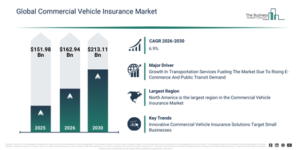
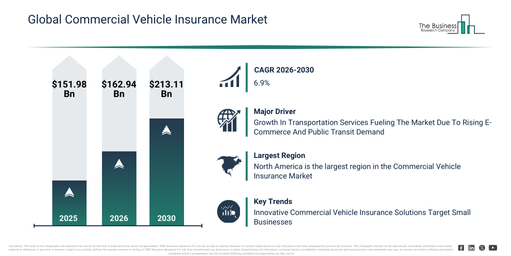
The commercial vehicle insurance market has experienced robust expansion in recent years. Projections indicate its value will rise from $151.98 billion in 2025 to $162.94 billion in 2026, demonstrating a compound annual growth rate (CAGR) of 7.2%. This historical increase is primarily due to factors such as the expansion of commercial vehicle fleets, heightened road freight and logistics activity, stricter regulatory insurance requirements, the proliferation of fleet ownership models, and the widespread adoption of standardized vehicle insurance products.
The commercial vehicle insurance market is anticipated to experience substantial expansion over the upcoming years. By 2030, its value is projected to reach $213.11 billion, exhibiting a compound annual growth rate (CAGR) of 6.9%. This growth during the forecast period stems from factors such as the expanding presence of electric commercial vehicles, the increasing use of data-driven approaches for insurance pricing, a heightened emphasis on optimizing fleet risks, the broader reach of digital insurance distribution, and a greater need for adaptable commercial vehicle coverage. Key trends anticipated during this period involve the rising uptake of telematics-based insurance products, an escalating demand for insuring electric commercial vehicles, the broadening scope of usage-based fleet insurance, the increased incorporation of digital systems for claims management, and a stronger commitment to adhering to regulatory standards.
Request A Free Commercial Vehicle Insurance Market Sample To Support Your Strategic Planning:
What Is Propelling The Commercial Vehicle Insurance Market Toward $213.11 Billion By 2030?
An expansion in transportation services is anticipated to drive the advancement of the commercial vehicle insurance market in the future. These services encompass the structured movement of individuals or products between locations using methods like road, rail, air, or water, thereby facilitating both personal journeys and business logistics. The growth of transportation services stems from the swift proliferation of e-commerce, which consequently boosts the demand for effective delivery and logistics networks to satisfy consumer needs. For transportation services, commercial vehicle insurance is crucial, offering protection to businesses against financial setbacks caused by accidents, theft, or damage to vehicles engaged in moving goods or passengers, thereby guaranteeing continuous operations and adherence to legal mandates. As an illustration, in May 2025, data from the American Public Transportation Association, a US-based trade group, indicated that public transportation users completed 7.7 billion trips in 2024. This figure represents a 7% increase compared to 2023 and a 25% surge since 2022. Consequently, the expansion of transportation services is fueling the rise of the commercial vehicle insurance market.
What Are The Key Segments And Subsegments In The Commercial Vehicle Insurance Market?
The commercial vehicle insurance market covered in this report is segmented –
1) By Coverage Type: Liability Coverage, Physical Damage Coverage, Medical Payments Coverage, Uninsured Or Underinsured Motorist Coverage, Other Coverage Types
2) By Vehicle Type: Light Commercial Vehicles (LCVs), Heavy Commercial Vehicles (HCVs), Electric Commercial Vehicles, Refrigerated Trucks, Specialized Vehicles
3) By Distribution Channel: Agents Or Brokers, Direct Response, Other Distribution Channels
4) By End User: Individual Owners, Fleet Owners, Logistics Companies, Public Transport Operators
Subsegments:
1) By Liability Coverage: Bodily Injury Liability, Property Damage Liability
2) By Physical Damage Coverage: Collision Coverage, Comprehensive Coverage, Fire And Theft Coverage, Specified Perils Coverage
3) By Medical Payments Coverage: Personal Injury Protection (PIP), No-Fault Medical Payments, Guest Passenger Coverage
4) By Uninsured Or Underinsured Motorist Coverage: Uninsured Motorist Bodily Injury, Uninsured Motorist Property Damage, Underinsured Motorist Coverage
5) By Other Coverage Types: Rental Reimbursement Coverage, Towing And Labor Coverage, Gap Insurance, Custom Equipment Coverage
Commercial Vehicle Insurance Market Trends Behind The 6.9% CAGR Forecast
Leading companies operating in the commercial vehicle insurance market are focusing on introducing innovative solutions, such as commercial vehicle insurance products specifically for small businesses, to provide affordable and comprehensive coverage. A commercial vehicle insurance product specifically for small businesses refers to a customized insurance policy that provides economical and flexible coverage for vehicles used by small enterprises, helping them protect against monetary losses from accidents, theft, or damage. For instance, in January 2025, Budget Direct Insurance, an Australia-based insurance company, launched a new commercial vehicle insurance product in Singapore, designed specifically for small businesses, contractors, tradespeople, and fleet managers who rely on light goods vehicles such as vans, lorries, and trucks. The product offers both comprehensive and third-party coverage plans, protecting against accidents, theft, and third-party liabilities. Customers can customize their policies with optional add-ons like 24-hour roadside assistance, a no-claim discount protector, and the any-workshop benefit that allows vehicle repairs at a preferred workshop.
Major Companies Profiled In The Commercial Vehicle Insurance Market Report
Major companies operating in the commercial vehicle insurance market are Berkshire Hathaway Inc., AXA S.A., Allianz SE, Munich Re, The People’s Insurance Company (Group) of China Limited, China Pacific Insurance (Group) Co. Ltd., American International Group Inc., The Progressive Corporation, Tokio Marine Holdings Inc., Talanx Aktiengesellschaft, Zurich Insurance Group Ltd., Chubb Limited, The Travelers Indemnity Company, Sompo Holdings Inc., MAPFRE S.A., The Hartford Financial Services Group Inc., QBE Insurance Group Limited, Auto-Owners Insurance Company, CNA Financial Corporation, Reliance General Insurance Company Limited, AmTrust Financial Services Inc.
Explore The Business Research Company’s Complete Commercial Vehicle Insurance Market Report:
Where Does The Commercial Vehicle Insurance Market Generate The Most Revenue?
North America was the largest region in the commercial vehicle insurance market in 2025. Asia-Pacific is expected to be the fastest-growing region in the forecast period. The regions covered in the commercial vehicle insurance market report are Asia-Pacific, South East Asia, Western Europe, Eastern Europe, North America, South America, Middle East, Africa.
Reach Out To Our Team:
The Business Research Company: https://www.thebusinessresearchcompany.com/
Americas: +1 310-496-7795
Asia: +44 7882 955267 & +91 8897263534
Europe: +44 7882 955267
Email us at: marketing@tbrc.info
Follow us on:
LinkedIn: https://in.linkedin.com/company/the-business-research-company
YouTube: https://www.youtube.com/channel/UC24_fI0rV8cR5DxlCpgmyFQ
Global Market Model: https://www.thebusinessresearchcompany.com/global-market-model

Wasay has over a decade of experience in market research, data modelling, and analytics, with prior experience at GlobalData and Decision Tree Consulting Services. At The Business Research Company , he leads research operations across syndicated studies, customized consulting engagements, and the Global Market Model platform. His professional experience includes supporting organizations such as Boston Consulting Group, KPMG, and Ernst & Young. Wasay holds a degree in Electronics and Communications Engineering, postgraduate management qualifications from International Management Institute Belgium and Indian School of Business and Entrepreneurship, and completed the Integrated Program in Business Analytics from Indian Institute of Management Indore.