With a focus on actionable insights and strategic value, The Business Research Company’s 2026 market reports include market attractiveness scoring, total addressable market sizing, company benchmarking matrices, interactive Excel dashboards, deeper supply chain intelligence, emerging startup tracking, and granular product-level insights.
Conventional Bank Automated Teller Machine Market Size Analysis: Historical Growth And Future Revenue Projections
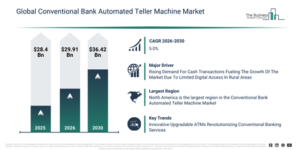
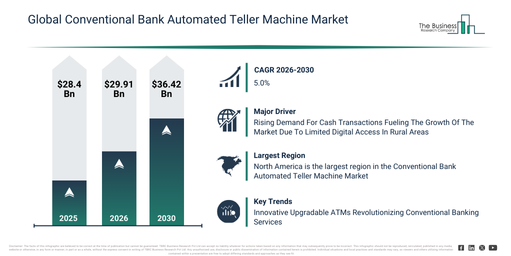
The conventional bank automated teller machine market size has experienced strong growth in recent years. It is projected to expand from $28.4 billion in 2025 to $29.91 billion in 2026, achieving a compound annual growth rate (CAGR) of 5.3%. Historically, this expansion has been driven by factors such as the proliferation of retail banking networks, a surge in demand for self-service banking channels, an increase in ATM deployments in urban and semi-urban regions, advancements in transaction processing systems, and the widespread use of card-based banking.
The market size for conventional bank automated teller machines is expected to show significant growth in the upcoming years. It is projected to increase to $36.42 billion by 2030, achieving a compound annual growth rate (CAGR) of 5.0%. This expansion during the forecast period can be attributed to a rising demand for secure cash access points, increased investments in ATM modernization, the proliferation of hybrid physical-digital banking models, an enhanced focus on fraud prevention technologies, and the continuing necessity for financial inclusion infrastructure. Major developments anticipated in this period involve the expanding deployment of contactless ATM interfaces, the increasing integration of advanced security features, a growing embrace of software-driven ATM upgrades, the broadening of multi-function ATM capabilities, and a heightened emphasis on network reliability and uptime.
Preview The Conventional Bank Automated Teller Machine Market Report With A Free Sample:
Conventional Bank Automated Teller Machine Market Drivers: What Is Fueling Demand Through 2030?
The increasing need for cash payments is anticipated to fuel the expansion of the conventional bank automated teller machine market moving forward. Cash transactions involve payments made with physical currency, such as coins or banknotes, rather than digital or electronic alternatives. This demand for cash is growing in rural areas due to limited access to digital infrastructure and inconsistent internet connectivity, which makes physical money a more reliable choice for daily purchases. Conventional bank automated teller machines are vital for cash transactions, as they allow users to conveniently withdraw or deposit physical currency without needing to visit a bank branch. For instance, in January 2025, according to CashEssentials, a Greece-based independent think tank, there were approximately 32.8 million cash withdrawals across its 1,260 ATMs and 605 branches in 2024, indicating a 10% rise compared to 2023. Consequently, the rising demand for cash transactions is propelling the growth of the conventional bank automated teller machine market.
Conventional Bank Automated Teller Machine Market Segmentation Analysis: Core Categories And Subcategories
The conventional bank automated teller machine market covered in this report is segmented –
1) By Type: Stand-Alone Automated Teller Machines (ATMs), Wall-Mounted Automated Teller Machines (ATMs), Floorstanding Automated Teller Machines (ATMs)
2) By Component: Hardware, Software, Services
3) By Transaction Types: Cash Withdrawals, Balance Inquiries, Fund Transfers, Bill Payments, Check Deposits
4) By Technology Usage: Conventional Automated Teller Machines (ATMs), Semi-Interactive Automated Teller Machines (ATMs), Fully Interactive Automated Teller Machines (ATMs), Contactless Automated Teller Machines (ATMs), Mobile-Integrated Automated Teller Machines (ATMs)
5) By End User: Banking, Retail, Government, Hospitals, Other End Users
Subsegments:
1) By Stand-Alone Automated Teller Machines: Compact Stand-Alone Automated Teller Machine, Weather-Resistant Stand-Alone Automated Teller Machine, Drive-Up Stand-Alone Automated Teller Machine
2) By Wall-Mounted Automated Teller Machines: Indoor Wall-Mounted Automated Teller Machine, Outdoor Wall-Mounted Automated Teller Machine, Recessed Wall-Mounted Automated Teller Machine
3) By Floorstanding Automated Teller Machines: Lobby Floorstanding Automated Teller Machine, Through-The-Wall Floorstanding Automated Teller Machine, Island Floorstanding Automated Teller Machine
Which Trends Will Define The Conventional Bank Automated Teller Machine Market Through 2030?
Major companies in the conventional bank automated teller machine market are prioritizing the introduction of advanced ATM solutions, such as upgradable automated teller machines, to boost functionality, decrease operational costs, and address evolving customer and regulatory demands. Upgradable automated teller machines are defined as modular ATMs capable of being enhanced with new hardware or software capabilities, enabling banks to adapt to emerging technologies and customer requirements without replacing the entire unit. For example, in April 2024, Hitachi Payment Services Ltd., a Japan-based provider of various payment solutions, unveiled India’s first upgradable ATM, a device that initially provides cash withdrawal services and can be efficiently upgraded to a high-performance cash recycling machine (CRM) whenever necessary. This upgrade, which takes only about 4 hours, bypasses the costly and prolonged process of replacing ATMs, allowing banks to secure their investment and extend services like cash deposits at non-branch locations based on market dynamics. Designed under the Make in India initiative, these ATMs also facilitate UPI-based cash withdrawals and deposits, aligning with recent RBI policies, which enhances banking flexibility and promotes financial inclusion in underserved regions.
Conventional Bank Automated Teller Machine Market Major Companies And Industry Participants
Major companies operating in the conventional bank automated teller machine market are Hitachi Ltd., Fujitsu Limited, NCR Corporation, Diebold Nixdorf Incorporated, Euronet Worldwide Inc., Tietoevry Corporation, OKI Electric Industry Co. Ltd., Genmega Inc., Hyosung TNS Inc., ACI Worldwide Inc., GRG Banking Equipment Co. Ltd., KEBA AG, Nautilus Hyosung America Inc., Auriga SpA, KAL ATM Software GmbH, Sigma S.p.A, Vortex Engineering Pvt Ltd, Automated Transaction Delivery Ltd., Ark Technologies Group, CMS Info Systems Ltd., Triton Systems of Delaware LLC, Puloon Technology Co. Ltd.
Buy The Full Conventional Bank Automated Teller Machine Global Market Report 2026:
Conventional Bank Automated Teller Machine Market Geographic Analysis: Which Region Accounts For The Biggest Share?
North America was the largest region in the conventional bank automated teller machine market in 2025. Asia-Pacific is expected to be the fastest-growing region in the forecast period. The regions covered in the conventional bank automated teller machine market report are Asia-Pacific, South East Asia, Western Europe, Eastern Europe, North America, South America, Middle East, Africa.
Reach Out To Our Team:
The Business Research Company: https://www.thebusinessresearchcompany.com/
Americas: +1 310-496-7795
Asia: +44 7882 955267 & +91 8897263534
Europe: +44 7882 955267
Email us at: marketing@tbrc.info
Follow us on:
LinkedIn: https://in.linkedin.com/company/the-business-research-company
YouTube: https://www.youtube.com/channel/UC24_fI0rV8cR5DxlCpgmyFQ
Global Market Model: https://www.thebusinessresearchcompany.com/global-market-model

Wasay has over a decade of experience in market research, data modelling, and analytics, with prior experience at GlobalData and Decision Tree Consulting Services. At The Business Research Company , he leads research operations across syndicated studies, customized consulting engagements, and the Global Market Model platform. His professional experience includes supporting organizations such as Boston Consulting Group, KPMG, and Ernst & Young. Wasay holds a degree in Electronics and Communications Engineering, postgraduate management qualifications from International Management Institute Belgium and Indian School of Business and Entrepreneurship, and completed the Integrated Program in Business Analytics from Indian Institute of Management Indore.