The Business Research Company’s 2026 market reports are designed to deliver research that is more actionable and strategically valuable. Key offerings include market attractiveness scoring, total addressable market sizing, company benchmarking matrices, interactive Excel dashboards, deeper supply chain intelligence, emerging startup tracking, and granular product-level insights.
Decentralized Insurance Market Size Insights: Annual Growth Rate, Revenue Outlook And Forecast Drivers
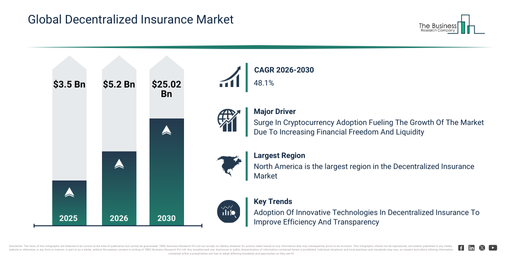
The decentralized insurance market has experienced substantial expansion in recent years. This market is projected to expand from $3.5 billion in 2025 to $5.2 billion in 2026, exhibiting a compound annual growth rate (CAGR) of 48.6%. Historically, its growth can be attributed to the rise of decentralized finance ecosystems, a higher occurrence of smart contract vulnerabilities, the initial adoption of blockchain-based financial services, the constraints of traditional insurance intermediaries, and the increasing volume of crypto-native risk exposure.
The decentralized insurance market size is projected to experience substantial growth over the coming years. This market is anticipated to reach $25.02 billion by 2030, exhibiting a compound annual growth rate (CAGR) of 48.1%. This expansion during the forecast period can be largely attributed to factors such as enhanced regulatory clarity for digital assets, increasing involvement of institutions in DeFi insurance, broader cross-chain insurance offerings, a rising need for automated and immediate claims processing, and improvements in decentralized governance models. Key developments expected within the forecast period encompass a surge in the adoption of smart contract-based insurance, the increasing deployment of peer-to-peer risk sharing protocols, the greater integration of automated claims settlement mechanisms, an expansion of coverage solutions at the protocol level, and a heightened emphasis on transparent and trustless insurance frameworks.
Request A Free Excerpt Of The Decentralized Insurance Global Market Report 2026:
What Will Drive Decentralized Insurance Market Growth Through 2030?
The increasing adoption of cryptocurrencies is expected to propel the growth of the decentralized insurance market going forward. Cryptocurrencies are digital or virtual currencies that use cryptography for secure transactions and operate on decentralized networks, typically based on blockchain technology. Their adoption is growing as they provide financial freedom by allowing users to make transactions without the need for traditional banks or government control. Decentralized insurance in crypto offers transparent, trustless protection against blockchain-related risks through smart contracts and community-funded pools. For instance, in November 2024, according to the Financial Conduct Authority, a UK-based financial regulatory body, 12% of UK adults now own cryptocurrency, up from 10% previously, while awareness has increased from 91% to 93%. The average value of crypto holdings has risen from $2,000 (£1,595) to $2,300 (£1,842). Therefore, the increasing adoption of cryptocurrencies is driving the growth of the decentralized insurance market.
Decentralized Insurance Market Segment Analysis Covering All Major Categories
The decentralized insurance market covered in this report is segmented –
1) By Coverage Type: Smart Contract Failure Insurance, Protocol Hack And Exploit Insurance, Stablecoin De-Peg Insurance, Oracle Failure Insurance, Custodial And Wallet Risk Insurance, Yield Loss And Slashing Risk Insurance, Cross-Chain Bridge Risk Insurance
2) By Technology: Blockchain, Smart Contracts, Decentralized Oracles, Distributed Ledger Technology, Cryptographic Risk Pools
3) By Insurance Model: Peer-To-Peer (P2P) Insurance, On-Chain Mutual Insurance, DAO-Governed Insurance, Parametric Insurance, Open-Source Insurance Protocols
4) By Application: Protocol Risk Coverage, Claims Automation And Settlement, On-Chain Risk Assessment, Decentralized Underwriting, Liquidity Pool And Capital Management, Insurance Aggregation And Marketplaces
5) By End-User: DeFi Protocols, Cryptocurrency Exchanges, DAO Treasury Managers, Retail DeFi Users, Institutional DeFi Participants
Subsegments:
1) By Smart Contract Failure Insurance: Code Vulnerability And Bug Exploit Coverage, Upgrade And Migration Failure Coverage, Governance Attack And Malicious Proposal Coverage, Flash Loan Attack Coverage, Reentrancy And Logic Error Coverage
2) By Protocol Hack And Exploit Insurance: Liquidity Pool Drain Coverage, Protocol Exploit And Theft Coverage, Governance Takeover Coverage, Insider Key Compromise Coverage, Front-Running And MEV Exploit Coverage
3) By Stablecoin De-Peg Insurance: Fiat-Backed Stablecoin De-Peg Coverage, Crypto-Collateralized Stablecoin De-Peg Coverage, Algorithmic Stablecoin Collapse Coverage, Peg Deviation Threshold Trigger Coverage, Liquidity Run And Redemption Failure Coverage
4) By Oracle Failure Insurance: Price Feed Manipulation Coverage, Oracle Downtime And Latency Coverage, Incorrect Data Submission Coverage, Single-Oracle Dependency Failure Coverage, Cross-Chain Oracle Mismatch Coverage
5) By Custodial And Wallet Risk Insurance: Smart Wallet Contract Failure Coverage, Private Key Compromise Coverage, Multi-Signature Wallet Failure Coverage, Custodian Insolvency Coverage, Phishing And Social Engineering Loss Coverage
6) By Yield Loss And Slashing Risk Insurance: Validator Slashing Coverage, Yield Farming Exploit Coverage, Staking Reward Reduction Coverage, Liquidity Pool Impermanent Loss Coverage, Lock-Up And Withdrawal Failure Coverage
7) By Cross-Chain Bridge Risk Insurance: Bridge Contract Exploit Coverage, Relay And Validator Failure Coverage, Asset Lock-Up And Transfer Failure Coverage, Wrapped Asset Devaluation Coverage, Cross-Chain Message Manipulation Coverage
Major Trends Shaping The Future Of The Decentralized Insurance Market
Leading companies within the decentralized insurance market are concentrating on developing innovative solutions, such as risk management infrastructure layers, to boost efficiency and transparency. This risk management infrastructure layer facilitates decentralized insurance by assessing, pricing, and mitigating risks through data analytics and smart contract automation. For instance, in March 2023, Nexus Mutual, a UK-based decentralized insurance provider, introduced Nexus Mutual v2 on the Ethereum mainnet. This upgrade brought in a modular system, allowing users to establish and manage their own mutuals for various risk types, including smart contract and custody risk. The new version supports permissionless product development, cross-chain functionality, and enhanced capital efficiency, thereby enabling broader participation in decentralized risk-sharing. Nexus Mutual v2 aims to accelerate the expansion of blockchain-based insurance by fostering innovation and community-driven insurance models.
Decentralized Insurance Market Competitive Environment And Key Companies
Major companies operating in the decentralized insurance market are Nexus Mutual, Etherisc, Tidal Finance, Neptune Mutual, Unslashed Finance, Bridge Mutual, InsurAce, Risk Harbor, Solace, Cover Protocol, Sherlock, Opyn, Bright Union, OpenCover, Armor, Nsure Network, Uno Re, Yinsure, VouchForMe, Ease
Access Expert Decentralized Insurance Market Analysis In The Full Report:
Which Regions Are Covered In The Decentralized Insurance Market Report?
North America was the largest region in the decentralized insurance market in 2025. Europe is expected to be the fastest-growing region in the forecast period. The regions covered in the decentralized insurance market report are Asia-Pacific, South East Asia, Western Europe, Eastern Europe, North America, South America, Middle East, Africa.
Reach Out To Our Team:
The Business Research Company: https://www.thebusinessresearchcompany.com/
Americas: +1 310-496-7795
Asia: +44 7882 955267 & +91 8897263534
Europe: +44 7882 955267
Email us at: marketing@tbrc.info
Follow us on:
LinkedIn: https://in.linkedin.com/company/the-business-research-company
YouTube: https://www.youtube.com/channel/UC24_fI0rV8cR5DxlCpgmyFQ
Global Market Model: https://www.thebusinessresearchcompany.com/global-market-model

Wasay has over a decade of experience in market research, data modelling, and analytics, with prior experience at GlobalData and Decision Tree Consulting Services. At The Business Research Company , he leads research operations across syndicated studies, customized consulting engagements, and the Global Market Model platform. His professional experience includes supporting organizations such as Boston Consulting Group, KPMG, and Ernst & Young. Wasay holds a degree in Electronics and Communications Engineering, postgraduate management qualifications from International Management Institute Belgium and Indian School of Business and Entrepreneurship, and completed the Integrated Program in Business Analytics from Indian Institute of Management Indore.