The Business Research Company’s 2026 market reports are designed to deliver research that is more actionable and strategically valuable. Key offerings include market attractiveness scoring, total addressable market sizing, company benchmarking matrices, interactive Excel dashboards, deeper supply chain intelligence, emerging startup tracking, and granular product-level insights.
Employee Stock Ownership Plan Market Revenue Projected To Rise To $3.32 Billion By 2030
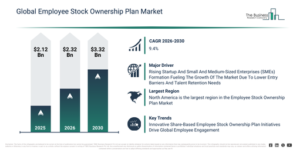
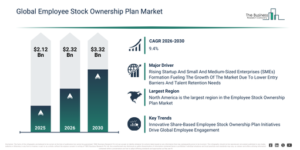
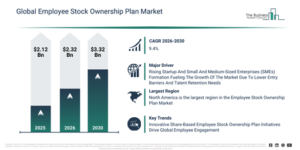
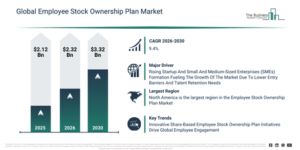
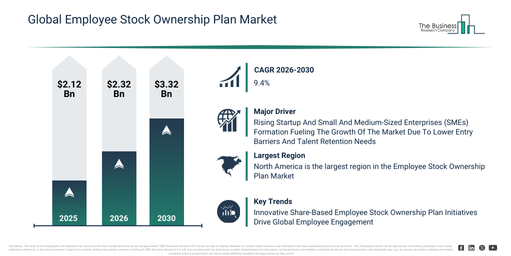
The market size for employee stock ownership plans has experienced robust growth recently. This market is projected to expand from $2.12 billion in 2025 to $2.32 billion in 2026, exhibiting a compound annual growth rate (CAGR) of 9.4%. Factors contributing to the historical growth include broader acceptance of employee ownership frameworks, the presence of favorable tax structures, a heightened focus on long-term workforce stability, increased adoption by privately held companies, and the development of a growing advisory ecosystem for ESOPs.
The employee stock ownership plan market is projected to experience robust expansion over the coming years, reaching $3.32 billion in 2030 at a compound annual growth rate (CAGR) of 9.4%. This growth can be attributed to several factors, including the increasing implementation of ESOPs in mid-sized enterprises, escalating demand for ownership transition solutions, broader availability of digital compliance and reporting instruments, a heightened emphasis on employee wealth accumulation, and a growing enthusiasm for inclusive corporate governance practices. Key trends during this period are the rising adoption of ESOPs for succession planning, increased utilization of digital platforms for ESOP administration, a burgeoning interest in employee ownership models, the broadening of leveraged ESOP frameworks, and an intensified focus on strategies for employee retention.
Want Deeper Employee Stock Ownership Plan Market Insights? Get A Free Sample Report:
Primary Growth Driver Shaping The Employee Stock Ownership Plan Market Outlook
The expanding presence of startups and small and medium-sized enterprises (SMEs) is projected to drive the expansion of the employee stock ownership plan market in the future. Startups and SMEs are defined as newly formed or small-to-medium scale businesses instrumental in fostering innovation, economic development, and employment opportunities. The count of startups and SMEs is escalating quickly because digital technology advancements have considerably reduced entry barriers, enabling entrepreneurs to readily utilize online tools, platforms, and markets for accelerated growth and cost reduction. An employee stock ownership plan (ESOP) assists startups and small and medium-sized enterprises (SMEs) in attracting and retaining skilled individuals, enhancing employee enthusiasm, and aligning their goals with the company’s achievements through shared equity. For example, data from November 2024, provided by the House of Commons of the United Kingdom, a UK governing body, indicated that in 2024, the UK hosted 5.5 million small and medium-sized enterprises (SMEs), constituting more than 99% of all businesses. These SMEs were responsible for 60% of the nation’s employment and contributed 48% of the overall business turnover. Consequently, the rising volume of startups and small and medium-sized enterprises (SMEs) is fueling the expansion of the employee stock ownership plan market.
Employee Stock Ownership Plan Market Structure: A Detailed Look At Segments And Subsegments
The employee stock ownership plan market covered in this report is segmented –
1) By Plan Type: Stock Bonus Plans, Employee Stock Ownership Trusts, Leveraged Employee Stock Ownership Plan, Non-Leveraged Employee Stock Ownership Plan
2) By Vesting Schedule: Immediate Vesting, Graded Vesting, Cliff Vesting
3) By Ownership Structure: Partial Ownership, Full Ownership
4) By Company Size: Small Enterprises, Medium Enterprises, Large Enterprises
5) By Industry: Manufacturing, Retail, Healthcare, Finance And Insurance, Technology, Construction, Professional Services, Energy, Real Estate
Subsegments:
1) By Stock Bonus Plans: Stock Bonus Plans, Deferred Profit Sharing Plans, Direct Stock Transfer Plans, Restricted Stock Bonus Plans, Phantom Stock Plans
2) By Employee Stock Ownership Trusts (ESOTs): Non-Leveraged Employee Stock Ownership Trusts, Leveraged Employee Stock Ownership Trusts, Hybrid Employee Stock Ownership Trusts
3) By Leveraged Employee Stock Ownership Plan: Bank-Financed Leveraged Employee Stock Ownership Plan, Seller-Financed Leveraged Employee Stock Ownership Plan, SBA-Guaranteed Leveraged Employee Stock Ownership Plan
4) By Non-Leveraged Employee Stock Ownership Plan: Contributory Employee Stock Ownership Plan, Non-Contributory Employee Stock Ownership Plan
Employee Stock Ownership Plan Market Innovation And Strategy Trends Among Leading Companies
Major companies in the employee stock ownership plan market are concentrating on introducing innovative solutions, such as share-based stock ownership plans, to improve employee participation in corporate equity and strengthen long-term organizational commitment. Share-based stock ownership plans are employee benefit schemes that enable workers to acquire company shares, typically at a discount or as a component of their compensation, to foster ownership, loyalty, and alignment with corporate performance. For instance, in April 2024, Eni SpA, an Italy-based oil industry company, launched its new employee stock ownership plan aimed at providing shareholding opportunities to over 65,000 employees across 62 countries. The plan allows employees to invest a portion of their salary in company shares at a reduced rate, with the potential for additional free shares based on performance and holding period. This initiative is designed to strengthen employee commitment, align workforce goals with corporate performance, and cultivate a stronger sense of inclusion in the company’s long-term strategy.
Top Companies Competing In The Employee Stock Ownership Plan Market
Major companies operating in the employee stock ownership plan market are Principal Financial Group Inc., BDO USA LLP, WinCo Foods LLC, Brookshire Brothers Ltd., Hatch Ltd., Recology Inc., Kroll LLC, SC&H Capital LLC, Blue Hippo LLC, Veritas Capital Fund Management LLC, Argent Financial Group LLC, Chartwell Financial Advisory LLC, Penmac Holdings LLC, GBQ Capital Advisors LLC, FMI Capital Advisors LLC, GreatBanc Trust Company, Trout CPA LLC, Wright Ford Young And Co. P.C., The Menke Group Ltd., Capstone Partners LLC, Praxis Consulting Group Inc.
View The Complete Employee Stock Ownership Plan Market Study With Segment And Regional Data:
Employee Stock Ownership Plan Market Regional Outlook Across Major Geographies
North America was the largest region in the employee stock ownership plan market in 2025. Asia-Pacific is expected to be the fastest-growing region in the forecast period. The regions covered in the employee stock ownership plan market report are Asia-Pacific, South East Asia, Western Europe, Eastern Europe, North America, South America, Middle East, Africa.
Reach Out To Our Team:
The Business Research Company: https://www.thebusinessresearchcompany.com/
Americas: +1 310-496-7795
Asia: +44 7882 955267 & +91 8897263534
Europe: +44 7882 955267
Email us at: marketing@tbrc.info
Follow us on:
LinkedIn: https://in.linkedin.com/company/the-business-research-company
YouTube: https://www.youtube.com/channel/UC24_fI0rV8cR5DxlCpgmyFQ
Global Market Model: https://www.thebusinessresearchcompany.com/global-market-model

Wasay has over a decade of experience in market research, data modelling, and analytics, with prior experience at GlobalData and Decision Tree Consulting Services. At The Business Research Company , he leads research operations across syndicated studies, customized consulting engagements, and the Global Market Model platform. His professional experience includes supporting organizations such as Boston Consulting Group, KPMG, and Ernst & Young. Wasay holds a degree in Electronics and Communications Engineering, postgraduate management qualifications from International Management Institute Belgium and Indian School of Business and Entrepreneurship, and completed the Integrated Program in Business Analytics from Indian Institute of Management Indore.