Backed by market attractiveness analysis, total addressable market sizing, company benchmarking matrices, interactive Excel dashboards, wider supply chain intelligence, emerging startup coverage, and detailed product-level insights, The Business Research Company’s 2026 market reports are designed to offer research that is more actionable and strategically valuable than ever.
Enterprise Asset Leasing Market Size Forecast: How Big Could The Market Get By 2030?
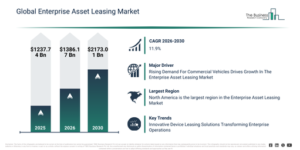
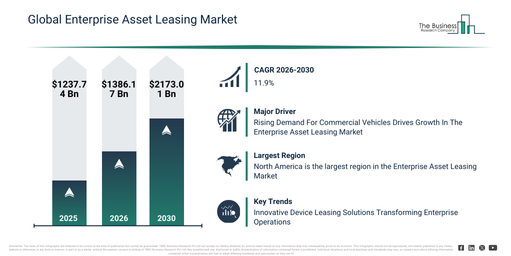
The enterprise asset leasing market has seen rapid expansion in recent years. This market is projected to increase from $1237.74 billion in 2025 to $1386.17 billion by 2026, registering a compound annual growth rate (CAGR) of 12.0%. Historically, this growth can be attributed to several factors including the expansion of capital-intensive industries, a heightened demand for operational flexibility, the broadening of commercial vehicle leasing, increased adoption of industrial automation equipment, and the availability of structured leasing products.
The enterprise asset leasing market size is poised for significant expansion in the upcoming years. It is forecast to climb to $2173.01 billion by 2030, demonstrating a compound annual growth rate (CAGR) of 11.9%. The projected increase can be attributed to several factors, including a growing demand for leasing electric and sustainable assets, the increasing digitalization of lease lifecycle management, the broader adoption of leasing among small and medium enterprises, a heightened focus on circular economy asset utilization, and the increased application of data-driven methods for leasing risk assessment. Notable trends during this period encompass a rising preference for asset-light business models, an increasing need for flexible leasing solutions, the expanding integration of technology-enabled lease management, a widening scope of leasing for advanced and electric assets, and an intensified emphasis on cost optimization and cash flow management.
Get A Free Sample Report With In-Depth Market Insights:
Enterprise Asset Leasing Market Growth Momentum: What Factors Are Shaping Demand?
The enterprise asset leasing market is expected to experience growth in the future, propelled by the increasing demand for commercial vehicles. These vehicles are specifically designed for business purposes, involving the transport of goods or passengers. They are indispensable to various industries, including logistics, transportation, construction, and public services. The escalating demand for commercial vehicles stems from factors such as growing urbanization, expanding industrial sectors, and a heightened need for goods and services. Enterprise asset leasing provides crucial support for commercial vehicles by offering businesses adaptable financing options, enabling them to procure and maintain their fleets without incurring significant upfront costs. For example, in January 2024, the European Automobile Manufacturers Association, a Belgium-based automotive industry trade association, reported that new car sales in the European Union reached 10.5 million in 2023, a 13.9% increase over 2022. Therefore, the rising demand for commercial vehicles is a key driver for the growth of the enterprise asset leasing market.
Enterprise Asset Leasing Market Segment Analysis: What Are The Core Market Categories?
The enterprise asset leasing market covered in this report is segmented –
1) By Asset Type: Commercial Vehicles, Machinery And Industrial Equipment, Real Estate, Information Technology (IT) Equipment, Other Asset Types
2) By Leasing Type: Operating Lease, Financial Lease
3) By Enterprise Size: Large Enterprises, Small And Medium Enterprises
4) By Industry Vertical: Transportation And Logistics, Manufacturing, Construction, Information Technology (IT) And Telecommunications, Government And Public Sector, Other Industry Verticals
Subsegments:
1) By Commercial Vehicles: Leasing Of Trucks And Lorries, Leasing Of Vans And Light Commercial Vehicles, Leasing Of Heavy-Duty Vehicles, Leasing Of Refrigerated Vehicles, Leasing Of Electric Commercial Vehicles
2) By Machinery And Industrial Equipment: Leasing Of Construction Equipment, Leasing Of Agricultural Machinery, Leasing Of Manufacturing Equipment, Leasing Of Material Handling Equipment, Leasing Of Mining And Excavation Equipment
3) By Real Estate: Leasing Of Office Spaces, Leasing Of Industrial And Warehouse Properties, Leasing Of Retail Spaces, Leasing Of Residential Properties For Corporate Use, Leasing Of Mixed-use Properties
4) By Information Technology (It) Equipment: Leasing Of Computers And Workstations, Leasing Of Servers And Data Center Equipment, Leasing Of Networking Equipment, Leasing Of Office Electronics, Leasing Of Software And It Infrastructure
5) By Other Asset Types: Leasing Of Aircraft, Leasing Of Marine Vessels, Leasing Of Healthcare Equipment, Leasing Of Tools And Equipment For Specialized Industries, Leasing Of Renewable Energy Equipment
Enterprise Asset Leasing Market Trends Redefining Industry Growth
Major companies operating in the enterprise asset leasing market are concentrating on developing innovative solutions, such as Device as a Service (DaaS), to enhance operational efficiency, decrease initial costs, and provide adaptable access to technology assets. Device as a service (DaaS) functions as a subscription-based financing model, enabling enterprises or individuals to obtain IT devices like laptops, desktops, smartphones, tablets, or other hardware through regular payments instead of purchasing them outright, with ownership remaining with the service provider. For instance, in January 2024, Jio Financial Services Limited (JFS), an India-based public financial services company, launched a DaaS-based rental offering covering laptops, mobile phones, and its proprietary AirFiber devices. Under this arrangement, JFS, via its subsidiary, leases these devices rather than selling them, while also managing their maintenance, upgrades, and support. This solution empowers enterprises to deploy and expand device fleets more efficiently, streamlines asset management, preserves working capital, and allows customers to return or upgrade hardware as their business requirements evolve.
Enterprise Asset Leasing Market Top Companies Driving Competitive Growth
Major companies operating in the enterprise asset leasing market are General Electric Company, John Deere Financial, BNP Paribas SA, Komatsu Financial LP, Liebherr-International Deutschland GmbH, Wells Fargo & Company, Orix Corporation, LeasePlan Corporation N.V., United Rentals Inc., Deutsche Leasing AG, Fifth Third Bank, Ashtead Group plc, Bohai Leasing Co. Ltd., Herc Rentals Inc., Caterpillar Financial Services Corporation, CIT Group Inc., De Lage Landen International BV, Maxim Crane Works L.P., Ahern Rentals Inc., Marlin Business Services Corp., BlueLine Rental, Mitsubishi HC Capital Inc., Mexarrend S.A.P.I. de C.V., ICBC Financial Leasing Co. Ltd
View The Full Enterprise Asset Leasing Market Report:
Enterprise Asset Leasing Market Regional Analysis: Which Geography Leads On Revenue?
North America was the largest region in the enterprise asset leasing market in 2025. Asia-Pacific is expected to be the fastest-growing region in the forecast period. The regions covered in the enterprise asset leasing market report are Asia-Pacific, South East Asia, Western Europe, Eastern Europe, North America, South America, Middle East, Africa.
Reach Out To Our Team:
The Business Research Company: https://www.thebusinessresearchcompany.com/
Americas: +1 310-496-7795
Asia: +44 7882 955267 & +91 8897263534
Europe: +44 7882 955267
Email us at: marketing@tbrc.info
Follow us on:
LinkedIn: https://in.linkedin.com/company/the-business-research-company
YouTube: https://www.youtube.com/channel/UC24_fI0rV8cR5DxlCpgmyFQ
Global Market Model: https://www.thebusinessresearchcompany.com/global-market-model

Wasay has over a decade of experience in market research, data modelling, and analytics, with prior experience at GlobalData and Decision Tree Consulting Services. At The Business Research Company , he leads research operations across syndicated studies, customized consulting engagements, and the Global Market Model platform. His professional experience includes supporting organizations such as Boston Consulting Group, KPMG, and Ernst & Young. Wasay holds a degree in Electronics and Communications Engineering, postgraduate management qualifications from International Management Institute Belgium and Indian School of Business and Entrepreneurship, and completed the Integrated Program in Business Analytics from Indian Institute of Management Indore.