The Business Research Company’s 2026 market reports combine market attractiveness scoring, total addressable market sizing, company benchmarking matrices, interactive Excel dashboards, deeper supply chain intelligence, emerging startup tracking, and granular product-level insights to deliver research that is more actionable and strategically valuable.
Excess Liability Insurance Market Size Review: What Shaped Past Growth And What Will Drive Future Expansion?
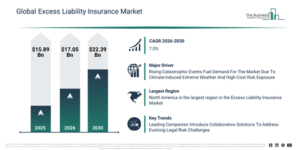
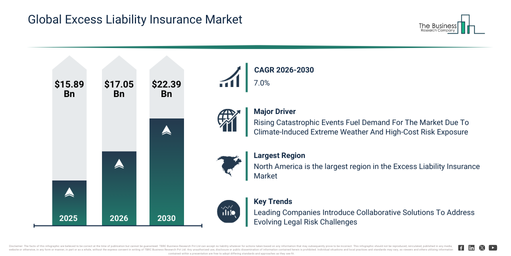
The excess liability insurance market size has shown strong growth in recent years. It is expected to increase from $15.89 billion in 2025 to $17.05 billion in 2026, achieving a compound annual growth rate (CAGR) of 7.3%. Historically, this market expansion can be attributed to the rising frequency of large liability claims, increasing litigation costs, the expansion of commercial insurance portfolios, growing awareness of risk exposure, and the development of layered insurance structures.
The excess liability insurance market is set to experience robust expansion over the next few years. It is projected to reach $22.39 billion by 2030, demonstrating a compound annual growth rate (CAGR) of 7.0%. This anticipated growth during the forecast period is driven by factors such as increasing demand from high-risk industries, the rising complexity of enterprise risk profiles, a growing need for umbrella liability protection, the expansion of digital insurance distribution, and an increasing focus on balance sheet protection. Key trends anticipated during this period include a rising demand for higher coverage limits, the growing customization of excess liability policies, an increasing adoption of industry-specific coverage, the expansion of broker-led risk advisory models, and an enhanced focus on catastrophic risk protection.
Access Free Sample Pages From The Excess Liability Insurance Market Report 2026:
Understanding The Main Driver Of The Excess Liability Insurance Market
The anticipated expansion of the excess liability insurance market is attributed to the rising occurrence and intensity of catastrophic events. These events are defined as extreme, unforeseen occurrences causing extensive damage, significant financial losses, or major disturbances to societies and infrastructure. Their increase stems from climate change, which exacerbates natural calamities like floods, wildfires, and hurricanes through altered weather patterns and elevated global temperatures. Excess liability insurance offers crucial protection for both businesses and individuals during such crises, extending financial coverage beyond standard primary policies to cover expensive claims resulting from extensive damage, injuries, or legal responsibilities. For example, the National Centers for Environmental Information (NCEI), a US government entity, reported in January 2024 that the US recorded an unprecedented 28 distinct weather and climate disasters in 2023, each incurring damages of at least $1 billion, marking the highest annual total ever. Consequently, the escalating incidence and intensity of catastrophic occurrences are fueling the expansion of the excess liability insurance sector.
Excess Liability Insurance Market Segment Mapping For 2026 And Beyond
The excess liability insurance market covered in this report is segmented –
1) By Coverage Type: Commercial Umbrella, Personal Umbrella, Follow-Form Excess, Stand-Alone Excess, Industry-Pacific Coverage
2) By Coverage Limit: Up To USD 5 Million, USD 5-10 Million, USD 10-50 Million, Above USD 50 Million
3) By Distribution Channel: Direct Sale, Brokers, Online Platforms, Agents, Bancassurance
4) By Application: Individual, Enterprise
5) By Industry: Healthcare, Construction, Manufacturing, Retail, Financial Services, Transportation And Logistics, Energy And Utilities
Subsegments:
1) By Commercial Umbrella: General Liability, Commercial Auto Liability, Employer’s Liability
2) By Personal Umbrella: Homeowners Liability, Auto Liability, Watercraft Liability
3) By Follow-Form Excess: General Liability Follow-Form, Auto Liability Follow-Form, Employer’s Liability Follow-Form
4) By Stand-Alone Excess: Specialized Excess Liability, Customized Policy Limits, Non-Standard Risk Coverage
5) By Industry-Specific Coverage: Construction, Healthcare, Manufacturing
What Key Trend Is Expected To Shape The Excess Liability Insurance Market Over The Forecast Period?
Leading companies operating in the excess liability insurance market are concentrating on creating novel solutions, such as the claims-made lead umbrella program, to improve coverage adaptability, simplify claims processing, and satisfy clients’ changing risk management requirements. A claims-made lead umbrella program denotes an excess liability insurance policy that delivers supplementary coverage beyond primary policies, activated by claims reported within the policy timeframe, and is structured as the initial layer of excess coverage, extending comprehensive protection over several underlying policies. As an illustration, in May 2025, Chubb Corporation, alongside Zurich North America and National Indemnity Company, three US-based insurance providers, introduced a new excess casualty facility offering up to $100 million in lead excess casualty insurance capacity on a claims-made basis. This unique facility, underwritten by Chubb and Zurich with backing from National Indemnity (Berkshire Hathaway’s primary reinsurer), aims to tackle the difficulties of an increasingly aggressive litigation landscape and a fluctuating excess casualty market by ensuring simplified insurance procurement, uniform coverage conditions, and professional claims management. The facility commenced underwriting immediately, with coverage effective from July 1, 2025, in the United States, representing a joint endeavor to present inventive and sustainable insurance options for major corporate clients confronting escalating legal exposures.
Excess Liability Insurance Market Major Players And Industry Competition Overview
Major companies operating in the excess liability insurance market are Allianz SE, Munich Re, American International Group Inc., Liberty Mutual Insurance Company, The Hartford Financial Services Group Inc., Fairfax Financial Holdings Limited, QBE Insurance Ltd., W. R. Berkley Corporation, Swiss Re Group, RLI Corporation, Chubb Limited, Travelers Companies Inc., Zurich Insurance Group, AXA S.A., Tokio Marine Holdings Inc., CNA Financial Corporation, Assicurazioni Generali S.p.A., MAPFRE S.A., HDI Global SE, Everest Group Ltd., Arch Capital Group Ltd., MS Amlin plc
Full Excess Liability Insurance Market Report: Market Size, Trends, Segments And Key Players:
Excess Liability Insurance Market Geographic Segmentation: Regions Covered In The Report
North America was the largest region in the excess liability insurance market in 2025. Asia-Pacific is expected to be the fastest-growing region in the forecast period. The regions covered in the excess liability insurance market report are Asia-Pacific, South East Asia, Western Europe, Eastern Europe, North America, South America, Middle East, Africa.
Reach Out To Our Team:
The Business Research Company: https://www.thebusinessresearchcompany.com/
Americas: +1 310-496-7795
Asia: +44 7882 955267 & +91 8897263534
Europe: +44 7882 955267
Email us at: marketing@tbrc.info
Follow us on:
LinkedIn: https://in.linkedin.com/company/the-business-research-company
YouTube: https://www.youtube.com/channel/UC24_fI0rV8cR5DxlCpgmyFQ
Global Market Model: https://www.thebusinessresearchcompany.com/global-market-model

Wasay has over a decade of experience in market research, data modelling, and analytics, with prior experience at GlobalData and Decision Tree Consulting Services. At The Business Research Company , he leads research operations across syndicated studies, customized consulting engagements, and the Global Market Model platform. His professional experience includes supporting organizations such as Boston Consulting Group, KPMG, and Ernst & Young. Wasay holds a degree in Electronics and Communications Engineering, postgraduate management qualifications from International Management Institute Belgium and Indian School of Business and Entrepreneurship, and completed the Integrated Program in Business Analytics from Indian Institute of Management Indore.