Built to provide research that’s more actionable and strategically valuable, The Business Research Company’s 2026 market reports include market attractiveness analysis, total addressable market sizing, company benchmarking matrices, interactive Excel dashboards, broader supply chain intelligence, emerging startup tracking, and in-depth product insights.
ESG Finance Market Set To Climb From $7810.46 Billion In 2026 To $11871 Billion By 2030
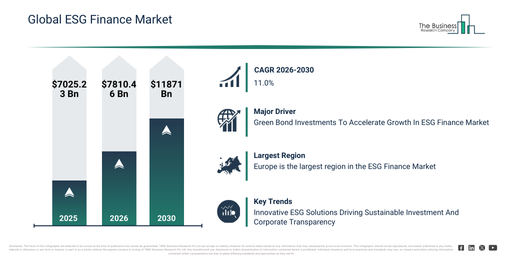
The esg finance market size has seen swift expansion in recent years. It is forecast to increase from $7025.23 billion in 2025 to $7810.46 billion in 2026, exhibiting a compound annual growth rate (CAGR) of 11.2%. The historical development in this market can be linked to heightened awareness of sustainability risks, the emergence of responsible investment mandates, greater involvement of institutional investors, the initial implementation of esg screening frameworks, and increasing stakeholder demand for openness.
The esg finance market is anticipated to experience substantial expansion over the coming years. Its valuation is set to reach $11871 billion by 2030, expanding at a compound annual growth rate (CAGR) of 11.0%. This projected growth is driven by factors such as stricter regulatory application of esg standards, a rising appetite for climate-focused investments, the proliferation of sustainable financial offerings, greater incorporation of AI in esg assessments, and an uptick in capital directed towards impact investing. Key developments expected during this forecast period encompass the deeper embedding of esg metrics into investment choices, an escalating need for esg data and analytical tools, a surge in the issuance of green and social bonds, broadening regulatory mandates for esg disclosures, and a sharpened emphasis on evaluating impact.
Get A Free Sample Report With In-Depth Market Insights:
ESG Finance Market Development Factors: What’s Supporting Demand?
Increased capital allocation to green bonds is anticipated to fuel the expansion of the ESG finance market in the future. These fixed-income instruments are created to secure funds exclusively for environmentally responsible endeavors and projects. This surge in green bond investment stems from heightened global awareness regarding climate change and a desire for socially conscious investment opportunities. Furthermore, major institutional investors, such as pension funds and insurance companies, are progressively targeting investments that meet environmental, social, and governance (ESG) standards. ESG insurance offers protection and reduces risks for environmentally sound projects, consequently boosting investor confidence and simplifying the funding process for green initiatives. As an illustration, in May 2024, The International Finance Corporation, a US-based international financial institution, projected that green bond issuance will increase at an annual rate of 7.5 percent, climbing from $135 billion in 2023 to $156 billion by 2025. Consequently, the increasing investments in green bonds will propel the expansion of the ESG finance market.
ESG Finance Market Segment Trends And Revenue Contributors
The esg finance market covered in this report is segmented –
1) By Investment Type: Equity, Fixed Income, Mixed Allocation, Other Investment Types
2) By Investor Type: Institutional Investors, Retail Investors
3) By Transaction Type: Green Bond, Social Bond, Mixed Sustainability Bond, ESG Integrated Investment Funds, Other Transaction Types
4) By Industry Vertical: Utilities, Transport And Logistics, Chemicals, Food And Beverage, Government, Other Industry Verticals
Subsegments:
1) By Equity: Esg-Focused Equity Funds (Green Etfs, Sustainable Equity Funds), Socially Responsible Investing (Sri) Equity Funds, Esg Integration In Corporate Equity Investment, Thematic Esg Equity Funds (Renewable Energy, Clean Technology), Impact Investing Equity Strategies
2) By Fixed Income: Green Bonds (Focused On Environmental Projects), Social Bonds (Focused On Social Impact Initiatives), Sustainable Bonds (Integrating Esg Factors), Esg Bond Funds And Etfs, Green And Social Impact Corporate Debt
3) By Mixed Allocation: Esg Multi-Asset Funds, Esg Diversified Portfolios (Equities, Bonds, And Alternative Assets), Esg Asset Allocation Funds (Combining Equities, Fixed Income, And Real Assets), Balanced Esg Funds, Thematic Esg Funds (Climate Change, Gender Equality)
4) By Other Investment Types: Esg-Focused Private Equity And Venture Capital, Impact Investing Funds, Esg Real Estate Investment Funds (Reits), Esg Commodities And Infrastructure Investments, Esg Alternative Investments (Hedge Funds With Esg Strategies)
ESG Finance Market Transformation Trends: What Innovations Are Driving Change?
Major companies in the ESG finance market are concentrating on utilizing innovative technologies like integrated scoring and compliance features to boost sustainable investment opportunities and enhance corporate transparency. Integrated scoring and compliance features function as tools within ESG platforms that automatically evaluate companies’ environmental, social, and governance performance against established standards and monitor regulatory compliance, assisting investors and organizations in making informed decisions, identifying risks, and ensuring adherence to ESG requirements. For example, in September 2023, Euronext N.V., a Netherlands-based stock exchange operator, introduced a suite of ESG solutions. These platforms incorporate ESG scoring, compliance tracking, and reporting capabilities, providing enhanced data accuracy, accessibility, and actionable insights for investors and issuers. The solutions support a wide range of applications, including ESG bond issuance, investment portfolio optimization, and corporate sustainability benchmarking, while fostering transparency and advancing sustainable finance initiatives across Europe.
ESG Finance Market Competitive Landscape: Which Companies Lead The Industry?
Major companies operating in the esg finance market are JPMorgan Chase & Co., HSBC Holdings plc, Morgan Stanley, BNP Paribas Asset Management S.A., The Goldman Sachs Group Inc., UBS Group AG, Deutsche Bank AG, Fidelity Investments Inc., The Bank of New York Mellon Corporation, BlackRock Inc., State Street Corporation, The Vanguard Group Inc., Franklin Templeton Holdings Ltd., Northern Trust Asset Management, T. Rowe Price Group Inc., Amundi Asset Management Inc., Invesco Ltd., Schroders plc, Pacific Investment Management Company LLC, Allianz Global Investors GmbH, Columbia Threadneedle Investments Inc., AXA Investment Managers S.A., Wellington Management Company LLP, Natixis Investment Managers International, Legal & General Investment Management Limited
View The Full ESG Finance Market Report:
ESG Finance Market Geographic Spread And Regional Opportunities
Europe was the largest region in the ESG finance market in 2025. North America is expected to be the fastest-growing region in the forecast period. The regions covered in the esg finance market report are Asia-Pacific, South East Asia, Western Europe, Eastern Europe, North America, South America, Middle East, Africa.
Reach Out To Our Team:
The Business Research Company: https://www.thebusinessresearchcompany.com/
Americas: +1 310-496-7795
Asia: +44 7882 955267 & +91 8897263534
Europe: +44 7882 955267
Email us at: marketing@tbrc.info
Follow us on:
LinkedIn: https://in.linkedin.com/company/the-business-research-company
YouTube: https://www.youtube.com/channel/UC24_fI0rV8cR5DxlCpgmyFQ
Global Market Model: https://www.thebusinessresearchcompany.com/global-market-model

Wasay has over a decade of experience in market research, data modelling, and analytics, with prior experience at GlobalData and Decision Tree Consulting Services. At The Business Research Company , he leads research operations across syndicated studies, customized consulting engagements, and the Global Market Model platform. His professional experience includes supporting organizations such as Boston Consulting Group, KPMG, and Ernst & Young. Wasay holds a degree in Electronics and Communications Engineering, postgraduate management qualifications from International Management Institute Belgium and Indian School of Business and Entrepreneurship, and completed the Integrated Program in Business Analytics from Indian Institute of Management Indore.