The Business Research Company’s 2026 market reports combine market attractiveness scoring, total addressable market sizing, company benchmarking matrices, interactive Excel dashboards, deeper supply chain intelligence, emerging startup tracking, and granular product-level insights to deliver research that is more actionable and strategically valuable.
Neobanking Market Value Projected To Grow At A 46.6% Compound Annual Growth Rate Through 2030
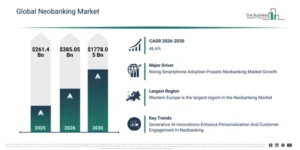
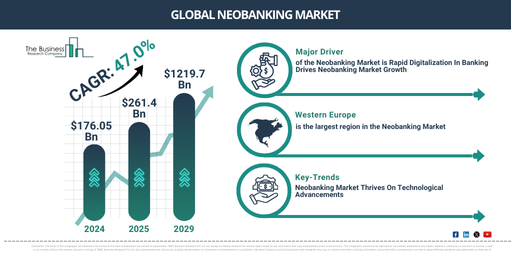
The neobanking market has seen substantial expansion in recent years. Its market size is anticipated to expand from $261.4 billion in 2025 to $385.05 billion in 2026, achieving a compound annual growth rate (CAGR) of 47.3%. Historically, this growth can be ascribed to factors such as increased smartphone usage, discontent with conventional banking services, the proliferation of digital payment networks, supportive regulatory environments, and the development of fintech innovation hubs.
The neobanking market is projected for significant growth in the upcoming years. It is expected to reach $1778.05 billion in 2030, demonstrating a compound annual growth rate (CAGR) of 46.6%. This expansion during the forecast period is driven by factors such as the increasing demand for fully digital financial ecosystems, a rising emphasis on financial inclusion, the broadening of cross-border digital banking services, greater integration of AI-driven credit assessment, and the expanding adoption of open banking frameworks. Key trends anticipated in this period include the widespread use of mobile-first banking platforms, a growing need for personalized digital financial services, increased integration of AI-based customer support, the proliferation of embedded finance offerings, and an enhanced focus on low-cost banking models.
Evaluate The Neobanking Market Report Before You Buy With A Free Sample:
Neobanking Market Growth Driver Analysis For The 2026–2030 Forecast Period
Increased smartphone adoption is anticipated to fuel the expansion of the neobanking market. These advanced mobile devices combine traditional phone functions with sophisticated computing capabilities. The neobanking market is significantly growing, driven by higher smartphone penetration, which provides wider access to digital financial services via mobile applications. This enables neobanks to reach a broader customer base with convenient, portable banking solutions, consequently boosting market uptake. For instance, a report from Uswitch Limited, a UK-based comparison service, stated in February 2023 that 2022 saw 71.8 million active mobile connections, a 3.8% increase from the year before. Projections indicate that by 2025, the UK’s population of 68.3 million will have an estimated 95% smartphone penetration. This illustrates how increasing smartphone penetration is a key driver for the expansion of the neobanking market.
Neobanking Market Segmentation Breakdown: Primary And Secondary Categories
The neobanking market covered in this report is segmented –
1) By Account Type: Business Account, Savings Account
2) By Service: Mobile Banking, Payments And Money Transfer, Checking/Savings Account, Loans, Other Services
3) By Application: Personal And Retail Banking, Small And Medium Enterprises And Freelancers, Cross-Border And International Banking Use Cases, Digital-Only Financial Management And Budgeting
Subsegments:
1) By Business Account: Sole Proprietorship Accounts, Partnership Accounts, Corporate Accounts, Freelancer Accounts
2) By Savings Account: Regular Savings Account, High-Interest Savings Account, Goal-Based Savings Account, Joint Savings Accounts
Neobanking Market Industry Trends: New Developments From Leading Companies
Major companies operating within the neobanking sector are prioritizing the development of innovations, such as customer assistants powered by generative AI, to enhance personalization, quicken service delivery, and provide customized financial advice for users. A generative AI customer assistant is defined as an artificial intelligence feature integrated into a neobank’s mobile or online platform that comprehends natural language, automates routine customer interactions, offers actionable financial insights, and improves the overall user experience. For instance, in December 2023, bunq B.V., a digital banking company based in the Netherlands, introduced Finn, a generative AI-driven personal assistant built into its application. This solution effectively replaces traditional search functions, delivers conversational answers to money-management inquiries, provides insights into spending and budgeting, and enables users to efficiently navigate banking features through natural language interaction.
Who Are The Top Competitors In The Neobanking Market?
Major companies operating in the neobanking market are Nubank, Chime Financial Inc., Revolut Ltd., Monzo Bank Ltd., N26 GmbH, Starling Bank Ltd., Varo Money Inc., SoFi Bank NA, Current Financial Inc., Bunq BV, WeBank Inc., Ubank Limited, KakaoBank Corp., Tinkoff Bank, Ally Bank, Dave Inc., Atom Bank PLC, Zopa Bank Limited, Vivid Money GmbH, Monese Ltd.
Access The Neobanking Market Report For Complete Segment-Level Analysis:
Which Region Leads The Neobanking Market, And Which Regions Are Covered?
Western Europe was the largest region in the neobanking market in 2025. Asia-Pacific is expected to be the fastest-growing region in the forecast period. The regions covered in the neobanking market report are Asia-Pacific, South East Asia, Western Europe, Eastern Europe, North America, South America, Middle East, Africa.
Reach Out To Our Team:
The Business Research Company: https://www.thebusinessresearchcompany.com/
Americas: +1 310-496-7795
Asia: +44 7882 955267 & +91 8897263534
Europe: +44 7882 955267
Email us at: marketing@tbrc.info
Follow us on:
LinkedIn: https://in.linkedin.com/company/the-business-research-company
YouTube: https://www.youtube.com/channel/UC24_fI0rV8cR5DxlCpgmyFQ
Global Market Model: https://www.thebusinessresearchcompany.com/global-market-model

Wasay has over a decade of experience in market research, data modelling, and analytics, with prior experience at GlobalData and Decision Tree Consulting Services. At The Business Research Company , he leads research operations across syndicated studies, customized consulting engagements, and the Global Market Model platform. His professional experience includes supporting organizations such as Boston Consulting Group, KPMG, and Ernst & Young. Wasay holds a degree in Electronics and Communications Engineering, postgraduate management qualifications from International Management Institute Belgium and Indian School of Business and Entrepreneurship, and completed the Integrated Program in Business Analytics from Indian Institute of Management Indore.