With a focus on actionable insights and strategic value, The Business Research Company’s 2026 market reports include market attractiveness scoring, total addressable market sizing, company benchmarking matrices, interactive Excel dashboards, deeper supply chain intelligence, emerging startup tracking, and granular product-level insights.
Open Banking Market Size Analysis: Historical Growth And Future Revenue Projections
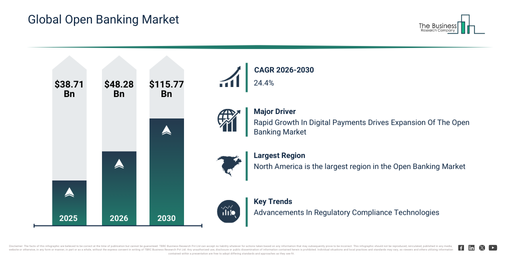
The open banking market has experienced substantial expansion in recent years. This market is projected to grow from $38.71 billion in 2025 to $48.28 billion in 2026, at a compound annual growth rate (CAGR) of 24.7%. Historically, this growth can be attributed to factors such as regulatory mandates supporting open banking, increasing adoption of digital banking, the expansion of fintech partnerships, a rising consumer demand for transparency, and the availability of standardized API frameworks.
The open banking market is projected to experience significant expansion in the coming years. It is anticipated to reach $115.77 billion by 2030, demonstrating a compound annual growth rate (CAGR) of 24.4%. This projected growth is largely due to the increasing implementation of AI-powered financial insights, the broadening of cross-industry open finance models, a heightened emphasis on data privacy compliance, the growing adoption of cloud-based banking platforms, and innovation in value-added financial services. Key trends throughout this period involve the wider embrace of API-based financial ecosystems, a rise in real-time data sharing services, an increasing demand for embedded finance solutions, the expansion of account aggregation capabilities, and a greater focus on secure data consent management.
Preview The Open Banking Market Report With A Free Sample:
Open Banking Market Drivers: What Is Fueling Demand Through 2030?
The increasing adoption of online payment platforms is fostering the expansion of the open banking market. The digital payment ecosystem is undergoing rapid growth, driven by evolving payment solutions, greater e-commerce penetration, enhanced broadband availability, and the emergence of novel technologies. Online platforms like Phone Pay, Paytm, and Google Pay employ payment gateway APIs for handling recurring charges, and these APIs frequently integrate with open banking frameworks. For example, data from July 2025 by the Bangko Sentral ng Pilipinas, a central banking authority located in the Philippines, indicated that digital retail payments represented 57.4% of the total transaction volume in 2024, showing a 4.6 percentage point increase compared to 2023. Consequently, the growing utilization of online payment platforms is projected to drive the future expansion of the open banking market.
Open Banking Market Segmentation Analysis: Core Categories And Subcategories
The open banking market covered in this report is segmented –
1) By Service Type: Transactional Services, Informative Services
2) By Distribution Channel: Bank Channels, App Market, Aggregators
3) By Financial Services: Bank And Capital Markets, Payments, Value-Added Services
4) By Deployment: Cloud, Hybrid
Subsegments:
1) By Transactional Services: Payment Initiation Services, Account Aggregation Services, Fund Transfer Services
2) By Informative Services: Financial Data Insights And Analytics, Credit Scoring And Reporting, Financial Health Reports
Which Trends Will Define The Open Banking Market Through 2030?
Leading companies in the open banking market are concentrating on developing advanced solutions, such as integrated open banking platforms, to improve secure data sharing, regulatory adherence, and the delivery of modern financial services. These integrated platforms utilize API-based technologies to connect financial institutions with standardized regulatory frameworks and identity verification systems, enabling features like streamlined onboarding, automated compliance, and secure transaction flows. For example, in November 2024, Brankas Pte. Ltd., a Singapore-based open finance technology provider, introduced its Integrated APAC Open Banking Compliance Solution. This API-driven platform is designed to help banks across the Asia-Pacific region meet open banking requirements, incorporating real-time eKYC verification through ADVANCE.AI, automated compliance alignment with standards such as Indonesia’s BI-SNAP, and seamless integration for regulated financial service workflows. The solution enhances regulatory compliance efficiency, strengthens secure customer authentication, and supports faster deployment of open banking services.
Open Banking Market Major Companies And Industry Participants
Major companies operating in the open banking market are Banco Santander S.A., BBVA SA, HSBC Bank plc, Barclays, NatWest Group plc, Lloyds Banking Group, ING, BNP Paribas, Citigroup, Capital One, DBS Bank, HDFC Bank, Axis Bank, Bank of Baroda, ING Bank, Bunq, Wise, Tinkoff Bank, WeBank, Ant Financial, Tarabut Gateway, Nordigen
Buy The Full Open Banking Global Market Report 2026:
Open Banking Market Geographic Analysis: Which Region Accounts For The Biggest Share?
North America was the largest region in the open banking market in 2025. Asia-Pacific is expected to be the fastest-growing region in the forecast period. The regions covered in the open banking market report are Asia-Pacific, South East Asia, Western Europe, Eastern Europe, North America, South America, Middle East, Africa.
Reach Out To Our Team:
The Business Research Company: https://www.thebusinessresearchcompany.com/
Americas: +1 310-496-7795
Asia: +44 7882 955267 & +91 8897263534
Europe: +44 7882 955267
Email us at: marketing@tbrc.info
Follow us on:
LinkedIn: https://in.linkedin.com/company/the-business-research-company
YouTube: https://www.youtube.com/channel/UC24_fI0rV8cR5DxlCpgmyFQ
Global Market Model: https://www.thebusinessresearchcompany.com/global-market-model

Wasay has over a decade of experience in market research, data modelling, and analytics, with prior experience at GlobalData and Decision Tree Consulting Services. At The Business Research Company , he leads research operations across syndicated studies, customized consulting engagements, and the Global Market Model platform. His professional experience includes supporting organizations such as Boston Consulting Group, KPMG, and Ernst & Young. Wasay holds a degree in Electronics and Communications Engineering, postgraduate management qualifications from International Management Institute Belgium and Indian School of Business and Entrepreneurship, and completed the Integrated Program in Business Analytics from Indian Institute of Management Indore.