
Backed by market attractiveness analysis, total addressable market sizing, company benchmarking matrices, interactive Excel dashboards, wider supply chain intelligence, emerging startup coverage, and detailed product-level insights, The Business Research Company’s 2026 market reports are designed to offer research that is more actionable and strategically valuable than ever.
Quantum-Artificial Intelligence (AI) Financial Liquidity Predictor Market Forecast: Value Set To Climb From $2.54 Billion To $8 Billion
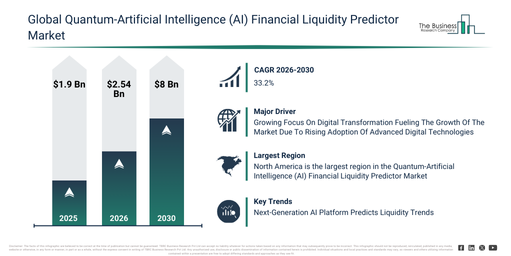
The quantum-artificial intelligence (ai) financial liquidity predictor market has experienced substantial growth in recent years. It is anticipated to expand from $1.9 billion in 2025 to $2.54 billion in 2026, demonstrating a compound annual growth rate (CAGR) of 33.7%. This historical expansion is attributable to factors such as the increasing complexity of global financial markets, the proliferation of electronic trading activities, a rising demand for liquidity risk management, the adoption of advanced treasury systems, and regulatory mandates for liquidity monitoring.
The quantum-artificial intelligence (ai) financial liquidity predictor market size is expected to experience substantial growth over the next few years. It is projected to expand to $8 billion by 2030, achieving a compound annual growth rate (CAGR) of 33.2%. This growth during the forecast period can be attributed to factors such as increased investments in quantum financial analytics, a rising demand for real-time treasury decision tools, the expansion of automated liquidity management platforms, growing regulatory mandates for stress testing, and the increasing adoption of cloud-based financial intelligence. Significant trends anticipated in the forecast period include the broadening of real-time liquidity forecasting models, a growing uptake of quantum-based stress testing, enhanced integration of AI-driven treasury analytics, a heightened focus on intraday liquidity optimization, and improved utilization of scenario simulation tools.
Get A Free Sample Report With In-Depth Market Insights:
Quantum-Artificial Intelligence (AI) Financial Liquidity Predictor Market Growth Momentum: What Factors Are Shaping Demand?
The increasing emphasis on digital transformation is anticipated to boost the expansion of the quantum-artificial intelligence (AI) financial liquidity predictor market in the future. Digital transformation involves implementing digital technologies to streamline business operations, improve customer interactions, and foster innovation within organizations. This shift is escalating as businesses strive to offer quicker, more tailored, and smoother customer experiences to maintain competitiveness. The quantum-artificial intelligence (AI) financial liquidity predictor aids digital transformation by offering real-time liquidity insights and predictive analytics, proving crucial for contemporary financial activities. It reduces manual analytical tasks through automated forecasting and risk assessment, thereby enhancing trading efficiency and the precision of decision-making. As an illustration, in August 2024, Eurostat, the statistical office of the European Union, reported that in 2023, 59 % of all EU businesses achieved a basic level of digital intensity, with large enterprises at 91 % and SMEs at 58 %. Consequently, the heightened focus on digital transformation is fueling the growth of the quantum-artificial intelligence (AI) financial liquidity predictor market.
Quantum-Artificial Intelligence (AI) Financial Liquidity Predictor Market Segmentation And Category Overview
The quantum-artificial intelligence (ai) financial liquidity predictor market covered in this report is segmented –
1) By Component: Software, Hardware, Services
2) By Deployment Mode: On-Premises, Cloud
3) By Organization Size: Small And Medium Enterprises, Large Enterprises
4) By Application: Banking, Asset Management, Insurance, Hedge Funds, Trading Firms, Other Applications
5) By End User: Banks, Insurance Companies, Hedge Funds And Asset Managers, Brokerage Firms, Financial Institutions, Government And Regulatory Bodies
Subsegments:
1) By Software: Predictive Analytics Platforms, Liquidity Risk Management Tools, Quantum-Artificial Intelligence (AI) Algorithms And Models, Dashboard And Visualization Tools, Compliance And Regulatory Reporting Software
2) By Hardware: Quantum Processors, High-Performance Computing (HPC) Servers, Data Storage Systems, Networking And Connectivity Devices, Edge Computing Devices
3) By Services: Consulting And Advisory Services, System Integration And Deployment, Managed Services, Training And Support Services, Maintenance And Upgrades
Quantum-Artificial Intelligence (AI) Financial Liquidity Predictor Market Trends Redefining Industry Growth
Major companies operating in the quantum-artificial intelligence (AI) financial liquidity predictor market are focusing on developing advanced platforms, such as AI-driven predictive analytics systems, to boost trading efficiency, enhance risk management, and reduce manual analysis and financial miscalculations. AI-driven predictive analytics systems refer to sophisticated software that leverages machine learning and quantum computing principles to analyze vast datasets, forecast market liquidity crunches, and identify optimal trading windows in real-time. For instance, in September 2024, Quantum Signal AI LLC, a US-based technology company, launched a next-generation artificial intelligence (AI) trading platform for the finance industry. This platform combines advanced artificial intelligence with quantum computing insights to deliver highly accurate predictions of mid-price movements and liquidity trends for equities and futures in intraday trading. The platform is designed to predict liquidity across various asset classes, providing traders and institutions with a powerful tool to navigate volatile markets. It includes automated signal generation and real-time risk assessment functionality, enabling proactive decision-making and capital allocation without constant manual oversight.
Quantum-Artificial Intelligence (AI) Financial Liquidity Predictor Market Competitive Analysis Of Leading Industry Participants
Major companies operating in the quantum-artificial intelligence (ai) financial liquidity predictor market are Google LLC, Microsoft Corporation, Bank of America Corporation, Citigroup Inc., HSBC Holdings PLC, Accenture plc, International Business Machines Corporation (IBM Corporation), BNP Paribas S.A., Fujitsu Limited, Barclays PLC, Standard Chartered PLC, Mizuho Financial Group Inc., Macquarie Group Limited, Quantinuum Limited, Xanadu Quantum Technologies, Multiverse Computing S.L., Terra Quantum AG, 1QB Information Technologies Inc., Rigetti Computing, IonQ Inc., D-Wave Quantum Inc., Alpine Quantum Technologies GmbH
View The Full Quantum-Artificial Intelligence (AI) Financial Liquidity Predictor Market Report:
Quantum-Artificial Intelligence (AI) Financial Liquidity Predictor Market Regional Analysis: Which Geography Leads On Revenue?
North America was the largest region in the quantum-artificial Intelligence (AI) financial liquidity predictor market in 2025. Asia-Pacific is expected to be the fastest-growing region in the forecast period. The regions covered in the quantum-artificial intelligence (ai) financial liquidity predictor market report are Asia-Pacific, South East Asia, Western Europe, Eastern Europe, North America, South America, Middle East, Africa.
Reach Out To Our Team:
The Business Research Company: https://www.thebusinessresearchcompany.com/
Americas: +1 310-496-7795
Asia: +44 7882 955267 & +91 8897263534
Europe: +44 7882 955267
Email us at: marketing@tbrc.info
Follow us on:
LinkedIn: https://in.linkedin.com/company/the-business-research-company
YouTube: https://www.youtube.com/channel/UC24_fI0rV8cR5DxlCpgmyFQ
Global Market Model: https://www.thebusinessresearchcompany.com/global-market-model

Wasay has over a decade of experience in market research, data modelling, and analytics, with prior experience at GlobalData and Decision Tree Consulting Services. At The Business Research Company , he leads research operations across syndicated studies, customized consulting engagements, and the Global Market Model platform. His professional experience includes supporting organizations such as Boston Consulting Group, KPMG, and Ernst & Young. Wasay holds a degree in Electronics and Communications Engineering, postgraduate management qualifications from International Management Institute Belgium and Indian School of Business and Entrepreneurship, and completed the Integrated Program in Business Analytics from Indian Institute of Management Indore.