Market attractiveness scoring, total addressable market sizing, company benchmarking matrices, interactive Excel dashboards, deeper supply chain intelligence, emerging startup tracking, and granular product-level insights are among the key offerings featured in The Business Research Company’s 2026 market reports, designed to deliver more actionable and strategically valuable research.
Sustainable Supply-Chain Financial Technology (FinTech) Market Growth Outlook: How Much Bigger Will The Market Be By 2030?
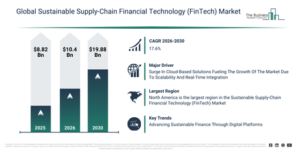
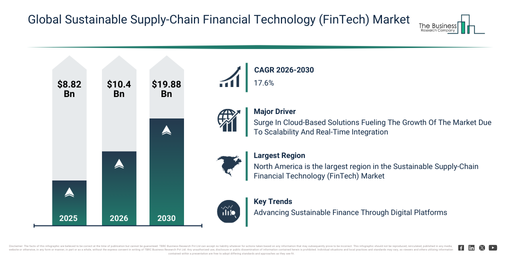
The sustainable supply-chain financial technology (fintech) market has experienced substantial expansion recently. This market is projected to expand from $8.82 billion in 2025 to $10.4 billion in 2026, demonstrating a compound annual growth rate (CAGR) of 17.9%. Historically, this expansion has been driven by factors such as the increasing intricacy of global supply chains, the development of digital payment infrastructure, a heightened need for supply chain transparency, the proliferation of sustainable sourcing initiatives, and the early adoption of fintech solutions in supply chains.
The sustainable supply-chain financial technology (fintech) market is projected to experience substantial expansion over the coming years. This market is anticipated to reach a value of $19.88 billion by 2030, demonstrating a compound annual growth rate (CAGR) of 17.6%. Factors contributing to this growth during the forecast period include an intensified regulatory emphasis on supply chain sustainability, a surge in investments directed towards digital trade finance, wider integration of blockchain technology within enterprise finance, an escalating need for robust supply chain financing solutions, and increased partnerships between fintech firms and corporations. Key trends expected to shape this period encompass the growing implementation of blockchain-based supply chain finance, increased uptake of ESG-linked payment platforms, deeper integration of transparency and traceability instruments, the broader deployment of green financing mechanisms across supply chains, and advanced automation for risk management and compliance.
Request A Free Sustainable Supply-Chain Financial Technology (FinTech) Market Sample From The Business Research Company:
How Is The Key Growth Driver Influencing The Sustainable Supply-Chain Financial Technology (FinTech) Market?
The increasing adoption of cloud-based solutions is anticipated to fuel expansion within the sustainable supply-chain financial technology (FinTech) market. These solutions comprise software or services offered via the internet from distant servers, enabling users to access and control them without requiring local hardware. Their ascent is attributed to their scalability, which permits businesses to rapidly adapt resources to evolving requirements, thereby cutting expenses and boosting efficiency. Furthermore, cloud technologies enable real-time data exchange, smooth integration, and enhanced transparency throughout global supply chains—critical elements for more effective and accountable financing of sustainable activities. As an illustration, a January 2025 report by AAG IT, a UK-based IT services firm, projected that approximately 63% of small and medium-sized business (SMB) workloads and 62% of SMB data would reside in public clouds by 2023, an increase from 57% of workloads and 56% of data in 2022. Consequently, the growing appeal of cloud-based solutions is stimulating the expansion of the sustainable supply-chain financial technology (FinTech) market.
Sustainable Supply-Chain Financial Technology (FinTech) Market Segmentation By Category: What Does The 2026 Report Cover?
The sustainable supply-chain financial technology (fintech) market covered in this report is segmented –
1) By Component: Software, Hardware, Services
2) By Deployment Mode: Cloud, On-Premises
3) By Enterprise Size: Small And Medium Enterprises, Large Enterprises
4) By Application: Procurement, Inventory Management, Logistics, Payment And Settlement, Risk And Compliance Management, Other Applications
5) By End-User: Manufacturing, Retail And E-Commerce, Healthcare, Automotive, Food And Beverage, Other End-Users
Subsegments:
1) By Software: Supply Chain Management Software, Payment Processing Software, Risk Management Software, Blockchain Platforms, Data Analytics Software, API Integration Tools
2) By Hardware: IoT Devices, RFID Tags, Barcode Scanners, Payment Terminals, Secure Data Storage Devices, Smart Sensors
3) By Services: Consulting Services, Integration Services, Maintenance And Support Services, Training Services, Managed Services, Compliance And Audit Services
How Are Industry Players Changing The Sustainable Supply-Chain Financial Technology (FinTech) Market Landscape?
Leading companies operating in the sustainable supply-chain financial technology (FinTech) market are concentrating on creating digital solutions that integrate sustainability criteria into financing for supply chains. These solutions enable suppliers to receive early payments on invoices via digital platforms, provided they comply with environmental and social responsibility standards. For instance, in March 2023, Eni, an Italy-based integrated energy company, launched a sustainability-focused supply chain finance programme in collaboration with financial partners Crédit Agricole, a France-based banking company, and UniCredit, an Italy-based banking company. This programme is powered by FinDynamic’s FinTech platform, which facilitates suppliers’ requests for invoice advance payments through a digital interface, on the condition that they commit to sustainable development. Suppliers gain access to the programme via Open-es, a platform designed to connect industry, finance, and trade associations to foster sustainable supply chain growth.
Sustainable Supply-Chain Financial Technology (FinTech) Market Global Key Players And Competitive Overview
Major companies operating in the sustainable supply-chain financial technology (fintech) market are IBM Corporation, Oracle Corporation, SAP SE, Infor Inc., GEP Worldwide, Coupa Software Incorporated, Basware Oyj, EcoVadis Inc., Jaggaer LLC, Assent Compliance Inc., Tradeshift Holdings Inc., Taulia LLC, Resilinc Corporation, ChainPoint BV, Sourcemap Inc., SupplyShift Inc., Vizibl Ltd., Everledger, Ariba, Tungsten Network
Explore Comprehensive Sustainable Supply-Chain Financial Technology (FinTech) Market Coverage In The Full Report:
Regional Analysis Of The Sustainable Supply-Chain Financial Technology (FinTech) Market: Where Is The Industry Concentrated?
North America was the largest region in the sustainable supply-chain financial technology (FinTech) market in 2025. Asia-Pacific is expected to be the fastest-growing region in the forecast period. The regions covered in the sustainable supply-chain financial technology (fintech) market report are Asia-Pacific, South East Asia, Western Europe, Eastern Europe, North America, South America, Middle East, Africa.
Reach Out To Our Team:
The Business Research Company: https://www.thebusinessresearchcompany.com/
Americas: +1 310-496-7795
Asia: +44 7882 955267 & +91 8897263534
Europe: +44 7882 955267
Email us at: marketing@tbrc.info
Follow us on:
LinkedIn: https://in.linkedin.com/company/the-business-research-company
YouTube: https://www.youtube.com/channel/UC24_fI0rV8cR5DxlCpgmyFQ
Global Market Model: https://www.thebusinessresearchcompany.com/global-market-model

Wasay has over a decade of experience in market research, data modelling, and analytics, with prior experience at GlobalData and Decision Tree Consulting Services. At The Business Research Company , he leads research operations across syndicated studies, customized consulting engagements, and the Global Market Model platform. His professional experience includes supporting organizations such as Boston Consulting Group, KPMG, and Ernst & Young. Wasay holds a degree in Electronics and Communications Engineering, postgraduate management qualifications from International Management Institute Belgium and Indian School of Business and Entrepreneurship, and completed the Integrated Program in Business Analytics from Indian Institute of Management Indore.