
Backed by market attractiveness analysis, total addressable market sizing, company benchmarking matrices, interactive Excel dashboards, wider supply chain intelligence, emerging startup coverage, and detailed product-level insights, The Business Research Company’s 2026 market reports are designed to offer research that is more actionable and strategically valuable than ever.
Trade Finance Digitization Market Revenue Outlook: What CAGR Lies Ahead Through 2030?
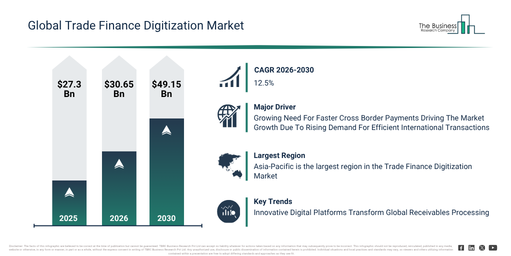
The trade finance digitization market size has seen substantial growth in recent years. This market is forecasted to increase from $27.3 billion in 2025 to $30.65 billion in 2026, demonstrating a compound annual growth rate (CAGR) of 12.3%. Historically, this expansion has been influenced by factors including reliance on manual and paper-based trade processes, expanding cross-border trade volumes, an escalating need for transaction security, the adoption of early digital document management systems, and a rising demand for operational efficiency in banks.
The trade finance digitization market size is projected to experience swift expansion over the coming years. It is anticipated to reach $49.15 billion by 2030, demonstrating a compound annual growth rate (CAGR) of 12.5%. This expansion during the projected timeframe is largely due to the increasing embrace of AI-powered trade finance solutions, the greater incorporation of blockchain for secure transaction processing, the broadening availability of cloud-native trade finance platforms, escalating regulatory requirements for adherence, and the escalating need for immediate trade insight and analytical capabilities. Key trends for the forecast duration encompass the heightened uptake of blockchain-powered trade platforms, the growing need for streamlined trade workflow automation, the deeper integration of tools for risk evaluation and fraud prevention, the widening scope of cloud-delivered trade finance services, and an intensified emphasis on meeting regulatory obligations and ensuring transaction clarity.
Get A Free Sample Report With In-Depth Market Insights:
Trade Finance Digitization Market Opportunity Drivers: What’s Unlocking New Revenue Potential?
The expanding requirement for expedited international payments is anticipated to drive the growth of the trade finance digitization market moving forward. Cross-border payments are defined as financial transactions involving the transfer of money between countries, typically across different currencies and banking systems. The demand for faster cross-border payments is increasing due to the rising volume of global trade and the necessity for quicker settlement of international transactions, which minimizes delays and improves business cash flow. Trade finance digitization streamlines and automates processes for documentation, verification, and settlement, enabling more rapid, transparent, and secure cross-border payments while simultaneously reducing errors and operational delays in international trade transactions. For instance, in December 2024, the Society for Worldwide Interbank Financial Telecommunication (SWIFT), a Belgium-based financial messaging cooperative, reported that over two million cross-border payment messages were exchanged daily across its network. Furthermore, 90% of cross-border payments sent over the SWIFT network reach the destination bank within an hour, significantly ahead of the G20’s target of 75% reaching the end customer’s account by 2027. Thus, the growing need for faster cross-border payments is a primary driver for the expansion of the trade finance digitization market.
Trade Finance Digitization Market Segment Analysis: What Are The Core Market Categories?
The trade finance digitization market covered in this report is segmented –
1) By Component: Software, Hardware, Services
2) By Deployment Mode: On-Premises, Cloud
3) By Application: Supply Chain Finance, Export And Import Finance, Inventory Finance, Other Applications
4) By End-User: Banks, Financial Institutions, Corporates, Other End-Users
Subsegments:
1) By Software: Document Digitization Platforms, Trade Workflow Automation Software, Compliance Management Software, Risk Assessment Software, Fraud Detection Software, Transaction Processing Software, Blockchain Trade Platforms, Analytics And Reporting Software
2) By Hardware: Server Infrastructure, Networking Equipment, Security Devices, Storage Solutions
3) By Services: Consulting And Advisory Services, System Integration Services, Implementation And Deployment Services, Customization And Configuration Services, Training And Education Services, Maintenance And Support Services, Managed Platform Services, Upgrade And Migration Services
Trade Finance Digitization Market Innovation Trends Shaping Future Development
Leading companies in the trade finance digitization sector are concentrating on creating advanced solutions, such as integrated digital platforms for discounting trade receivables, aimed at quickening working capital cycles and decreasing reliance on paper. These integrated digital trade receivable discounting platforms are cloud-powered systems that digitize the entire lifecycle of trade receivables, from their creation to acceptance, endorsement, and financing. This innovation assists businesses by speeding up cash flow, cutting down on manual paperwork, minimizing errors, and enhancing clarity among all participants in the trade process. As an illustration, Citigroup Inc., a US-based multinational investment bank and financial services corporation, introduced Citi Digital Bill (CDB) in October 2024. This groundbreaking digital trade receivable finance solution redefines traditional paper-focused bill discounting by integrating it directly into its proprietary CitiDirect platform. Citi Digital Bill empowers sellers, buyers, and the bank to digitally sign, accept, endorse, and finance trade bills, thereby eliminating the need for physical document handling and its associated delays. It also provides greater visibility into invoice and bill statuses and significantly shortens the time required to monetize receivables, from several weeks to less than an hour, when compared to conventional approaches.
Trade Finance Digitization Market Competitive Overview And Top Companies
Major companies operating in the trade finance digitization market are Citigroup Inc., J.P. Morgan Chase & Co., Deloitte Touche Tohmatsu Limited, Accenture plc, IBM Corporation, Ernst & Young Global Limited, PricewaterhouseCoopers International Limited (PwC), Oracle Corporation, A.P. Moller – Maersk A/S, KPMG International Cooperative, SAP SE, Kuehne + Nagel International AG, Capgemini SE, DHL Global Forwarding, Expeditors International of Washington Inc., Thomson Reuters Corporation, Flexport Inc., Finastra Inc., Avalara Inc., Livingston International Inc., Descartes Systems Group Inc., E2open LLC, Sovos Compliance LLC, Komgo SA.
View The Full Trade Finance Digitization Market Report:
Trade Finance Digitization Market Top Region: Where Does Most Revenue Come From?
Asia-Pacific was the largest region in the trade finance digitization market in 2025. Asia-Pacific is expected to be the fastest-growing region in the forecast period. The regions covered in the trade finance digitization market report are Asia-Pacific, South East Asia, Western Europe, Eastern Europe, North America, South America, Middle East, Africa.
Reach Out To Our Team:
The Business Research Company: https://www.thebusinessresearchcompany.com/
Americas: +1 310-496-7795
Asia: +44 7882 955267 & +91 8897263534
Europe: +44 7882 955267
Email us at: marketing@tbrc.info
Follow us on:
LinkedIn: https://in.linkedin.com/company/the-business-research-company
YouTube: https://www.youtube.com/channel/UC24_fI0rV8cR5DxlCpgmyFQ
Global Market Model: https://www.thebusinessresearchcompany.com/global-market-model

Wasay has over a decade of experience in market research, data modelling, and analytics, with prior experience at GlobalData and Decision Tree Consulting Services. At The Business Research Company , he leads research operations across syndicated studies, customized consulting engagements, and the Global Market Model platform. His professional experience includes supporting organizations such as Boston Consulting Group, KPMG, and Ernst & Young. Wasay holds a degree in Electronics and Communications Engineering, postgraduate management qualifications from International Management Institute Belgium and Indian School of Business and Entrepreneurship, and completed the Integrated Program in Business Analytics from Indian Institute of Management Indore.