Delivering more actionable and strategically valuable research, The Business Research Company’s 2026 market reports feature market attractiveness analysis, total addressable market evaluation, company benchmarking matrices, interactive Excel dashboards, expanded supply chain intelligence, emerging startup coverage, and detailed product insights.
Edible Three-Dimensional (3D) Printing Market Size Forecast: How Large Could The Market Become By 2030?
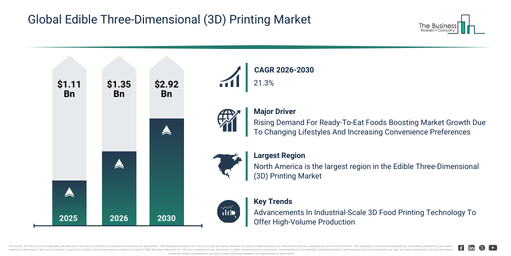
The market for edible three-dimensional (3d) printing has seen substantial expansion in recent years. It is projected to expand from $1.11 billion in 2025 to $1.35 billion in 2026, achieving a compound annual growth rate (CAGR) of 21.6%. This historical development can be credited to advancements in additive manufacturing technologies, innovative culinary experiments, the desire for personalized food presentation, an increase in specialty food services, and its initial use in upscale restaurants.
The edible three-dimensional (3d) printing market is projected to experience substantial growth in the coming years, reaching a valuation of $2.92 billion by 2030, demonstrating a robust compound annual growth rate (CAGR) of 21.3%. This anticipated expansion over the forecast period is driven by several factors, including the increasing reach of personalized healthcare nutrition, greater uptake in diets for the elderly and clinical settings, escalating investment in smart kitchen technologies, a heightened emphasis on sustainable food production, and broader consumer acceptance of printed foods. Key trends expected during this period involve the expanding application of personalized nutrition designs, the development of customizable food structures, an increase in alternative protein printing, a stronger focus on precision in texture and nutrients, and the incorporation of smart food printers.
Download A Free Sample Report For Comprehensive Market Insights:
Edible Three-Dimensional (3D) Printing Market Growth Drivers: What Factors Are Accelerating Expansion?
The rising consumer need for ready-to-eat food items is anticipated to drive the expansion of the edible 3D printing market in the future. Ready-to-eat (RTE) food products are food items that are entirely pre-made, packaged, and intended for immediate consumption, requiring no further cooking or preparation. The impetus behind the demand for ready-to-eat foods stems from busy lifestyles, increased urbanization, better accessibility, and the appeal of meal options that save time. This strong consumer demand for ready-to-eat meals boosts edible 3D printing, as it facilitates the rapid creation of personalized and aesthetically pleasing food. Such technology improves user convenience through automated preparation and also addresses consumer desires for both nutritious and novel food choices. A notable example is observed in October 2023, where Archer Daniels Midland, a US-based food processing firm, reported that the ready-to-eat meal market witnessed a 10.6% increase in sales in 2022, amounting to approximately $16.4 billion. Moreover, projections indicate the market will expand by 21% from 2022 to 2027, forecast to reach an estimated $19.9 billion by the conclusion of this period. Consequently, the heightened demand for ready-to-eat food products is a primary force propelling the expansion of the edible 3D printing market.
Edible Three-Dimensional (3D) Printing Market Segmentation: How Is The Market Structured Across Key Categories?
The edible three-dimensional (3d) printing market covered in this report is segmented –
1) By Technology: Extrusion-Based Printing, Binder Jetting, Inkjet Printing
2) By Application: Three-Dimensional (3D) Printed Sugar, Three-Dimensional (3D) Printed Chocolate, Three-Dimensional (3D) Printed Pasta, Other Applications
3) By End-User: Restaurants, Bakery And Confectionary, Individual Consumer
Subsegments:
1) By Extrusion-Based Printing: Fused Deposition Modeling (FDM), Syringe-based Extrusion
2) By Binder Jetting: Powder-based Binder Jetting, Gel-based Binder Jetting
3) By Inkjet Printing: Drop-on-Demand Inkjet Printing, Continuous Inkjet Printing
Edible Three-Dimensional (3D) Printing Market Trends: What Is Shaping Future Industry Growth?
Leading companies in the edible 3D printing market are concentrating on developing advanced products, such as food 3D printers, to deliver personalized nutrition solutions. A food 3D printer is a machine that utilizes additive manufacturing technology to create food items by layering ingredients according to a digital design, thereby enabling customized shapes, textures, and structures. For instance, in January 2024, Revo Foods GmbH, an Austria-based food-tech company, launched the Food Fabricator X2, which is the world’s first industrial-scale 3D printer designed for food production. This innovative technology features a multi-nozzle system for continuous production and a high-precision extrusion system, allowing manufacturers to combine different ingredients into predefined structures. The Food Fabricator X2 facilitates mass customization, providing flexible control of product parameters such as size, shape, material, and texture without necessitating hardware adjustments. Revo Foods intends to use this technology to scale production and is offering public investment opportunities to expand its operations.
Edible Three-Dimensional (3D) Printing Market Competitive Landscape And Leading Companies
Major companies operating in the edible three-dimensional (3d) printing market are BeeHex LLC, Revo Foods, 3P Innovation, Wiiboox, Biozoon GmbH, Cocoa Press LLC, FELIXprinters B.V., ByFlow, Natural Machines Ltd., Sugar Lab Inc., Dovetailed, Print4Taste GmbH, La Pâtisserie Numérique SAS, Chocola3D, Changxing Shiyin Technology Co. Ltd., 3Desserts Graphiques, The Hershey Company, Barilla Group, Miam Factory, WASP (World’s Advanced Saving Project)
Access The Complete Edible Three-Dimensional (3D) Printing Market Report:
Edible Three-Dimensional (3D) Printing Market Geographic Distribution And Regional Opportunities
North America was the largest region in the edible three-dimensional (3D) printing market in 2025. Asia-Pacific is expected to be the fastest-growing region in the forecast period. The regions covered in the edible three-dimensional (3d) printing market report are Asia-Pacific, South East Asia, Western Europe, Eastern Europe, North America, South America, Middle East and Africa.
Get in touch with us:
The Business Research Company: https://www.thebusinessresearchcompany.com/
Americas: +1 310-496-7795
Asia: +44 7882 955267 & +91 8897263534
Europe: +44 7882 955267
Email us at: marketing@tbrc.info
Follow us on:
LinkedIn: https://in.linkedin.com/company/the-business-research-company
YouTube: https://www.youtube.com/channel/UC24_fI0rV8cR5DxlCpgmyFQ
Global Market Model: https://www.thebusinessresearchcompany.com/global-market-model

Wasay has over a decade of experience in market research, data modelling, and analytics, with prior experience at GlobalData and Decision Tree Consulting Services. At The Business Research Company , he leads research operations across syndicated studies, customized consulting engagements, and the Global Market Model platform. His professional experience includes supporting organizations such as Boston Consulting Group, KPMG, and Ernst & Young. Wasay holds a degree in Electronics and Communications Engineering, postgraduate management qualifications from International Management Institute Belgium and Indian School of Business and Entrepreneurship, and completed the Integrated Program in Business Analytics from Indian Institute of Management Indore.