Enhanced with market attractiveness analysis, total addressable market evaluation, company benchmarking matrices, interactive Excel dashboards, expanded supply chain intelligence, emerging startup coverage, and detailed product insights, The Business Research Company’s 2026 market reports deliver more actionable and strategically valuable research.
Faba Beans Market Expansion Outlook: What Revenue Opportunities Lie Ahead?
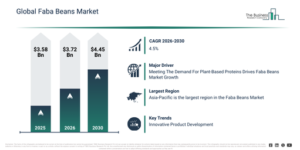
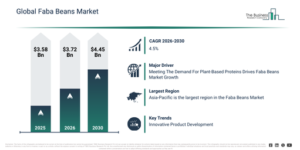
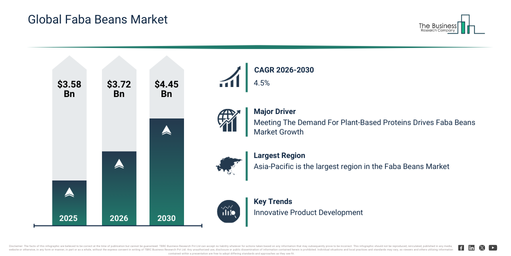
The faba beans market has demonstrated steady expansion in recent years. Its valuation is anticipated to climb from $3.58 billion in 2025 to $3.72 billion in 2026, reflecting a compound annual growth rate (CAGR) of 4.0%. Historical growth can be attributed to factors such as the expansion of pulse crop cultivation, a growing demand for plant-based proteins, an increase in protein demand for livestock feed, rising utilization in food processing, and the accessibility of conventional faba bean varieties.
The faba beans market is projected to experience consistent expansion in the coming years. This market is anticipated to reach $4.45 billion by 2030, demonstrating a compound annual growth rate (CAGR) of 4.5%. The expansion during this period stems from factors such as the growing uptake of alternative protein items, a surge in demand for organic pulses, the broadening of sports and nutraceutical nutrition sectors, increased funding in sustainable farming practices, and the rising incorporation of faba beans into protein mixtures. Key trends expected over the forecast period involve the expanded utilization of faba beans as a plant-based protein source, an escalating need for sustainable protein components, broader integration into animal feed formulations, the enlargement of organic faba bean farming, and a heightened emphasis on transparent supply chains.
Download A Free Sample Report For Comprehensive Market Insights:
Faba Beans Market Opportunity Drivers: What Is Creating New Revenue Potential?
The increasing adoption of veganism significantly contributed to the expansion of the faba beans market during the historical period. Veganism involves the avoidance of animal products, particularly regarding an individual’s diet. For instance, in March 2023, according to the World Animal Foundation, a US-based digital platform advocating for animal rights, approximately 4% of the U.S. population in 2023, amounting to around 13.4 million people, identified as vegan. However, figures related to plant protein indicate that over 6% of U.S. consumers, translating to more than 15.5 million individuals, adhere to a vegan lifestyle. Consumers globally are rapidly shifting towards veganism, thereby creating a substantial rise in demand for plant-based proteins, which is expected to propel the need for faba beans throughout the forecast period.
Faba Beans Market Segment Analysis And Revenue Opportunities
The faba beans market covered in this report is segmented –
1) By Nature: Organic Faba Beans, Conventional Faba Beans
2) By End Use: Food Processing, Animal Feed, Nutraceuticals, Sports Nutrition, Infant Nutrition
3) By Distribution Channel: Supermarkets/Hypermarkets, Convenience Stores, Specialty Stores, Online Retailers, Other Distribution Channels
Subsegments:
1) By Organic Faba Beans: Certified Organic Faba Beans, Transitional Organic Faba Beans
2) By Conventional Faba Beans: Non-GMO Conventional Faba Beans, Standard Conventional Faba Beans
Faba Beans Market Innovation Trends Driving Future Development
Major companies in the faba beans market are concentrating on developing innovative offerings, including plant-based food and beverage products, to satisfy the increasing demand for sustainable and high-protein alternatives. Plant-based beverages crafted from faba beans serve as dairy-free milk alternatives, leveraging the natural protein found in fava beans combined with additional ingredients such as oats to deliver a smooth texture, a subtle nutty flavor, and a well-rounded nutritional profile. For instance, in March 2023, Nestlé S.A., a Switzerland-based food and beverage company, introduced a new plant-based beverage blending oats and fava beans. This milk alternative offers a smooth consistency and a mild, nutty taste derived from both fava beans and oats, making it suitable for consumption on its own, in smoothies, or with cereal at any time of the day.
Faba Beans Market Leading Players Shaping Industry Direction
Major companies operating in the faba beans market are Prairie Fava Ltd, Unigrain Pty Ltd, Roland Beans, Alberta Pulse Growers Commission, Stamp Seeds Inc, Pawnee Buttes Seed Inc, Archer Daniels Midland Company, Cargill Incorporated, Bunge Limited, AGT Food and Ingredients Inc, SunOpta Inc, The Scoular Company, Roquette Frères, Verdient Foods Inc, Best Cooking Pulses Inc, The Andersons Inc, Bonduelle Group, Dakota Dry Bean Inc, Bean Growers Australia, Mercer Foods
Access The Complete Faba Beans Market Report:
Faba Beans Market Regional Analysis And Leading Geography
Asia-Pacific was the largest region in the faba beans market in 2025. The regions covered in the faba beans market report are Asia-Pacific, South East Asia, Western Europe, Eastern Europe, North America, South America, Middle East and Africa.
Get in touch with us:
The Business Research Company: https://www.thebusinessresearchcompany.com/
Americas: +1 310-496-7795
Asia: +44 7882 955267 & +91 8897263534
Europe: +44 7882 955267
Email us at: marketing@tbrc.info
Follow us on:
LinkedIn: https://in.linkedin.com/company/the-business-research-company
YouTube: https://www.youtube.com/channel/UC24_fI0rV8cR5DxlCpgmyFQ
Global Market Model: https://www.thebusinessresearchcompany.com/global-market-model

Wasay has over a decade of experience in market research, data modelling, and analytics, with prior experience at GlobalData and Decision Tree Consulting Services. At The Business Research Company , he leads research operations across syndicated studies, customized consulting engagements, and the Global Market Model platform. His professional experience includes supporting organizations such as Boston Consulting Group, KPMG, and Ernst & Young. Wasay holds a degree in Electronics and Communications Engineering, postgraduate management qualifications from International Management Institute Belgium and Indian School of Business and Entrepreneurship, and completed the Integrated Program in Business Analytics from Indian Institute of Management Indore.