Enhanced with market attractiveness analysis, total addressable market evaluation, company benchmarking matrices, interactive Excel dashboards, expanded supply chain intelligence, emerging startup coverage, and detailed product insights, The Business Research Company’s 2026 market reports deliver more actionable and strategically valuable research.
Food Cultures Market Size Forecast: How Large Could The Market Become By 2030?
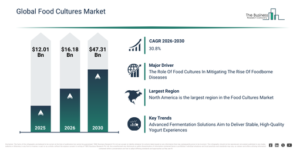
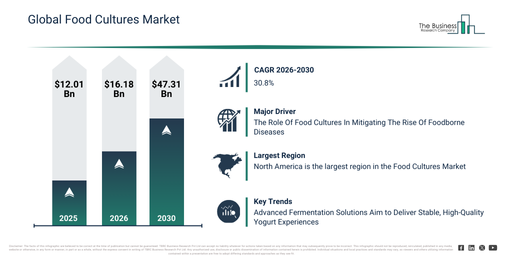
The food cultures market has experienced rapid growth in its market size recently. The market is expected to expand from $12.01 billion in 2025 to reach $16.18 billion in 2026, exhibiting a compound annual growth rate (CAGR) of 34.8%. Key factors contributing to its historical growth include the surge in fermented food consumption, the enlargement of industrial dairy processing, an increased understanding of the benefits to gut health, the broader implementation of microbial preservation techniques, and innovations in microbial strain development.
The food cultures market is projected for significant expansion in the coming years, with its size expected to reach $47.31 billion by 2030, growing at a compound annual growth rate (CAGR) of 30.8%. This growth throughout the forecast period can be attributed to factors such as increasing consumer demand for functional and probiotic foods, rising investments in precision fermentation technologies, a growing focus on clean-label food ingredients, the expansion of plant-based fermented products, and the increasing application of tailored microbial solutions. Major trends anticipated during this period include the wider adoption of customized starter cultures, an increasing demand for probiotic-enriched food products, the growing use of protective cultures for extending shelf life, the proliferation of application-specific microbial strains, and an enhanced focus on optimizing flavor and texture.
Download A Free Sample Report For Comprehensive Market Insights:
Food Cultures Market Industry Drivers: What Is Driving Revenue Growth?
The increasing prevalence of foodborne diseases is anticipated to fuel the growth of the food culture market moving forward. These preventable diseases arise from consuming contaminated food or drink, manifesting in symptoms ranging from mild discomfort to severe, potentially life-threatening conditions. The widespread occurrence of foodborne diseases is attributed to factors such as poor personal hygiene, improper holding temperatures, and contaminated equipment or cross-contamination. Food cultures (FC) are instrumental in developing the distinct sensory characteristics of fermented foods, including flavor, color, and texture, while also extending their shelf-life by outcompeting spoilage microbes, thus minimizing food waste and the potential for foodborne illnesses. For instance, in February 2025, Food Safety Magazine, a U.S.-based food-safety reporting source, reported that in 2024, foodborne-illness incidents rose from 1,118 cases in 2023 to 1,392 cases. Additionally, hospitalizations increased from 230 to 487, and deaths grew from 8 to 19 compared to the previous year. Consequently, the rising incidence of foodborne diseases significantly drives the food culture market.
Food Cultures Market Segments: Where Are The Largest Growth Opportunities?
The food cultures market covered in this report is segmented –
1) By Product: Starter Cultures, Protective Cultures, Probiotic Cultures
2) By Microorganism Type: Bacteria, Yeast, Mold
3) By Function: Flavoring, Preservative, Texture, Other Functions
4) By Application: Dairy Products, Meat, Beverage, Other Applications
Subsegments:
1) By Starter Cultures: Lactic Acid Bacteria (LAB) Starter Cultures, Yeast Starter Cultures, Mould Starter Cultures
2) By Protective Cultures: Bacteriocin-Producing Cultures, Lactic Acid Bacteria (LAB) Protective Cultures, Non-pathogenic Microbial Cultures
3) By Probiotic Cultures: Bifidobacterium, Lactobacillus
#Food Cultures Market Growth Trends: What Is Influencing The Future Outlook?
Companies operating within the food cultures market are prioritizing the development of sophisticated starter cultures, including Delvo Fresh Pioneer, to elevate product consistency, secure pH stability, and ensure premium taste and texture throughout their shelf life. Next-generation yogurt starter cultures are intricately designed blends of advantageous microbes intended to sustain stable pH, consistent taste, and texture during both yogurt production and storage, thereby enabling manufacturers to minimize post-acidification, enhance product quality, and achieve uniformity across batches. As an illustration, in September 2023, dsm-firmenich, a global nutrition and health firm headquartered in the Netherlands, launched Delvo Fresh Pioneer, an advanced starter culture tailored for very mild yogurts. This innovative culture guarantees exceptional pH stability for up to 60 days under cold storage, effectively reducing post-acidification even in demanding conditions like elevated temperatures. Formulated with meticulously selected microbial strains, Delvo Fresh Pioneer delivers a smooth, creamy texture and consistent taste across batches, supporting both premium and reduced-sugar yogurt formulations while boosting production reliability. These cultures are integrated into dsm-firmenich’s comprehensive fermented dairy toolkit, which also includes bioprotective and probiotic cultures, enzymes, and hydrocolloids, providing manufacturers with flexible options to optimize yogurt production.
Food Cultures Market Major Participants And Competitive Dynamics
Major companies operating in the food cultures market are Associated British Foods PLC, International Flavours & Fragrances Inc., Kerry Group PLC, Givaudan SA, Angel Yeast Co. Ltd., Corbion NV, Lallemand Inc., Chr. Hansen Holding A/S, The TATUA Co-operative Dairy Company Ltd., Cargill Incorporated, Meat Cracks Technologie GmbH, CSK Food Enrichment B.V, LB Bulgaricum Ltd., Wyeast Laboratories Inc., E&O Laboratories Ltd., Sacco Srl, Dalton Biotechnologie S.r.l, Lactina Ltd., DSM-Firmenich, Yakult Honsha Co. Ltd.
Access The Complete Food Cultures Market Report:
#Food Cultures Market Largest Region: Which Geography Holds The Highest Market Share?
North America was the largest region in the food cultures market in 2025. Asia-Pacific is expected to be the fastest-growing region in the forecast period. The regions covered in the food cultures market report are Asia-Pacific, South East Asia, Western Europe, Eastern Europe, North America, South America, Middle East and Africa.
Get in touch with us:
The Business Research Company: https://www.thebusinessresearchcompany.com/
Americas: +1 310-496-7795
Asia: +44 7882 955267 & +91 8897263534
Europe: +44 7882 955267
Email us at: marketing@tbrc.info
Follow us on:
LinkedIn: https://in.linkedin.com/company/the-business-research-company
YouTube: https://www.youtube.com/channel/UC24_fI0rV8cR5DxlCpgmyFQ
Global Market Model: https://www.thebusinessresearchcompany.com/global-market-model

Wasay has over a decade of experience in market research, data modelling, and analytics, with prior experience at GlobalData and Decision Tree Consulting Services. At The Business Research Company , he leads research operations across syndicated studies, customized consulting engagements, and the Global Market Model platform. His professional experience includes supporting organizations such as Boston Consulting Group, KPMG, and Ernst & Young. Wasay holds a degree in Electronics and Communications Engineering, postgraduate management qualifications from International Management Institute Belgium and Indian School of Business and Entrepreneurship, and completed the Integrated Program in Business Analytics from Indian Institute of Management Indore.