Backed by market attractiveness analysis, total addressable market sizing, company benchmarking matrices, interactive Excel dashboards, wider supply chain intelligence, emerging startup coverage, and detailed product-level insights, The Business Research Company’s 2026 market reports are designed to offer research that is more actionable and strategically valuable than ever.
Food Preservatives Market CAGR Outlook And Future Development
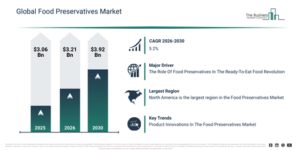
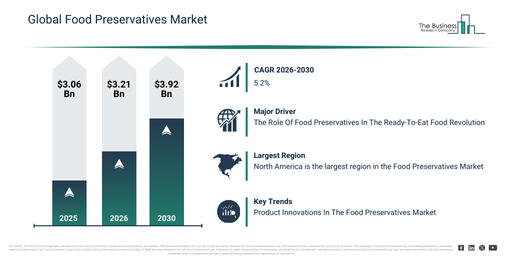
In recent years, the food preservatives market has experienced steady growth in its size. The market is predicted to enlarge from $3.06 billion in 2025 to $3.21 billion in 2026, with a compound annual growth rate (CAGR) of 4.9%. Factors contributing to the historical expansion include the growth of packaged food consumption, the expansion of food supply chains, the rising need for spoilage prevention, the widespread use of synthetic preservatives, and increasing food processing capacity.
The food preservatives market is projected to experience substantial expansion over the upcoming years, with its valuation set to reach $3.92 billion by 2030, exhibiting a compound annual growth rate (CAGR) of 5.2%. This projected growth stems from several factors, including heightened regulatory scrutiny on chemical preservatives, a growing embrace of natural preservation techniques, the widening availability of ready-to-eat food items, an increasing consumer preference for minimally processed foods, and advancements in preservative formulations. Key developments anticipated during this period encompass a greater reliance on natural and clean-label preservatives, an escalating need for solutions that extend shelf life, broader implementation of antimicrobial preservation methods, the proliferation of multi-functional preservative compounds, and an intensified emphasis on maintaining food safety and quality.
Get A Free Sample Report With In-Depth Market Insights:
Food Preservatives Market Industry Drivers: What’s Behind The Revenue Growth?
The rising intake of convenience foods, driven by hectic routines, is projected to fuel expansion within the food preservatives market in the foreseeable future. To mitigate spoilage from microbial activity and enhance food quality, ready-to-eat products incorporate diverse natural and synthetic preservatives. This heightened demand for processed or ready-to-eat food stems from a growing working demographic that favors convenient meal options over home preparation. An illustrative example comes from July 2024, where the American Frozen Food Institute, a US-based national trade association, reported that frozen food retail dollar growth climbed from 1.6% in the fourth quarter of 2023 to 2.9% in the first quarter of 2024. Consequently, the substantial consumption of ready-to-eat items is a key factor propelling the food preservatives market’s expansion.
Food Preservatives Market Breakdown By Product Type And Application
The food preservatives market covered in this report is segmented –
1) By Type: Synthetic, Natural
2) By Function: Anti-Microbial, Anti-Oxidant, Chelating Agents, Enzyme Attackers
3) By Application: Beverages, Oils And Fats, Bakery, Dairy And Frozen Products, Snacks, Meat, Poultry, Confectionery, Other Applications
Subsegments:
1) By Synthetic Preservatives: Sorbates, Benzoates, Nitrites And Nitrates, Propionates
2) By Natural Preservatives: Salt, Sugar, Vinegar, Essential Oils, Antioxidants
#Food Preservatives Market Growth Trends: What’s Shaping The Future Outlook?
Leading companies in the food preservatives market are prioritizing the development of innovative products, including clean-label preservatives. These clean-label preservatives function as food additives designed to preserve both the natural flavor and the texture of final products. For instance, in July 2023, BioVeritas, a US-based ingredients company, introduced a clean-label mould inhibitor. This particular clean-label mould inhibitor was created to tackle the persistent challenge of satisfying customer demands for effective non-petrochemical-based components while delivering end-products that excel in flavor and texture.
Food Preservatives Market Company Landscape And Competitive Strategy
Major companies operating in the food preservatives market are Kerry Group, DuPont de Nemours Inc., BASF SE, Cargill Incorporated, Celanese Corporation, Corbion N.V., Archer Daniels Midland Company, Galactic SA, Kemin Industries Inc., DSM, Tate & Lyle PLC, Danisco A/S, ABF Ingredients Ltd., Ajinomoto Co Inc., Jungbunzlauer Suisse AG, Chr Hansen Holding A/S, Naturex SA, MAYASAN Food Industries AS, BTSA Biotecnologías Aplicadas SL, Kalsec Inc.
View The Full Food Preservatives Market Report:
Food Preservatives Market Largest Region: Which Geography Holds The Biggest Share?
North America was the largest region in the food preservatives market in 2025. Asia-Pacific is expected to be the fastest-growing region in the forecast period. The regions covered in the food preservatives market report are Asia-Pacific, South East Asia, Western Europe, Eastern Europe, North America, South America, Middle East and Africa.
Reach Out To Our Team:
The Business Research Company: https://www.thebusinessresearchcompany.com/
Americas: +1 310-496-7795
Asia: +44 7882 955267 & +91 8897263534
Europe: +44 7882 955267
Email us at: marketing@tbrc.info
Follow us on:
LinkedIn: https://in.linkedin.com/company/the-business-research-company
YouTube: https://www.youtube.com/channel/UC24_fI0rV8cR5DxlCpgmyFQ
Global Market Model: https://www.thebusinessresearchcompany.com/global-market-model

Wasay has over a decade of experience in market research, data modelling, and analytics, with prior experience at GlobalData and Decision Tree Consulting Services. At The Business Research Company , he leads research operations across syndicated studies, customized consulting engagements, and the Global Market Model platform. His professional experience includes supporting organizations such as Boston Consulting Group, KPMG, and Ernst & Young. Wasay holds a degree in Electronics and Communications Engineering, postgraduate management qualifications from International Management Institute Belgium and Indian School of Business and Entrepreneurship, and completed the Integrated Program in Business Analytics from Indian Institute of Management Indore.