Delivering more actionable and strategically valuable research, The Business Research Company’s 2026 market reports feature market attractiveness analysis, total addressable market evaluation, company benchmarking matrices, interactive Excel dashboards, expanded supply chain intelligence, emerging startup coverage, and detailed product insights.
Frozen Fish Market Expected To Reach $41.67 Billion By 2030 At 7.4% CAGR
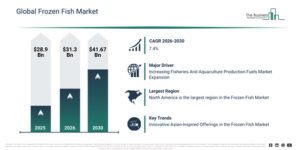
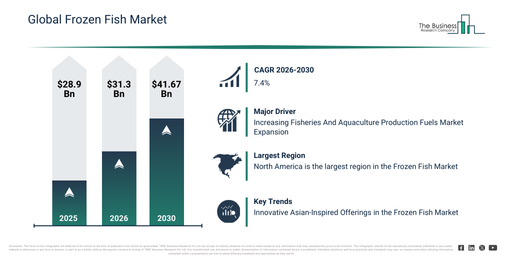
The frozen fish market has experienced substantial growth in recent years. It is projected to expand from $28.9 billion in 2025 to $31.3 billion in 2026, demonstrating a compound annual growth rate (CAGR) of 8.3%. This historical expansion can be attributed to factors such as the increasing global consumption of seafood, the proliferation of frozen food retail channels, advancements in freezing and storage technologies, the rising demand for convenient foods from urban populations, and the broadening of international seafood trade.
The frozen fish market is projected for significant expansion over the coming years, reaching a valuation of $41.67 billion by 2030, demonstrating a compound annual growth rate (CAGR) of 7.4%. This anticipated growth during the forecast period is driven by factors such as an increasing consumer preference for seafood sourced sustainably, greater investment in cold storage and logistics, the expansion of online platforms for seafood retail, a surging demand for products with traceability, and advancements in the efficiency of freezing technologies. Key developments expected throughout this period encompass the wider adoption of rapid freezing techniques, a heightened demand for frozen fish products with added value, a greater emphasis on sustainable fishing methods, an enlargement of cold chain infrastructure, and a stronger focus on preserving product quality.
Download A Free Sample Report For Comprehensive Market Insights:
Frozen Fish Market Development Factors: Which Trends Are Supporting Demand?
The expanded output from fisheries and aquaculture operations is anticipated to boost the frozen fish market’s expansion moving ahead. Fisheries encompass the sector focused on catching, processing, and distributing fish, whereas aquaculture pertains to cultivating, raising, and harvesting fish and other aquatic life in regulated settings. This growth in fisheries and aquaculture output stems from advancements in technology, better breeding methods, growing worldwide demand for seafood, supportive governmental frameworks, and improved sustainability efforts. Advanced freezing and enhanced processing methods within these sectors guarantee that frozen fish maintains its nutritional content, consistency, and taste. Rapid freezing techniques help uphold freshness and reduce the deterioration of fish quality during its storage and transit. For example, data from March 2024 released by the Department of Agriculture and Water Resources, an Australia-based government entity, indicates that Australia’s fisheries and aquaculture sectors are forecast to generate an average of $3.48 billion each year from 2024–25 to 2028–29. Additionally, the overall production volume is predicted to increase by 1%, reaching 296,000 tons by 2024–2025 relative to figures from 2022–2023. Consequently, the expanding production from fisheries and aquaculture is a key factor propelling the frozen fish market’s growth.
Frozen Fish Market Segment Landscape: Which Areas Lead Market Development?
The frozen fish market covered in this report is segmented –
1) By Type: Salmon, Tuna, Cod, Tilapia, Shrimp, Other Types
2) By Distribution Channel: Supermarkets And Hypermarkets, Convenience Stores, Specialty Stores, Online Retail
3) By End Use: Food Processing Industry, Food Service Provider, Retail Or Household
Subsegments:
1) By Salmon: Atlantic Salmon, Pacific Salmon
2) By Tuna: Yellowfin Tuna, Skipjack Tuna, Bluefin Tuna
3) By Cod: Atlantic Cod, Pacific Cod
4) By Tilapia: Farmed Tilapia, Wild-Caught Tilapia
5) By Shrimp: White Shrimp, Black Tiger Shrimp, Vannamei Shrimp, Other Shrimp Varieties
6) By Other Types: Haddock, Mackerel, Sardines, Pollock, Other Fish Varieties
Frozen Fish Market Transformation Trends: Which Innovations Are Driving Change?
Key players in the frozen fish market are concentrating on creating innovative items, such as Asian-inspired frozen fish, to satisfy evolving consumer preferences and enlarge their footprint in the expanding frozen fish sector. Asian-inspired frozen fish refers to frozen fish items that are flavored, prepared, or designed to echo the tastes, components, or culinary methods commonly found in Asian gastronomy. These offerings are crafted to attract consumers desiring convenient yet savory selections that capture the true nature of Asian cooking. For instance, in February 2024, Young’s Seafood, a UK-based firm focused on the production and distribution of frozen, fresh, and chilled seafood, unveiled a collection of coated fish products influenced by Asian cuisine under its Gastro brand. The ‘Taste of Asia’ range consists of four limited-edition products with flavors drawn from authentic Southeast Asian cuisines, including Korean, Thai, and Japanese. These novel products seek to give consumers a straightforward way to incorporate more seafood into their meals, providing diverse flavor profiles and engaging new dining choices beyond the conventional fish and chips.
Frozen Fish Market Industry Leaders And Market Competition
Major companies operating in the frozen fish market are Maruha Nichiro Corporation, Mowi ASA, Nissui Corporation, Austevoll Seafood ASA, Nomad Foods Limited, SalMar ASA, Nueva Pescanova Group, Cooke Inc., High Liner Foods Inc., Camanchaca Inc, Clearwater Seafoods Incorporated, Tassal Group Limited, Iceland Seafood International hf, Dongwon Industries Co Ltd, Zhangzidao Group Co Ltd, Hansung Enterprise Co Ltd, Surapon Foods Public Company Limited, Lyons Seafoods Limited, FCF Fishery Company Ltd, Chicken of the Sea International, Lerøy Seafood Group ASA, AquaChile SA, Bright Star Group LLC, Marine Harvest Group
Access The Complete Frozen Fish Market Report:
Frozen Fish Market Regional Analysis And Leading Geography
North America was the largest region in the frozen fish market in 2025. The regions covered in the frozen fish market report are Asia-Pacific, South East Asia, Western Europe, Eastern Europe, North America, South America, Middle East and Africa.
Get in touch with us:
The Business Research Company: https://www.thebusinessresearchcompany.com/
Americas: +1 310-496-7795
Asia: +44 7882 955267 & +91 8897263534
Europe: +44 7882 955267
Email us at: marketing@tbrc.info
Follow us on:
LinkedIn: https://in.linkedin.com/company/the-business-research-company
YouTube: https://www.youtube.com/channel/UC24_fI0rV8cR5DxlCpgmyFQ
Global Market Model: https://www.thebusinessresearchcompany.com/global-market-model

Wasay has over a decade of experience in market research, data modelling, and analytics, with prior experience at GlobalData and Decision Tree Consulting Services. At The Business Research Company , he leads research operations across syndicated studies, customized consulting engagements, and the Global Market Model platform. His professional experience includes supporting organizations such as Boston Consulting Group, KPMG, and Ernst & Young. Wasay holds a degree in Electronics and Communications Engineering, postgraduate management qualifications from International Management Institute Belgium and Indian School of Business and Entrepreneurship, and completed the Integrated Program in Business Analytics from Indian Institute of Management Indore.