Built to provide research that’s more actionable and strategically valuable, The Business Research Company’s 2026 market reports include market attractiveness analysis, total addressable market sizing, company benchmarking matrices, interactive Excel dashboards, broader supply chain intelligence, emerging startup tracking, and in-depth product insights.
Frozen Food Market Revenue Outlook: What CAGR Lies Ahead Through 2030?
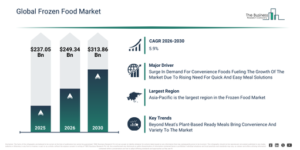
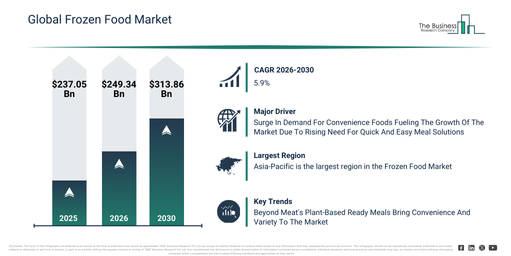
The frozen food market has experienced significant expansion over recent years. It is anticipated to grow from $237.05 billion in 2025 to $249.34 billion in 2026, achieving a compound annual growth rate (CAGR) of 5.2%. Historically, this market’s growth can be attributed to factors such as an increase in dual-income households, the expansion of modern retail infrastructure, a rising adoption of freezers in households, increased packaged food consumption, and advancements in freezing technologies.
The frozen food market is anticipated to experience robust expansion over the coming years. By 2030, this market is projected to reach a valuation of $313.86 billion, exhibiting a compound annual growth rate (CAGR) of 5.9%. This projected increase is primarily driven by factors such as a greater demand for convenience foods, the expansion of e-commerce grocery platforms, increased investments in cold chain infrastructure, a stronger emphasis on reducing food waste, and a rising consumer preference for premium frozen products. Key trends during this period are expected to encompass an escalating demand for ready-to-eat frozen meals, an increase in the consumption of frozen fruits and vegetables, an enhanced focus on solutions for extended shelf life, the expanded implementation of advanced cold chain logistics, and a greater uptake of portion-controlled items.
Get A Free Sample Report With In-Depth Market Insights:
Frozen Food Market Demand Drivers: What’s Powering Industry Growth?
The rising consumer need for convenience foods is anticipated to fuel the expansion of the Frozen Food Market. Convenience foods, which are pre-packaged or pre-prepared items designed for rapid and simple consumption with little cooking or effort, are seeing increased demand due to hectic lifestyles, growing urbanization, and the desire for quick, easy-to-make meals that don’t sacrifice flavor or nutritional value. Frozen food products fulfill this need by providing ready-to-cook or ready-to-eat choices that save time and simplify meal preparation. An example of this trend is seen in April 2024, where the National Association of Convenience Stores, a US-based trade association, reported that in 2023, foodservice sales (comprising prepared foods, commissary items, and dispensed beverages) made up 26.9% of in-store sales, an increase from 25.6% in 2022. Furthermore, prepared food sales per store per month climbed by 12.2% in 2023 compared to 2022. Consequently, the growing consumer preference for convenience foods is a primary driver for the Frozen Food Market’s growth. The escalating need for food safety is propelling the future growth of the Frozen Food Market. Food safety encompasses the methods and environments that guarantee food is secure for consumption, free of contaminants, and harmless to human health. This aspect is crucial for enhancing the frozen food market by fostering consumer trust, assuring product standards, and mitigating the threat of foodborne diseases. For example, in June 2023, the World Health Organization, a Switzerland-based public health agency, reported that globally around 1 in 10 individuals, approximately 600 million each year, become sick from contaminated food, highlighting the growing concern for food safety. Thus, the heightened focus on food safety is a significant impetus behind the expansion of the frozen market.
Frozen Food Market Segment Landscape: Which Areas Lead Development?
The frozen food market covered in this report is segmented –
1) By Type: Frozen Fruit, Juice, And Vegetable, Frozen Specialty Food
2) By User: Food Service Industry, Retail Users
3) By Distribution Channel: Supermarkets Or Hypermarkets, Convenience Stores, E-Commerce, Other Distribution Channels
Subsegments:
1) By Frozen Fruit, Juice, And Vegetable: Frozen Fruits, Frozen Vegetables, Frozen Fruit Juices
2) By Frozen Specialty Food: Frozen Ready Meals, Frozen Snacks, Frozen Breakfast Foods
Frozen Food Market Trends Shaping Long-Term Demand
Major companies operating in the frozen food market are introducing innovative new food products to maintain their position. Advanced and recently frozen foods refer to items preserved using sophisticated freezing technologies or techniques that effectively sustain the food’s quality, texture, and nutritional value. For instance, in May 2023, Beyond Meat Inc., a US-based food company, unveiled three frozen plant-based ready meals at Tesco stores, namely Spaghetti Bolognese, Keema Curry & Pilau Rice, and Chili with Coriander Rice. These convenient meals are suitable for flexitarians, vegetarians, and vegans with demanding schedules, providing an enjoyable plant-based variation of traditional comfort foods. The dishes are both quick to prepare and high in protein. The new Beyond Meals are sold across all Tesco locations in the UK, following the earlier debut of Beyond Meat’s plant-based chicken in the UK.
Frozen Food Market Industry Leaders And Competitive Landscape
Major companies operating in the frozen food market are Nippon Suisan Kaisha Ltd, Frosta Aktiengesellschaft, Nestle SA, Unilever PLC, Tyson Foods Inc, The Kraft Heinz Company, General Mills Inc, Kelloggs Company, Conagra Brands Inc, McCain Foods Limited, Ajinomoto Co Inc, BRF SA, J R Simplot Company, On Cor Frozen Foods Inc, Lamb Weston Holdings Inc, Rich Products Corporation, Nomad Foods Ltd, J and J Snack Foods Corp, Schwans Company, Wawona Frozen Foods Inc, Bellisio Foods Inc, Oregon Ice Cream Co LLC, Amys Kitchen Inc, Goya Foods Inc
View The Full Frozen Food Market Report:
Frozen Food Market Largest Region: Which Geography Holds The Biggest Share?
Asia-Pacific was the largest region in the frozen food market in 2025. North America was the second-largest region in the frozen food market. The regions covered in the frozen food market report are Asia-Pacific, South East Asia, Western Europe, Eastern Europe, North America, South America, Middle East and Africa.
Reach Out To Our Team:
The Business Research Company: https://www.thebusinessresearchcompany.com/
Americas: +1 310-496-7795
Asia: +44 7882 955267 & +91 8897263534
Europe: +44 7882 955267
Email us at: marketing@tbrc.info
Follow us on:
LinkedIn: https://in.linkedin.com/company/the-business-research-company
YouTube: https://www.youtube.com/channel/UC24_fI0rV8cR5DxlCpgmyFQ
Global Market Model: https://www.thebusinessresearchcompany.com/global-market-model

Wasay has over a decade of experience in market research, data modelling, and analytics, with prior experience at GlobalData and Decision Tree Consulting Services. At The Business Research Company , he leads research operations across syndicated studies, customized consulting engagements, and the Global Market Model platform. His professional experience includes supporting organizations such as Boston Consulting Group, KPMG, and Ernst & Young. Wasay holds a degree in Electronics and Communications Engineering, postgraduate management qualifications from International Management Institute Belgium and Indian School of Business and Entrepreneurship, and completed the Integrated Program in Business Analytics from Indian Institute of Management Indore.